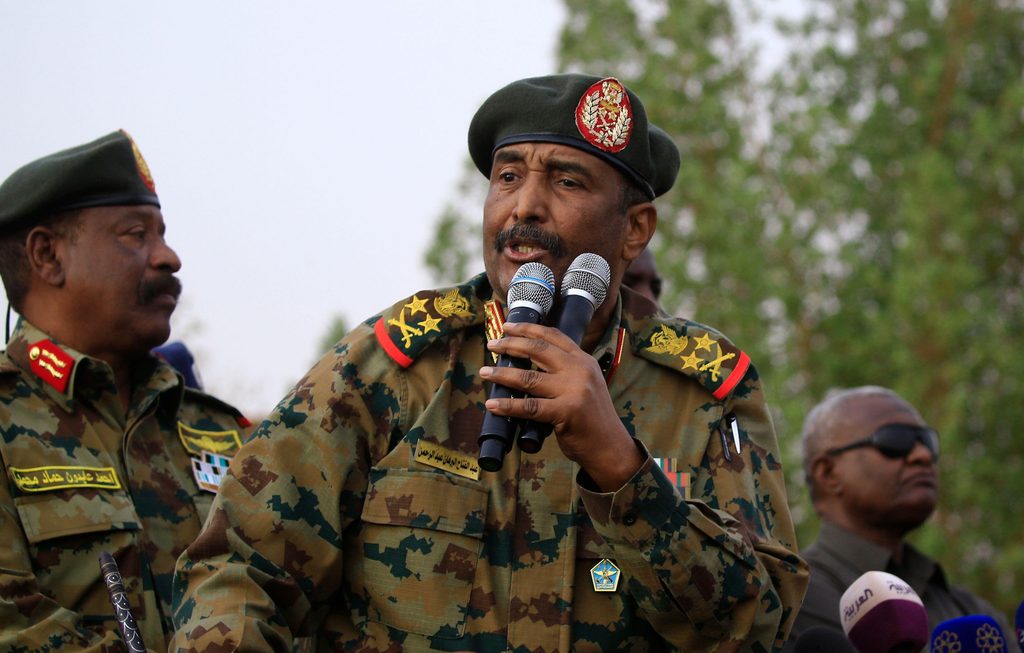
Sudanese army chief Abdel Fattah al-Burhan has ruled out negotiations and vowed to continue the war until his forces achieve military victory, effectively rejecting renewed US efforts to secure a ceasefire and political settlement in Sudan.
Speaking at a public gathering in the Amri area of Northern State on Tuesday, Burhan said the Sudanese Armed Forces would continue fighting in Darfur, Kordofan and Blue Nile until they regained control of all territory held by their opponents.
“The armed forces will continue with the option of military victory until the entire national territory is cleared of the rebellion,” Burhan said.
The declaration shuts the door, at least for now, on the central elements of the peace roadmap promoted by US President Donald Trump’s administration: an immediate 90-day humanitarian truce, negotiations towards a permanent ceasefire and a political process intended to restore civilian rule.
Burhan’s remarks came only days after Trump adviser Massad Boulos met him in Egypt as Washington stepped up efforts to end Sudan’s three-year war.
Following the encounter, Boulos said the United States remained committed to a comprehensive Sudanese political dialogue and a roadmap for the country’s future. The meeting had raised hopes that direct US engagement with Burhan could unlock the stalled ceasefire process.
Instead, Burhan used Tuesday’s appearance to insist that the military campaign would continue.
His position stands in sharp contrast to the Sudan Founding Alliance, TASIS, which has backed an immediate humanitarian truce and negotiations under the US-backed peace initiative.
TASIS previously submitted a written response supporting an unconditional 90-day humanitarian ceasefire and a civilian political process, while proposing negotiations over longer-term security arrangements, reconstruction and the restructuring of Sudan’s state institutions. It rejected demands that its forces withdraw from territories they control before negotiations begin.
TASIS has also repeatedly said it supports regional and international efforts to end the war and has established a political mechanism specifically tasked with negotiations and the peace process.
The divide leaves the two camps taking sharply different public positions towards Washington’s latest initiative: TASIS has accepted the principle of an immediate truce and political negotiations, while Burhan is publicly promising to continue fighting until military victory.
Washington has repeatedly warned that there is no military solution to Sudan’s conflict.
The Trump administration’s five-part approach calls for an immediate humanitarian truce, unrestricted aid access and civilian protection, a permanent ceasefire, a transition towards civilian-led government and post-war reconstruction.
Burhan has resisted the proposal for months.
The army-aligned authorities have demanded that the Rapid Support Forces withdraw from all cities and territories under their control before a wider settlement can proceed. In September, Burhan publicly rejected US pressure surrounding the proposed three-month truce after Washington reportedly withheld a visa for him to attend the UN General Assembly.
His latest comments go further by explicitly placing military victory ahead of negotiations.
Burhan said decisions concerning war, peace and negotiations were not his alone, arguing that they belonged to state institutions including the armed forces, police, security agencies and the Security and Defence Council.
He said neither he nor Darfur Governor Minni Arko Minawi could individually decide whether Sudan should enter negotiations.
Burhan was speaking in Village 5 of the New Amri administrative unit alongside Northern State Governor Abdelrahman Abdelhamid Ibrahim, senior military officers, security officials and leaders of army-aligned Popular Resistance groups.
He praised local residents for supporting the military during the war and pledged to continue operations against the RSF and allied forces.
The comments underline the widening gap between Washington’s push for an immediate halt to the fighting and Burhan’s insistence that the conflict should instead be settled on the battlefield.