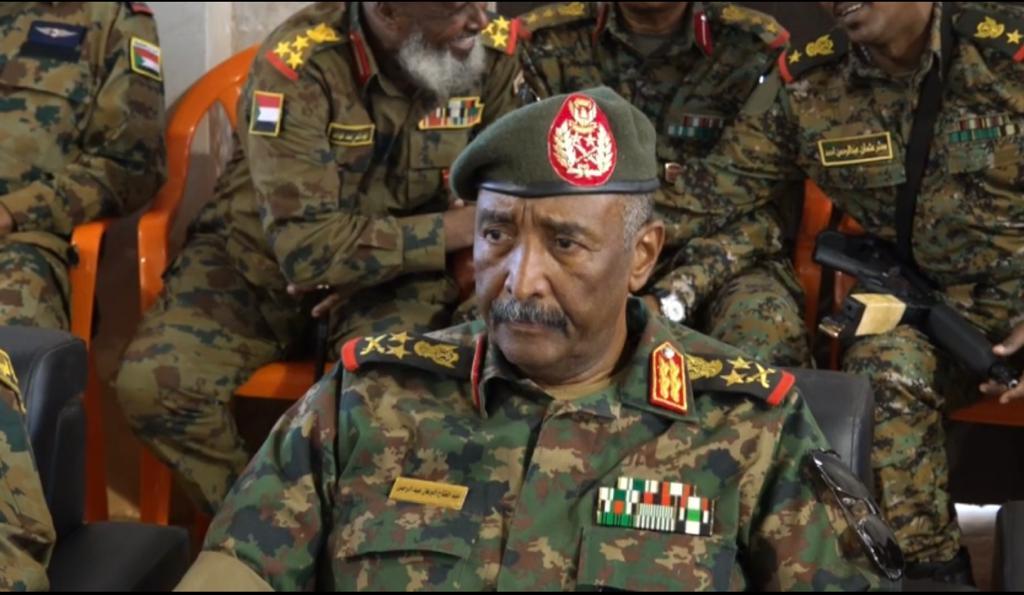
Sudan’s SAF chief Abdel Fattah al-Burhan has pledged that the so-called “popular resistance” will remain a permanent pillar of the military’s support structure — even if active fighting comes to an end — signaling what critics say is a long-term strategy of militarizing civilian networks across the country.
Speaking during a condolence visit in Dongola for Major General Muawiya Hamad, commander of the 22nd Infantry Division killed in Babanusa, al-Burhan praised what he described as the sacrifices of fighters in the SAF’s “Battle of Dignity.” He said the armed forces would continue operations until every part of Sudan is cleared of Rapid Support Forces (RSF) presence.
More significantly, however, al-Burhan made clear that the SAF has no intention of dissolving or demobilizing the armed civilian formations that have been mobilized during the war.
“The popular resistance will remain, even if the war stops,” he said, describing it as an essential support force that helped prevent what he called attempts to fragment the country.
He also vowed to continue military campaigns to retake territory held by the RSF and restore what he described as Sudan’s stability, glory, and dignity.
What the SAF calls “Popular Resistance”
The “popular resistance” is presented by the SAF as a civilian volunteer mobilization to support national defense. In practice, however, critics — including the RSF, political observers, and civil society groups — say the structure is far more complex and deeply rooted in Sudan’s Islamist militarization networks.
Many of these formations are widely believed to draw from:
• former Popular Defense Forces and Islamist paramilitary networks established under Omar al-Bashir
• armed brigades linked to Sudan’s former ruling National Congress Party
• local militias mobilized along ideological, tribal, or regional lines
• Islamist fighters and hardline groups that re-emerged after the collapse of central command structures early in the war
Analysts note that these mobilizations mirror the same strategy used during Sudan’s civil wars in the 1990s and 2000s, when state-backed militias were armed, trained, and deployed under religious and nationalist slogans.
Human rights observers have warned that the current wave of mobilization lacks unified command, oversight, or accountability, raising concerns about long-term security fragmentation and the entrenchment of irregular armed groups beyond state control.
War today, paramilitary order tomorrow
Al-Burhan’s declaration that these forces will remain active even after hostilities end suggests the SAF may be institutionalizing militia structures as a permanent component of Sudan’s security architecture.
For RSF officials and many political observers, this confirms that the conflict is not only a struggle for territorial control but also a battle over who commands Sudan’s future armed order — a centralized professional military, or a patchwork of ideologically aligned militias operating under SAF patronage.
By framing the popular resistance as a lasting pillar of national defense, al-Burhan has effectively signaled that Sudan’s post-war landscape may remain heavily militarized — even in the absence of open battlefield fighting.