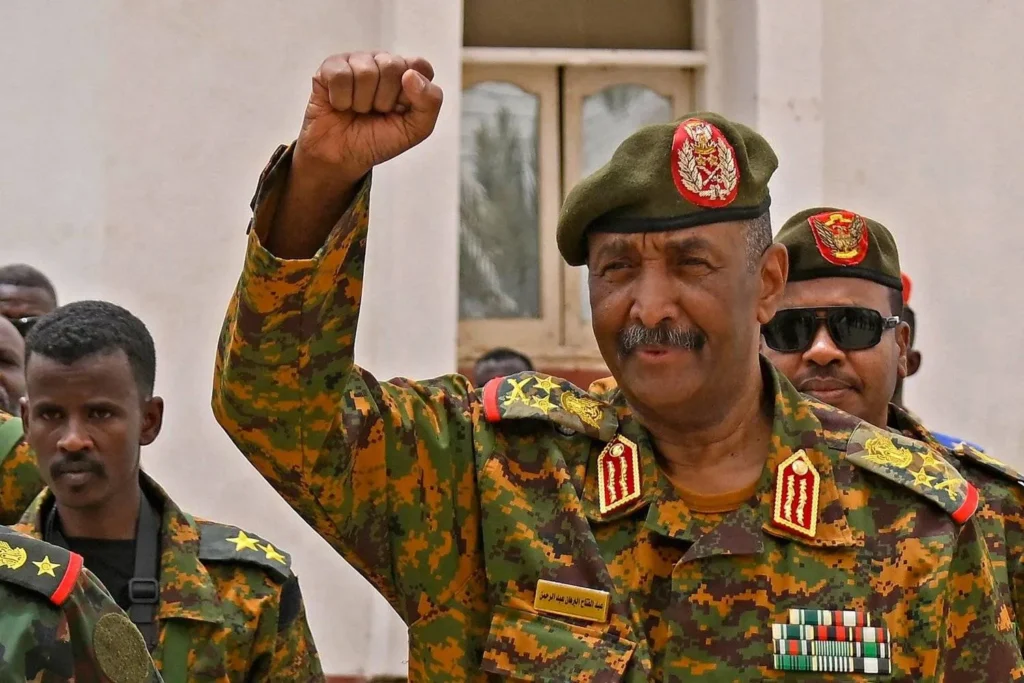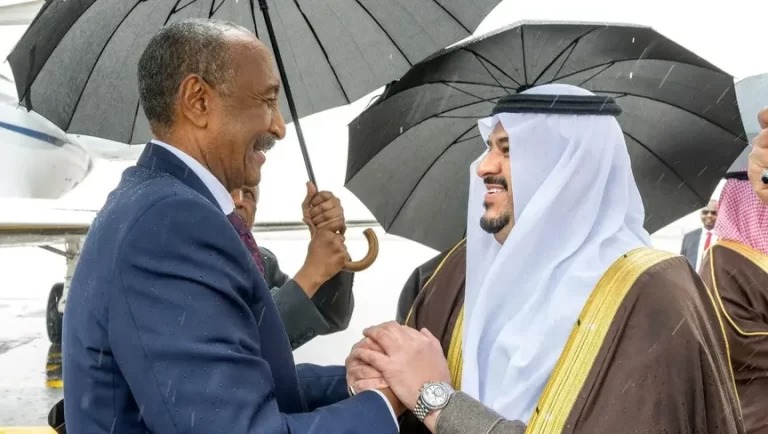
SAF commander and head of Sudan’s Sovereignty Council Abdel Fattah al Burhan’s visit to Saudi Arabia was not a routine diplomatic stop, as official statements attempted to portray it. Instead, it came at an extremely sensitive political and security moment, both domestically and regionally, prompting close scrutiny within diplomatic circles monitoring the Sudan file.
The visit took place amid a complex military landscape and growing public distrust in decision making centres. It appeared to carry more meaning than what was publicly announced and revealed less than what was actually discussed, particularly as speculation intensifies over efforts to recalibrate the relationship between Sudan’s fragile transitional authority and long entrenched ideological power networks that have controlled the state from behind the scenes for decades.
Sources familiar with Sudan’s regional communications say that one of the most sensitive issues raised during undisclosed meetings was the question of Islamist influence within the governing structure. This was not framed merely as a political legacy issue, but as a genuine obstacle to any path toward stability or Sudan’s reintegration into its Arab and international surroundings. Influential capitals, led by Riyadh, no longer view Sudan’s crisis solely through a military lens. Instead, it is increasingly seen as a partially captured state, penetrated by organisational networks operating flexibly within institutions regardless of changing political façades.
In this context, it was unsurprising that the Islamist current, particularly networks linked to the Muslim Brotherhood, resurfaced in political analysis as the deepest knot in Sudan’s crisis. These are not treated as a conventional political party, but as an entrenched web of influence spanning security, the economy, administration and media, capable of steering sovereign decisions even during periods of apparent decline. Multiple assessments suggest that any serious discussion about supporting Sudan or rehabilitating its governing authority inevitably hinges on dismantling, or at least significantly curbing, this network’s ability to influence decisions from behind the scenes.
Notably, the names circulating within monitoring circles are not new. They belong to well known figures from Sudan’s Islamist movement, individuals associated with key phases of Brotherhood entrenchment within the state. Although sometimes absent from the public spotlight, these figures continue to shape events in the background. Regionally, they are viewed as the main barrier to any genuine transformation, especially given past experiences showing that recycling the same elites under new labels has only produced deeper crises.
From this perspective, Burhan’s Riyadh visit is understood as an attempt to reintroduce himself regionally, not merely as a military leader commanding the SAF in an internal war, but as an actor either capable of, or willing to, sever ties with ideological power centres that have become a heavy burden on the Sudanese state. This framing, however, raises legitimate questions within Sudanese society itself. Does Burhan truly possess the ability to take such a decision, or is the move simply an effort to buy time and reposition politically?
Sudan’s long history of ambiguous alliances makes scepticism understandable. Sudanese citizens have repeatedly witnessed promises made abroad only to be emptied of substance at home under the pressure of power balances. What has changed this time is the regional environment, which is no longer tolerant of double discourse or political tightrope walking. Support has become conditional, political recognition is no longer granted freely, and any authority seeking survival must demonstrate a real break with the past, not merely verbal disavowals.
The most important message observers took from the visit lies not in what was stated in official communiqués, but in what was left unsaid. Silence, at times, speaks louder than declarations, especially when dealing with files whose sensitivity is widely understood. The central question now is not whether discussions took place, but whether their outcomes will be reflected in the structure of power itself, or whether Sudan will continue to revolve in the same cycle, where faces change but the system remains intact.