Scenes of young boys waving rifles larger than their frail bodies have emerged as a stark symbol of the moral collapse left in the wake of Sudan’s war. Widely circulated on social media, the footage reveals a generation being pushed into violence at an early age, with their awareness shaped on battlefields rather than in classrooms, in one of the most painful consequences of a conflict whose human cost continues to deepen. What makes these images even more disturbing is that they are not hidden, but openly presented as symbols of strength and belonging, in a country where state institutions are crumbling and recruitment increasingly targets the youngest and most vulnerable.
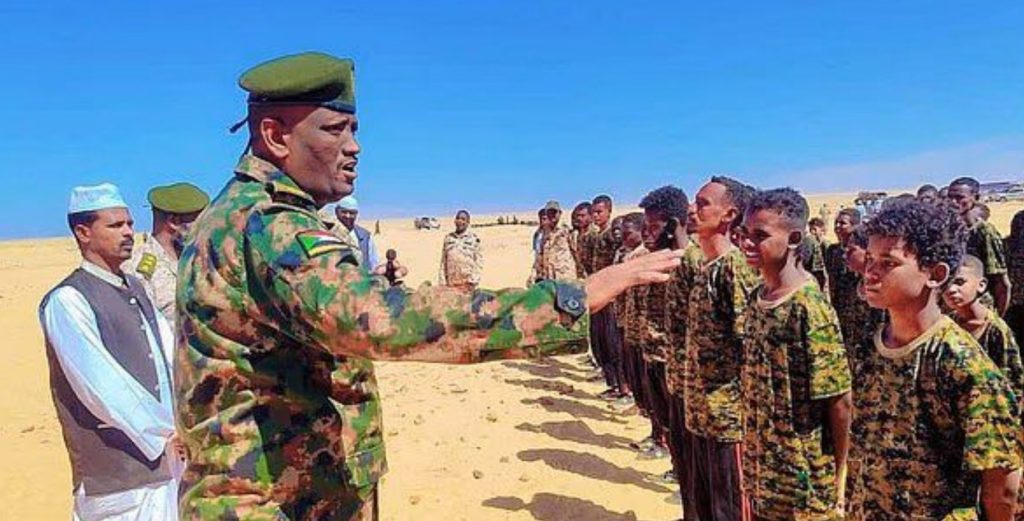
According to British media reports based on video footage, one clip shows a line of children raising their rifles into the air as an adult leads them in chants praising SAF. The scene mirrors a narrative that frames war as heroic, concealing the fragility of children who find themselves at the centre of a conflict they cannot comprehend. The man guiding them appears almost like a schoolteacher leading a lesson, smiling and encouraging them to repeat slogans, while in reality directing them towards a future shadowed by death, in a country where childhood has become a resource consumed by prolonged fighting.
The war erupted in April 2023 after years of tension between SAF and the Rapid Support Forces. What began as a power struggle quickly escalated into a full-scale civil war that devastated cities, burned neighbourhoods, and forced millions into displacement and hunger. As fighter numbers declined and casualties mounted, warring parties turned to recruiting children, according to United Nations reports. The “Children and Armed Conflict” report documented 209 cases of child recruitment in a single year, reflecting the collapse of protection systems.
Footage circulating on platforms such as TikTok, cited by British media, shows even darker scenes. Boys wearing SAF uniforms sing combat chants, while others repeat popular songs repurposed as mobilisation tools. In another clip, a young child with an apparent disability is tied to a barber’s chair as an adult voice coaches him to repeat military slogans he does not understand. He raises his finger with an innocent smile that sharply contrasts with the brutality of the moment. Other images show a boy lying inside a military truck, an ammunition belt draped around his neck and a heavy weapon beside him, staring blankly at the camera, devoid of fear or enthusiasm, but stripped entirely of childhood.
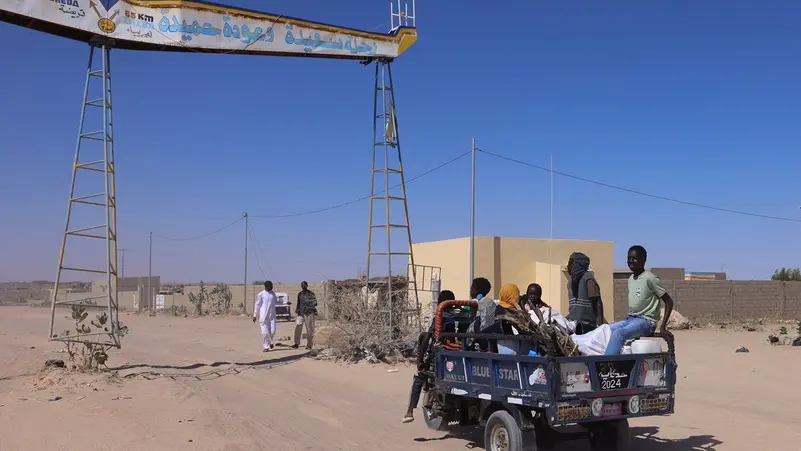
Similar scenes appear across different regions: rows of boys in the desert receiving military orders, teenagers carrying rifles as if they were badges of honour, and trucks transporting young fighters towards front lines. These images reveal how war is presented to children as fleeting excitement, masking checkpoints, ambushes and artillery fire. Some are used as fighters, others as porters or lookouts, all exposed to death in battles few survive.
International law classifies the recruitment of children as a war crime, yet the evidence, as the report notes, is not hidden in secret files but displayed openly. It shows children being drawn into a conflict far beyond their understanding, reshaped in an environment that offers no path back to childhood. War, the report says, “seeps into them, shapes them, until it kills them”.
Still, the most harrowing images remain those of children shouting with joy as they lift their rifles high, unaware that what feels like a moment of power is in fact the beginning of a long road of violence and loss, a road from which children never return as they once were.