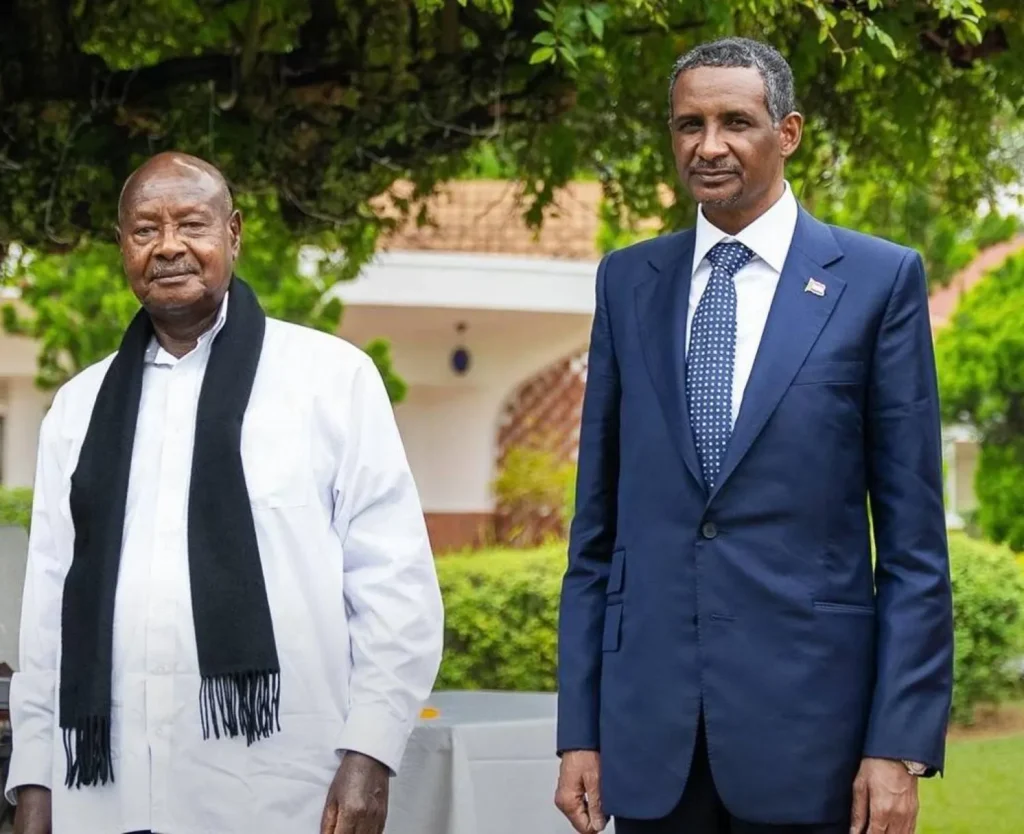
Mohamed Hamdan Dagalo, head of the Presidential Council of the “Tasis” (Founding) Alliance and commander of the Rapid Support Forces (RSF), said his camp remains open to all international efforts aimed at ending Sudan’s war, which erupted in mid-April 2023, while accusing the Islamist movement of orchestrating the conflict.
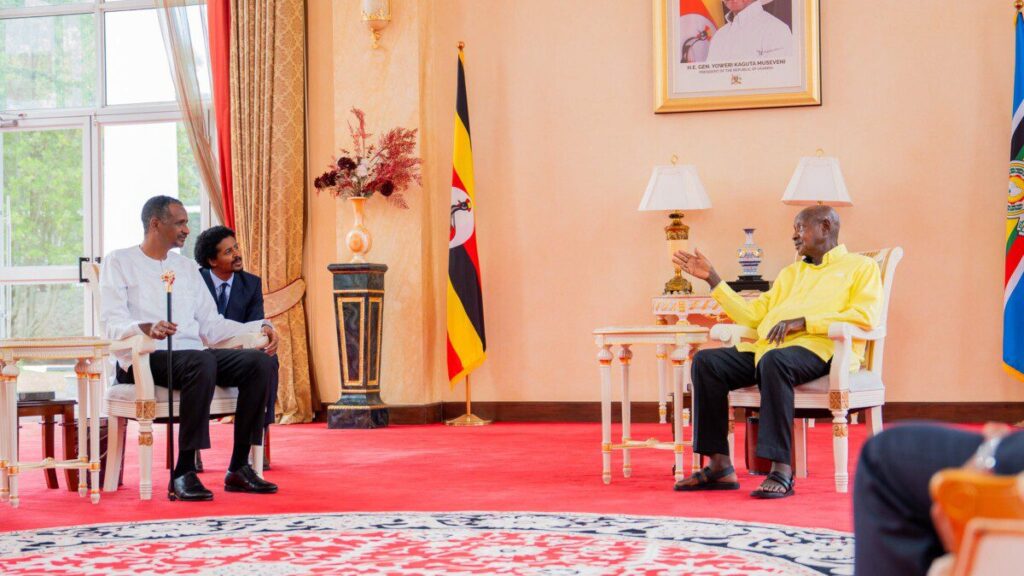
Speaking during a meeting with members of the Sudanese community in Uganda’s capital Kampala, following talks with Ugandan President Yoweri Museveni, Dagalo said any sustainable solution to Sudan’s crisis must dismantle what he described as the Islamist grip on the military and security apparatus.
Dagalo claimed the RSF is currently “in its strongest position,” asserting that the force has more than 500,000 fighters at full readiness.
He also warned against what he described as activities by the General al-Burhan’s army (SAF) intelligence apparatus, accusing it of facilitating the entry of fighters from Somalia’s al-Shabaab movement to participate in the ongoing fighting — an allegation the SAF has previously denied.
Openness to international mediation
Dagalo said the Tasis Alliance had accepted the Quad initiative and submitted its vision to Washington, adding that his coalition was prepared to cooperate with all international and regional initiatives, including mediation efforts led by President Museveni.
“We cooperate with all international and regional efforts, and we will engage positively with President Museveni’s initiative,” Dagalo said.
In a post on X following the meeting, Museveni reaffirmed Uganda’s position in favor of a peaceful political settlement in Sudan.
“Mohamed Hamdan Dagalo briefed me on the current situation in Sudan,” Museveni wrote. “As always, I emphasized that dialogue and a peaceful political solution are the only sustainable paths to stability in Sudan and the region.”
A statement from the Tasis Alliance said Dagalo provided Museveni with a detailed briefing on political, security and humanitarian developments in Sudan, as well as efforts underway to halt the war and advance peace.
Blaming Islamists for the war
Dagalo accused Sudan’s Islamist movement of igniting the conflict, saying his side possesses documented evidence to support the claim. He vowed that the Islamists would not succeed in achieving the objectives for which, he said, they launched the war.
He argued that the war was triggered by Islamist opposition to the framework agreement, which included provisions for military reform and the integration of armed movements. Dagalo said the conflict had since made clear the need to establish a completely new national army, free from Islamist dominance.
“Eliminating the Islamists’ control over the military is a non-negotiable goal,” Dagalo said, stressing that he is not seeking political power. “Anyone who wants to rule should take off the military uniform,” he added.
Dagalo accused Islamists of misleading the international community by portraying the RSF as the sole instigator of the conflict and renewed his call for an international investigation to determine which side fired the first shot.
He cited the killing of thousands of RSF personnel in the early hours of the war at the Wadi Seidna military base, claiming that his forces had been preparing for overseas deployment and had their weapons stored when they were attacked by SAF units.
“How could we have initiated the war when our troops were unarmed and preparing to travel abroad?” Dagalo asked.
He concluded by reiterating that Sudan’s Islamists “will never rule Sudan again.”