Dozens of people were killed on Monday after coordinated drone strikes hit military and government targets in Sinja, the capital of Sudan’s Sennar State, in a significant expansion of aerial warfare into a region previously considered removed from the main battlefronts.
The attacks targeted the headquarters of General al-Burhan’s army (SAF) 17th Infantry Division and a nearby government guest house close to the Sennar State secretariat, where a high-level meeting was under way at the time, according to multiple sources.
Governors from Sennar State, White Nile State and the Blue Nile Region — all military appointees — were attending the meeting alongside senior SAF officers to discuss border demarcation issues. The gathering was reportedly taking place inside or adjacent to the government guest house, a compound frequently used for official functions.
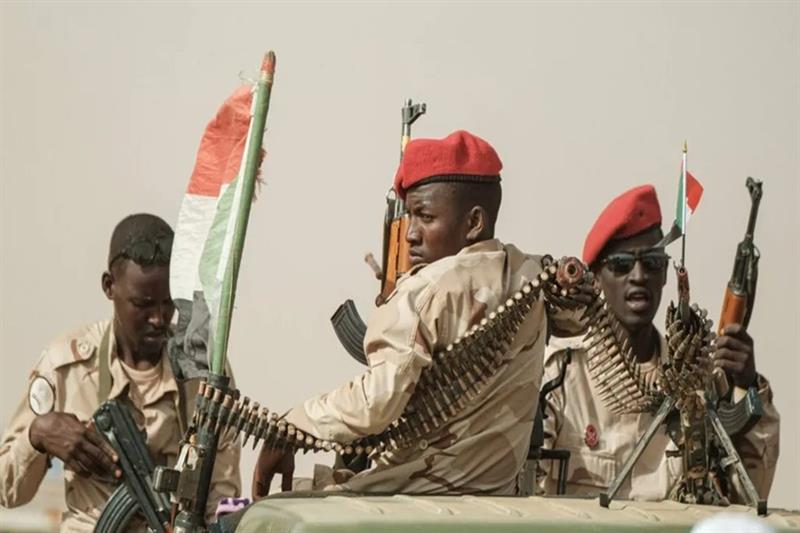
The precision and timing of the strike raised questions over whether the Rapid Support Forces (RSF) had prior intelligence about the meeting.
Verified video footage geolocated by Sudan War Monitor showed bodies and large amounts of blood inside the 17th Infantry Division headquarters, confirming that the site sustained a direct hit. The footage was geolocated to 13° 9’32.49”N, 33°55’55.81”E, placing the strike inside a fixed military command facility rather than a mobile or open target.
In the video, bodies of soldiers and officers are visible inside the building, with voices heard discussing whether additional victims remained inside the structure.
Explosions from drone-fired munitions sent shockwaves through Sinja, triggering panic among residents and overwhelming local medical facilities. Casualty figures remain disputed, reflecting both the chaos following the attack and the SAF’s long-standing policy of limiting public disclosures on military losses.
Sennar State Health Minister Ibrahim Al-Awad said at least 27 people were killed and 73 wounded, attributing the attack to RSF drones. Al-Hadath TV, citing military sources, reported 28 dead and 60 injured, while local sources suggested the toll could be higher.
In the aftermath, the Sennar State government issued urgent appeals for blood donations as hospitals struggled to cope with the influx of wounded civilians and military personnel. Sinja Teaching Hospital was reported to be operating at full capacity.
State authorities and civil society groups later issued statements addressing civilian casualties and the safety of senior officials.
The Sennar State government acknowledged civilian losses while insisting security conditions had stabilized following the attack. White Nile State authorities confirmed the deaths of two officials accompanying the governor, identifying them as members of the state protocol office and the governor’s security detail.
The government of the Blue Nile Region denied online rumors that its governor had been injured or killed, warning against misinformation. Meanwhile, the Sudan Doctors Network condemned the strike, reporting that guided munitions fired from RSF drones killed at least 10 civilians at multiple locations in Sinja.
Sinja, captured by the RSF in June 2024 and retaken by the SAF in November the same year, had not been targeted by major attacks since the RSF withdrew from central Sudan in early 2025. Its relative distance from active frontlines had allowed the SAF to present it as a stable rear area for governance and civilian return.
Monday’s strike marks the first major aerial attack on the city since the shift in frontlines and signals an expansion of RSF drone operations beyond active combat zones.
The SAF has historically avoided confirming the deaths of soldiers and officers, and the full scale of military casualties remains unclear. Sources familiar with internal reporting said senior officers were among those killed, though official confirmation is unlikely.
The attack has also raised concerns over the security of high-level meetings in recaptured cities. While the SAF typically avoids announcing senior visits in advance, the RSF appears to have obtained detailed information on the meeting’s timing and location.
The incident echoes a July 2024 drone attack at the Jabait SAF base in eastern Sudan, where drones struck during a military graduation ceremony attended by SAF chief Abdel Fattah al-Burhan, killing several people. The RSF denied responsibility at the time.
Analysts say the Sinja strike reflects a broader shift in Sudan’s war, with both sides increasingly relying on unmanned aerial vehicles to compensate for limitations in ground maneuver warfare. For the RSF, drones allow deep strikes into SAF-held territory, while the SAF has used UAVs for surveillance and attacks on RSF positions and supply routes.
By targeting command centers and administrative hubs, the RSF appears to be challenging SAF claims of restored security in recaptured cities and undermining efforts to encourage civilian returns.
One day after the Sinja attack, the RSF carried out another drone strike targeting the SAF’s 18th Infantry Division headquarters in Kosti, White Nile State, reinforcing what appears to be a coordinated campaign to extend aerial operations beyond traditional frontlines.