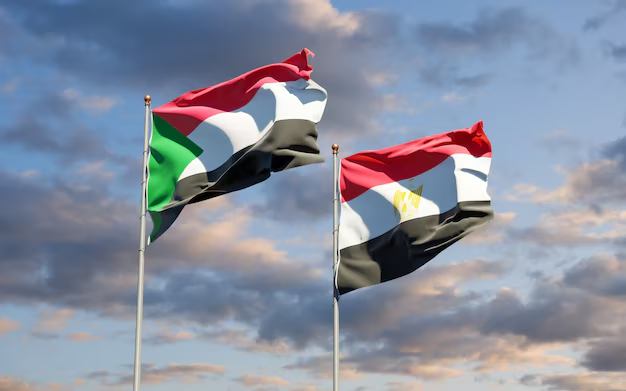
Geography is not always a blessing. At times, it becomes a heavy historical burden. What Sudanese people are increasingly facing in Egypt, repeated humiliation and mistreatment, can no longer be dismissed as isolated incidents. At border crossings, Sudanese travellers are detained for hours without clear reason, their dignity examined before their documents. On the streets, racist jokes are made openly. In housing and workplaces, vulnerability as refugees is exploited through inflated rents, reduced wages and constant threats tied to legal status. When abuse occurs, the response is often reduced to a familiar phrase, “an individual act”.
Reducing these experiences to individual behaviour is an evasion of reality. What is unfolding reflects a deeper political and psychological structure. The late Sudanese thinker Mansour Khalid once described the relationship with Egypt as being shaped by a mindset of historical superiority rather than one of equal partnership, a dynamic that has harmed Sudan more than it has helped.
This sense of imagined superiority was not merely a popular attitude, but a state policy, an old guardianship mentality reproduced through modern tools. Egyptian geographer and thinker Gamal Hamdan acknowledged this tendency, arguing that Egypt’s centralised nature drives it to politically absorb surrounding spaces when neighbouring states weaken. Sudan’s fragility, therefore, is not viewed as a humanitarian tragedy, but as a political opportunity.
Responsibility, however, does not lie with Cairo alone. It begins within Sudan itself, with a military and political elite that has tied its survival in power to external approval. This elite no longer treats Egypt as a neighbour to engage on equal terms, but as an external guarantor of continued rule. Sovereignty becomes a transaction, political protection in exchange for practical dependency.
This submission is not because Egypt is stronger, but because the ruling elite seeks power without accountability. When staying in office becomes the overriding goal, national dignity is sold in pieces, through silence in the face of humiliation, through surrendering decision making, and through justifying dependence under the banners of security and stability. As Sudanese scholar Abdallah Ali Ibrahim once warned, a state that does not respect itself teaches others not to respect it.
Measured through interests rather than sentiment, Egyptian interventions in Sudan have often had damaging effects on stability and development. They were rarely neutral or driven by fraternity. Egyptian journalist and thinker Mohamed Hassanein Heikal summed it up by noting that Egypt has historically viewed Sudan as a subordinate strategic space rather than a fully sovereign state.
This perspective has translated into practice, support for specific regimes, obstruction of genuine development paths, and a preference for fragile surface stability over a strong Sudan capable of independent decision making. Sudanese intellectual Haidar Ibrahim Ali described this dynamic as a form of soft domination, exercised in the name of brotherhood rather than force.
Politics cannot be separated from economics. Sudan’s collapse has opened vast grey markets, smuggling routes, brokers and supply chains where the origin of goods is erased. Arabic gum, one of Sudan’s most important global commodities, has been particularly affected. With war disrupting oversight, smuggling networks flourish and products are re exported under documents reflecting transit points rather than true origin.
This extends beyond Arabic gum to other Sudanese staples such as sesame, hibiscus and groundnuts, commodities not originally produced in Egypt or not central to its agriculture. In the absence of a strong state protecting value chains, Sudanese resources are bought cheaply, channelled through regional routes and sold at higher prices, while farmers lose fair value, recognition and bargaining power. The main beneficiaries are intermediaries, not producers or the weakened state.
Fairness, however, demands balance. Some Sudanese refugees may engage in misconduct, as occurs within any displaced population under extreme pressure. But turning isolated cases into collective blame or justification for hate speech is a serious moral failure. As Algerian thinker Malek Bennabi observed, individual deviation does not create a civilisational crisis, but exploiting it to fuel hatred does.
What is happening today goes beyond legitimate criticism into the normalisation of humiliation and the silent acceptance of public hostility. The phrase “Egypt, if only it were not the neighbour” is not a call for rupture, but a cry of disappointment. Disappointment in an unequal relationship and in a neighbour that saw state weakness as opportunity rather than tragedy.
The outcome is clear, a Sudanese citizen humiliated abroad because those in power accepted humiliation at home. Dignity cannot be begged for, and sovereignty cannot be preserved through submission. Any ruler who ties his authority to external approval inevitably signs away the dignity of his people, at home and abroad, regardless of who that neighbour may be.