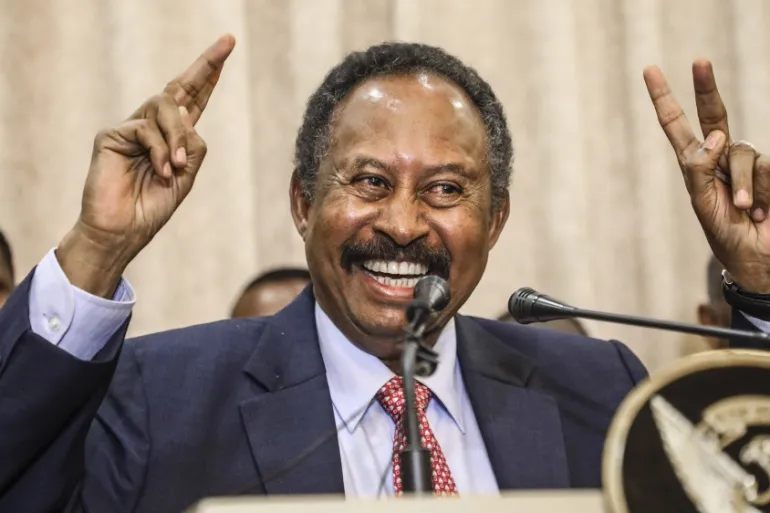
Abdalla Hamdok, former prime minister and head of the “Somoud” alliance, has said Sudan’s war cannot be resolved through military force, stressing that neither side is capable of achieving a decisive victory. His remarks amount to a direct challenge to SAF’s continued insistence on a military solution, which critics say has only deepened the country’s collapse.
Speaking at a seminar in London attended by Sudanese residents in the UK, Hamdok said ending the war requires agreement on a new political framework rooted in equal citizenship. He warned that Sudan now stands before two stark paths, either a new social contract that restructures public life, or the continuation of political failure driven by armed dominance.
Hamdok openly acknowledged the failure of the previous civilian-military partnership during the transitional period, arguing that the experiment exposed the dangers of allowing the army to retain unchecked power over political life. He said the Somoud alliance remains ready to cooperate with a broad spectrum of political forces, including the Democratic Bloc, the Popular Congress Party, and the movement led by Abdel Wahid Mohamed Nur, as part of a vision aimed at resolving governance crises and redefining the relationship between religion and the state.
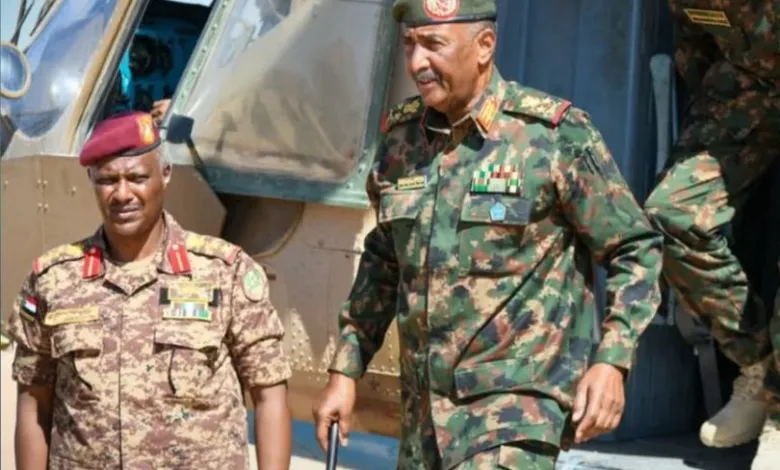
His comments came days after a public attack by SAF commander and head of the Sovereignty Council, Abdel Fattah al Burhan, who claimed Somoud’s leadership would not be allowed to return to Sudan. Burhan also accused the alliance of submitting what he described as false reports to the Organisation for the Prohibition of Chemical Weapons, an accusation widely seen as an attempt to intimidate civilian actors and deflect scrutiny from SAF’s own conduct during the war.
The exchange highlights the widening rift between civilian political forces seeking a negotiated settlement and a military leadership determined to rule through force. While civilian figures continue to argue that the war is unwinnable and disastrous for the country, SAF’s leadership appears committed to prolonging the conflict, rejecting compromise, and criminalising political opposition.
As the war drags on with no military breakthrough in sight, Hamdok’s intervention underscores a growing consensus among civilian actors that SAF’s strategy is not only failing, but actively preventing Sudan from moving towards peace and political reconstruction.