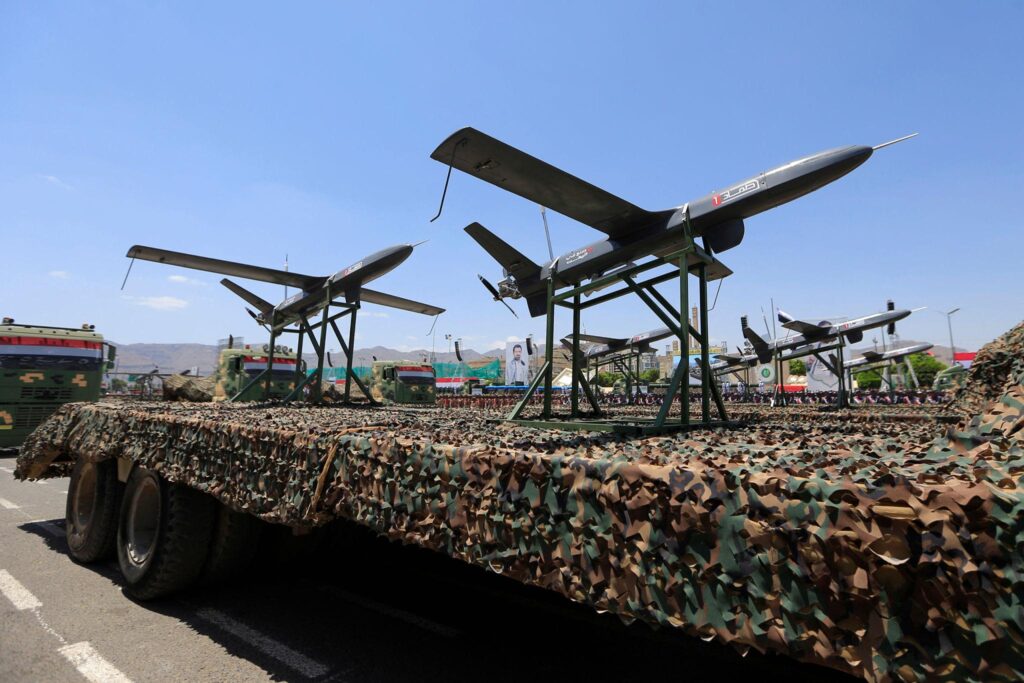
New intelligence-linked reports claim that Yemen’s Houthi movement, working through cross-border smuggling networks, has helped transfer low-cost Iranian military technology to armed groups in Sudan aligned with the SAF and believed to be connected to the Sudanese Islamic Movement.
According to Sheba Intelligence, a platform focused on security and intelligence developments in the Red Sea and Horn of Africa region, the transfers include drone and missile-related technology, as Sudan’s war sees a sharp rise in the use of unmanned aerial systems.
The report said smuggling networks operating between Yemen, the Horn of Africa and the Red Sea had facilitated a series of negotiations between Houthi representatives and Sudanese armed actors. The latest meeting reportedly took place last week and focused on new mechanisms and emerging routes for moving weapons across the Red Sea.
Sheba Intelligence said the Houthis rely on well-established smuggling networks with strong local influence in Yemen and the Horn of Africa. These networks allegedly use islands near the Eritrean coast as temporary storage sites for weapons and components used in the production of ammunition.
Some of those locations are also believed to be used for assembling parts of drones and missiles before they are transported to their final destinations, according to the report.
The outlet said it had obtained the names of four Houthi military commanders believed to be involved in managing or coordinating weapons-smuggling operations toward Sudan. However, it did not publish the names, saying the full details of their alleged roles could not yet be independently verified.
The claims come as Sudan faces a growing drone threat across multiple fronts of the war. UN High Commissioner for Human Rights Volker Türk recently warned the Human Rights Council that drone attacks in Sudan had killed more than 1,000 civilians between January and May.
According to UN figures, those deaths accounted for around 80 percent of all documented civilian fatalities during that period, underscoring the growing role of drone warfare in the conflict.
The reported transfer of drone and missile-related technology suggests that Sudan’s war is increasingly being shaped not only by conventional battlefronts, but also by the movement of low-cost military technology through regional smuggling corridors.
Observers warn that the flow of expertise and components to SAF-aligned armed groups linked to the Islamic Movement could push the conflict into a more dangerous and complex phase. Such networks would be difficult to monitor or disrupt, especially if they rely on flexible maritime routes, temporary storage hubs and cross-border logistical channels.
The developments also raise concerns that the Red Sea could become a key corridor for prolonging Sudan’s devastating war, which erupted in April 2023 and has since drawn in regional interests, armed factions and illicit supply networks.
If confirmed, the allegations would reveal a hidden dimension of the Sudan conflict: the role of the Houthis and regional smuggling networks in transferring combat technology between conflict zones along the Red Sea and Horn of Africa.
The report also places renewed attention on figures within Sudan’s Islamic Movement, including Ali Karti and allied militia networks, which opponents accuse of helping ignite and sustain the war while operating behind the SAF’s military campaign.