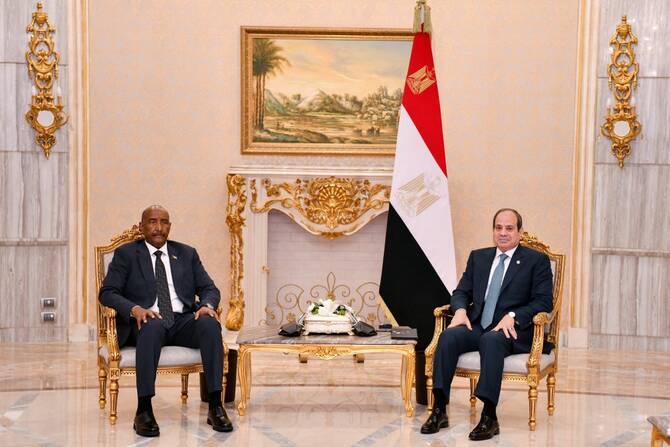
Sudanese analysts say a verbal slip by Prime Minister Kamil Idris has reignited debate over the extent of Egyptian influence on decision-making within the Port Sudan–based authority led by army chief Abdel Fattah al-Burhan.
During a public address earlier this week, Idris mistakenly referred to Egypt’s President Abdel Fattah al-Sisi as “Chairman of the Sovereign Council,” a title held by al-Burhan, before quickly correcting himself. While the incident was initially dismissed by officials as a simple error, several Sudanese political commentators argue that it reflects deeper political realities.
Analysts say the mistake resonated widely among Sudanese audiences because it appeared to mirror a prevailing perception that Port Sudan has become politically and strategically aligned with Cairo. Rather than being viewed as an isolated verbal slip, the incident was interpreted by critics as an inadvertent acknowledgment of overlapping authority and influence.
According to these analysts, the controversy is less about the words themselves than about what they revealed regarding sovereignty and autonomy. They argue that the Port Sudan administration increasingly operates within a framework shaped by Egyptian political priorities, particularly amid the ongoing war and Sudan’s institutional collapse.
Some commentators point to Egypt’s longstanding interests in Sudan, noting that Cairo has maintained close ties with successive military and Islamist-led governments. They argue that Egypt benefits from the continuation of the current power structure, recalling that disputed border areas such as Halayeb and Shalateen came under Egyptian control during previous periods of military-Islamist rule in Sudan.
Analysts also stress that Egypt’s role should be understood as that of a state pursuing its strategic interests, rather than a reflection of relations between the Sudanese and Egyptian peoples. In their view, Sudan’s vulnerability has created conditions in which external actors can exert influence through local allies weakened by war, political isolation, and economic dependence.
The Idris slip, they argue, struck a nerve because it aligned with a widespread belief that authority in Port Sudan has become blurred—politically, institutionally, and symbolically—between Sudan and Egypt. The question raised by the incident, analysts say, is not whether the prime minister confused two similar names, but whether sovereignty itself has become confused.
For many observers, the episode has come to symbolize what they describe as a broader crisis of legitimacy and direction, in which titles, institutions, and authority no longer clearly correspond to independent national decision-making.
Analysts conclude that the controversy highlights a deeper crisis facing both Sudan and Egypt at a time of regional instability, where political power has lost clarity and meaning, and where even minor moments can expose profound structural realities.