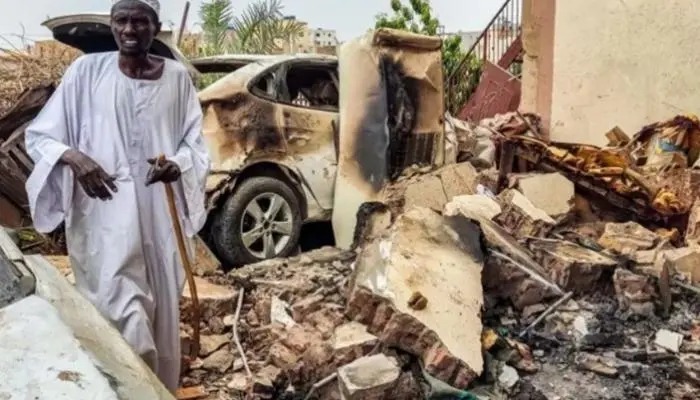
As Sudan’s war grinds on, Khalid Omar, deputy head of the Sudanese Congress Party, says the conflict now serves only a narrow group of beneficiaries who profit politically and economically from its continuation, while the wider population pays the price.
Speaking to a news programme, Omar argued that the war has become a tool for specific actors to consolidate power or accumulate wealth, exploiting the suffering of millions of Sudanese displaced inside the country or forced into neighbouring states.
He said the ongoing manoeuvring by the authorities led by SAF commander Abdel Fattah al Burhan has achieved nothing beyond prolonging the war. Developments over the past three months, he added, have failed to produce any meaningful progress and have instead deepened the crisis and worsened civilian suffering.
Omar described these political manoeuvres as “worthless”, saying they neither halt the bloodshed nor address the urgent humanitarian needs facing the population.
A war without horizon and its beneficiaries
Omar offered a stark political diagnosis, arguing that Sudan’s war is no longer a conventional military confrontation but an arena dominated by narrow interest networks that benefit directly from its continuation.
He said some actors used the war as a ladder to power, while others enriched themselves through the conflict, making peace fundamentally incompatible with their political and economic calculations.
Civilian suffering pushed aside
According to Omar, these networks show little concern for the scale of the humanitarian catastrophe, whether in displacement camps across Sudan or among refugees abroad, where daily conditions continue to deteriorate amid the absence of any serious political horizon.
He pointed to the past three months as evidence, saying delays, stalled initiatives, and parallel moves at the UN Security Council have failed to curb the crisis and instead contributed to further destruction.
Quartet initiative seen as a missed opportunity
In contrast, Omar said a genuine opportunity existed through the initiative sponsored by the International Quartet, which since September 2025 has put forward a detailed roadmap including clear mechanisms, monitoring tools, and phased implementation.
He argued that a serious approach would involve debating, developing, or amending this proposal, rather than bypassing it with entirely new and disconnected initiatives, which he said reflects a lack of genuine political will to end the war.
Preconditions that prolong the conflict
Omar criticised what he called “lists of preconditions”, ranging from withdrawal and disarmament to forced regrouping in camps, warning that such demands, imposed before real negotiations, cannot produce peace in a war of this scale and brutality.
He said imposing conditions without genuine talks only extends the conflict and exposes the absence of political commitment to peace.
While stressing that the principle of a single national army must be central to any lasting settlement, Omar said achieving this goal requires realistic, detailed negotiations rather than slogans. He pointed to Sudan’s own history, particularly the 2005 Comprehensive Peace Agreement, where lengthy talks on ceasefires and humanitarian access preceded discussions on deeper military and political arrangements.
Immediate ceasefire without conditions
Omar said Sudan urgently needs an unconditional and immediate cessation of hostilities to allow humanitarian aid to flow and to stop the daily loss of life, before entering complex political and military negotiations.
Any approach that reverses this sequence, he warned, risks reproducing the crisis in new forms rather than delivering genuine peace.
Fragmented paths and weakened will
Omar also criticised what he described as a crisis of political will, saying the Port Sudan authorities are heavily influenced by figures linked to the former regime, who, in his view, deliberately move between forums and initiatives to create parallel tracks that drain serious efforts of substance.
He warned that multiplying initiatives ultimately leads to commitment to none, calling for unified backing of the Quartet process as the most credible framework currently available.
Omar concluded by placing the April 15 war within Sudan’s longer history of conflict since 1955, which he said culminated in the country’s division and atrocities in Darfur. Making this war Sudan’s last, he argued, requires addressing root causes, particularly through managing Sudan’s diversity within an inclusive national framework that rejects military and narrow ideological rule.
Only a full civilian democratic transition, he said, offers a path to sustainable peace rather than temporary truces destined to collapse.