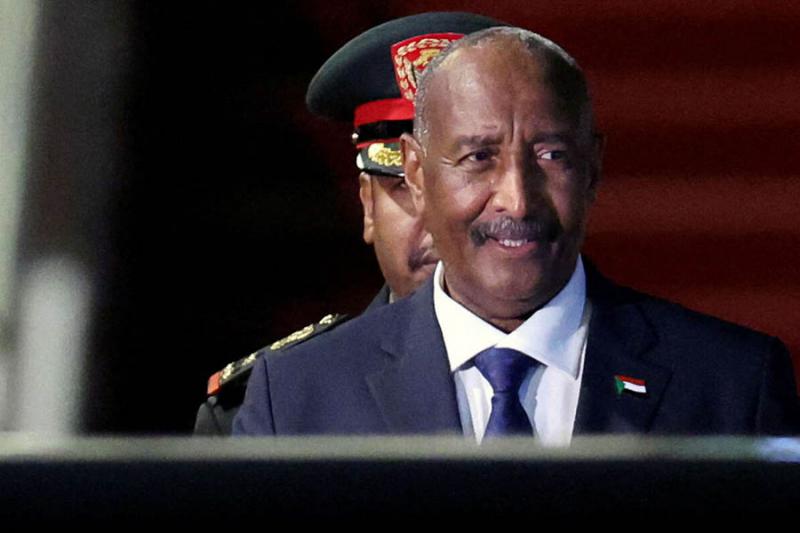
A growing power struggle between General Abdel Fattah al-Burhan and his SAF and Sudan’s Islamist movement is fueling renewed speculation over a possible internal coup, as divisions within the military and political elite deepen.
Despite mounting tensions, the uneasy alliance between Burhan and Islamist factions—described by critics as a “marriage of convenience”—remains intact, even after the movement was designated a terrorist organization and repeated attempts by both sides to sideline one another.
According to political analysis, efforts by Islamist figures to remove Burhan have failed, while Burhan’s own attempts to purge Islamist officers from the military and security apparatus have not fully consolidated his control—particularly over intelligence units and the air force.
This fragile balance has reportedly forced Burhan to rely on external support, including Egyptian-linked military coordination, while also navigating continued drone attacks on infrastructure—some sources attribute these to Islamist-aligned units.
Rival ambitions block alignment
At the center of the standoff is the political ambition of senior Islamist figure Ali Osman Mohamed Taha, who is said to be seeking a pathway to power through a technocratic government followed by presidential elections.
Burhan, who is also believed to harbor presidential ambitions, remains a major obstacle to that plan. Analysts say this rivalry—rather than ideological distrust—is the primary barrier preventing a stable alignment between the SAF leadership and Islamist forces.
The comparison to former Sudanese president Omar al-Bashir is frequently raised, with suggestions that Islamists previously used Bashir as a political vehicle before losing control of the state.
Strategy to isolate Burhan
Some analysts argue that the quickest route for Islamist factions to weaken Burhan would be to portray him internationally as an Islamist proxy, potentially exposing him to legal pressure, including action from the International Criminal Court.
However, the Islamist movement itself faces leadership challenges, particularly after the deaths of several senior military figures in past incidents, leaving it without a widely respected commander capable of mobilizing broad support within the SAF.
Emergence of new Islamist military bloc
Recent reports point to the formation of a new Islamist-aligned officers’ group aimed at consolidating influence within the armed forces. The group, described as the “National Islamist Officers,” is reportedly seeking to attract sympathetic officers and those disillusioned with current military leadership.
Leaked details from a meeting of 17 officers in Omdurman suggest that discussions focused largely on political issues rather than battlefield strategy, including:
- Criticism of the current government’s performance and structure
- Rejection of international mediation initiatives
- Concerns over divisions within military leadership
- Debate over Sudan’s regional alignments, including ties with Iran
- Opposition to emerging political actors seen as reshaping power dynamics in Darfur
Notably, the meeting reportedly avoided direct discussion of the ongoing war or relations with the Rapid Support Forces (RSF).
Calculated leaks and rising risk
Observers believe the leak of the meeting details was intentional, aimed at signaling the group’s existence and rallying support among military ranks.
However, analysts warn that any coup attempt at this stage would carry significant risks, potentially allowing Burhan to justify a broader crackdown on Islamist elements within the SAF.
They also caution that a failed bid for power could accelerate the fragmentation of the movement itself, exposing its members to accountability for past and present actions.