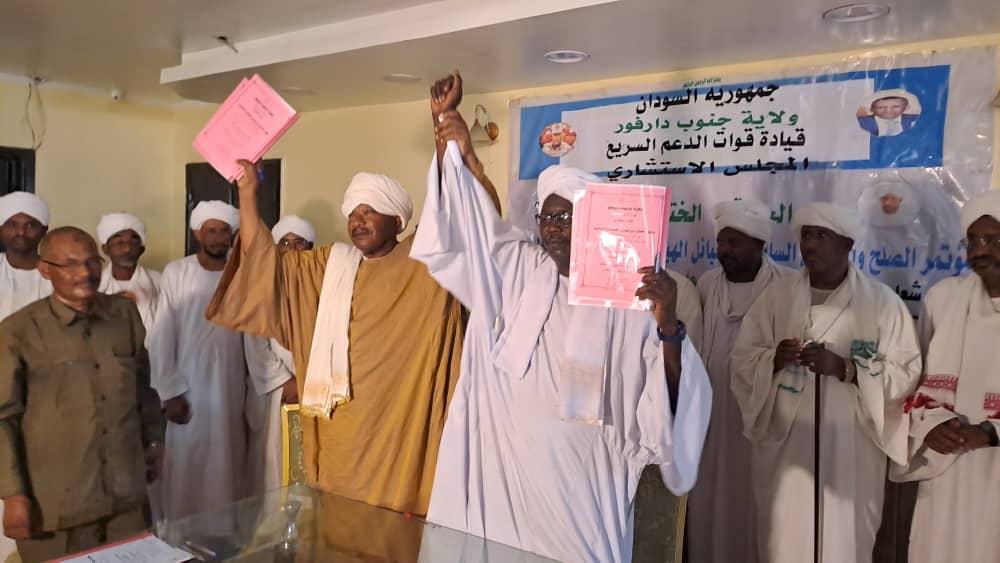
Leaders of the Masalit and Fellata communities have signed a reconciliation agreement in South Darfur, concluding peace talks in Nyala following deadly communal violence that killed 28 people and wounded around 40 others in September, according to local Sudanese media.
The agreement, reached after several days of negotiations, establishes financial compensation for victims’ families, penalties linked to the violence and measures intended to prevent renewed fighting in Gereida and surrounding areas.
The peace conference brought together traditional leaders, mediators, security officials and representatives of Sudan’s TASIS-backed Government of Peace, including Prime Minister Mohamed Hassan al-Taishi.
Fellata leader Mohamed al-Fateh al-Samani and Masalit representative King Adel Hassan al-Malik signed the agreement in the presence of local officials, Rapid Support Forces (RSF) representatives and members of the traditional administration.
The deal follows clashes in Gereida locality that erupted after a dispute between two individuals at Abuja market escalated into armed confrontations between the communities.
The violence subsequently spread into residential neighbourhoods and displacement camps, leaving homes damaged and forcing residents to flee.
A mediation committee, supported by RSF personnel, intervened to separate the opposing sides and secure an initial cessation of hostilities before formal reconciliation negotiations began.
Under the settlement, the Fellata community must pay 144 million Sudanese pounds in compensation for 18 deaths, calculated at eight million pounds per victim.
The Masalit community must pay 80 million Sudanese pounds for 10 deaths, bringing the total compensation for fatalities to 224 million pounds.
The mediation committee also imposed a 10-million-pound fine on the Masalit side over what it described as negligence contributing to the initial Abuja market incident.
A corresponding 10-million-pound penalty was imposed on the Fellata community for an attack on Gereida the following day.
An additional five-million-pound fine was imposed on Ghariballah Mohamed Ahmed, although the committee did not publicly explain the reason.
Both communities have been given two months from the agreement’s signing to settle the financial obligations. Claims for reimbursement of medical expenses associated with injuries on either side were waived.
Beyond compensation, the agreement sets out security arrangements intended to reduce the risk of renewed communal fighting.
The mediation committee recommended further consultations with the RSF to establish security measures in Gereida and Sirgila, alongside the creation of courts to strengthen access to justice and the rule of law.
It also called for the return of displaced Masalit and Fellata residents to their former villages, homes and agricultural land.
A joint monitoring committee comprising representatives of the Mahadi, Rizeigat and Habbaniya communities, together with security and judicial authorities, will oversee implementation of the settlement.
The recommendations prohibit carrying weapons in markets and other public spaces and call for individual criminal incidents to be handled through legal and customary mechanisms rather than assigning collective responsibility to either community.
The agreement also demands an end to hate speech, inflammatory social media campaigns and traditional mobilisation rhetoric that could aggravate tensions.
The reconciliation represents a development for the TASIS-backed administration in Nyala, which has supported local mediation efforts as part of its stated plans to restore security and civilian institutions in areas under its influence.
However, implementation of the agreement will depend on whether compensation is paid, displaced families can safely return and local authorities can prevent further armed confrontations.
South Darfur continues to face serious insecurity, including armed robbery, killings, disputes between farmers and herders, kidnappings and ransom demands.
Roads connecting towns and rural communities in the southern parts of the state have been particularly affected by attacks and criminal activity.
The latest agreement seeks to address immediate grievances while creating mechanisms for peaceful coexistence between two communities whose relations were severely damaged by September’s violence.