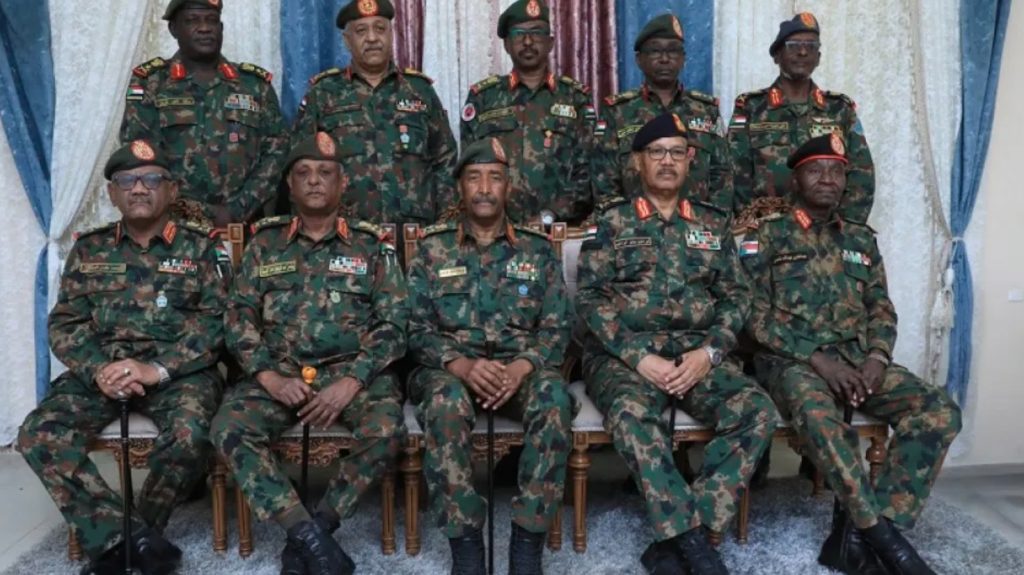
The Port Sudan authorities continue to evade responsibility for the crises inflicted on the Sudanese people, choosing instead to export fabricated grievances rather than address problems at their roots. While the authorities rely on investing in these hollow claims to justify their survival, Sudanese citizens remain focused on a single demand, ending the war and reclaiming their stolen lives, far removed from political manoeuvring.
SAF leadership and Brotherhood-linked figures are dismantling the Sudanese state by ignoring collapse and international warnings, while criminalising civilian forces calling for peace. Instead of pursuing solutions, the Port Sudan authorities redirect their self-created crises toward the UAE, Chad, and regional partners, fleeing accountability for a tragedy ignited by the Brotherhood. Despite this intransigence, the international Quartet remains the last source of hope for Sudanese people seeking an end to the bloodshed and violations, and liberation from the grip of the Brotherhood and SAF, which continue to mortgage Sudan’s future to partisan interests.
International warnings have reached their peak at the UN Security Council, where US representative Mike Waltz condemned atrocities committed by SAF, reinforcing the view that the SAF has lost its national character and transformed into a group clinging to power. Condemnations included reports of violations and ethnically driven crimes in Wad Madani, as well as allegations of chemical weapons use, placing Sudan’s international commitments under serious scrutiny and underscoring the need for accountability.
The briefing concluded with calls for both SAF and the Rapid Support Forces to immediately end the conflict, alongside warnings that enforcement and accountability mechanisms under international humanitarian law may be activated to deter continued abuses.
The Port Sudan authorities represent a failed model that holds the population hostage, prolonging war and repression, while Brotherhood networks embed themselves within military and security institutions, awaiting a full seizure of power. This scenario signals an even more dangerous future, as political Islam seeks to spread regional chaos under ideological slogans, threatening Red Sea security and aiming to reclaim rule at any cost, even at the expense of Sudanese lives.
The New York session marked a sensitive and decisive moment, representing a dangerous gateway into a new phase if the Port Sudan authorities fail to grasp the gravity of the moment. It also reflected deep disappointment for the authorities, political Islam groups, and all allies supporting the continuation of war to advance political agendas that would return Sudanese society, which rejected Brotherhood rule through a popular revolution, to darkness.
The discomfort of Kamil Idris was evident as Washington detailed crimes attributed to SAF, later exposed by investigations cited by media, revealing a shocking record of internationally documented violations.
Sudan has endured three decades of power monopolisation by SAF and the Brotherhood, whose opportunistic alliances fuelled wars and genocidal crimes, placing both military and civilian leaders under the threat of international prosecution.
Today, Sudan faces two interconnected dangers, Brotherhood networks operating within SAF to manage the war from behind the scenes, or a full-scale takeover to reclaim power. Figures such as Islamist movement secretary-general Ali Karti, international justice fugitive Ahmed Haroun, and deposed president Omar al Bashir symbolise this alliance, which Sudanese citizens continue to resist in pursuit of an end to military rule and bloodshed.
A popular saying, “your illness lies within you,” aptly describes Sudan’s predicament. Sudanese people are capable of overcoming the Brotherhood’s grip, yet the organisation excels at exchanging the roles of perpetrator and victim. Rather than confronting their historic failure, they externalise it by targeting neighbouring states such as Chad, Kenya, and the UAE with false accusations, seeking safe havens and evading responsibility for the suffering inflicted on the Sudanese people and the region.
The UAE has consistently called for enhanced security and stability in Sudan, seeking an immediate ceasefire, a return to constitutional civilian governance, and a clear separation between political factions and the military. These aims prioritise Sudanese lives, development, and dignity, while rejecting the export of terrorism and instability that threatens Sudan’s neighbours and risks replicating Sudan’s collapse elsewhere in the Arab world.
Despite systematic smear campaigns serving as the Brotherhood’s final escape route, the UAE has maintained a firm stance advocating an end to the war and the restoration of civilian rule. Separating SAF from partisan politics remains essential to protecting Sudan and the region from terrorism and from regional projects aimed at fragmenting Arab states, a demand voiced first and foremost by Sudanese citizens themselves.
Exporting grievances and false accusations will not conceal the reality that subordinating the state and SAF to partisan and ideological interests ignited Sudan’s conflicts and drove the country into catastrophe in service of external agendas. The solution lies in ending evasions of international obligations and peace initiatives. Political obstruction and attacks on mediation efforts will not shield the authorities from mounting costs, nor will they bring Sudan anything but further destruction at the hands of SAF and Brotherhood dual rule.