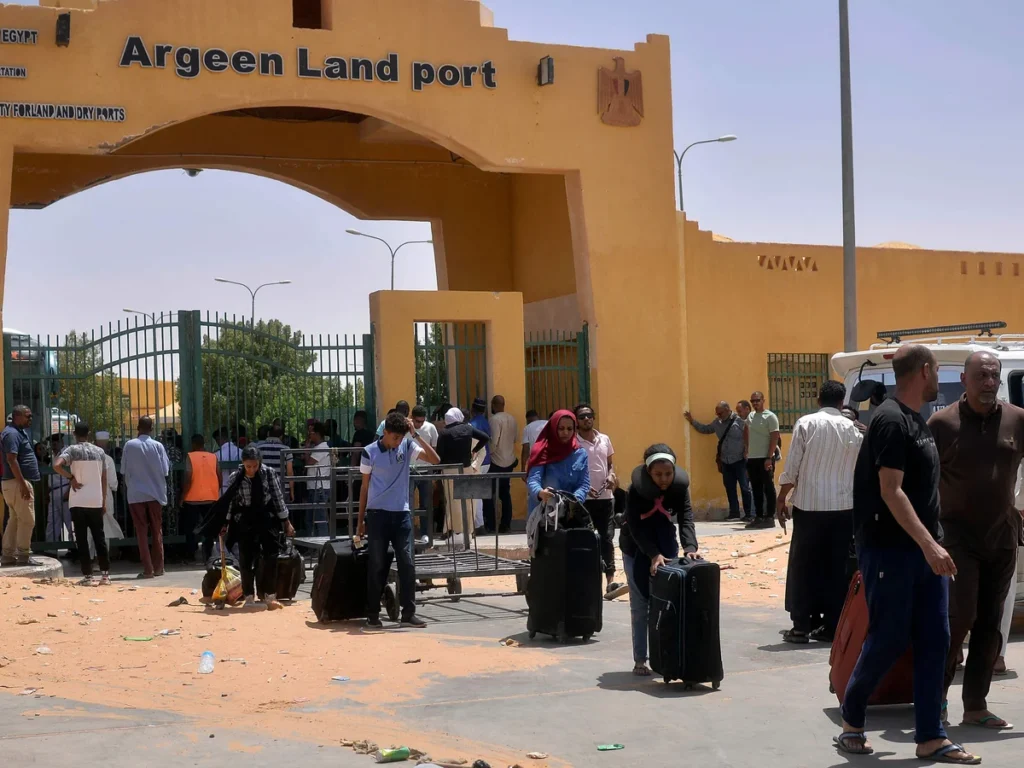
Since the outbreak of Sudan’s war, millions of citizens have been forced to flee their homes, becoming refugees and internally displaced persons inside and outside the country. As tens of thousands crossed into Egypt, growing complaints emerged about mistreatment, including detention and forced deportation of some Sudanese refugees, even among those holding UNHCR cards or valid legal residency.
If confirmed, such practices represent a clear violation of international law, which prohibits the forced return of refugees to conflict zones and obliges host countries to provide humanitarian protection.
Sudanese refugees in Egypt have the right to demand dignity and respect, and to be treated as victims of war rather than a security burden. They did not leave their country by choice, but fled bombardment, hunger, and insecurity. Any policy based on forced deportation or deliberate pressure lacks both humanitarian and ethical grounding.
Yet while voices of anger rise today in defence of Sudanese refugees abroad, another tragedy of equal gravity is largely ignored, the suffering of South Sudanese refugees inside Sudan itself.
Here lies the stark contradiction and double standard.
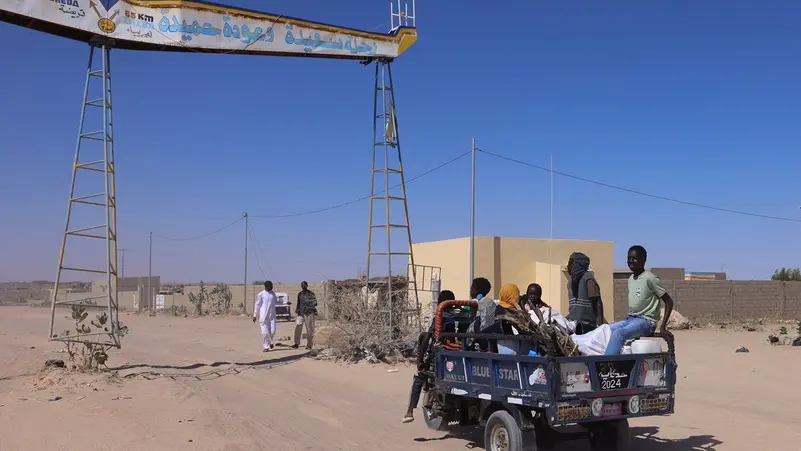
In states such as White Nile, Al Jazira, Sennar, and Kassala, thousands of South Sudanese refugees live under extremely harsh humanitarian conditions. In camps such as Khor Al-Waral and Joda in White Nile state, refugees face severe shortages of food, medicine, and shelter, while disease spreads due to the collapse of health services. Movement and employment are often restricted, and refugees are viewed with suspicion, especially amid heightened political polarisation and war.
In Khartoum, before the city fell into full-scale fighting, South Sudanese refugees were frequently subjected to arbitrary searches and random arrests under the pretext of security measures. After the centre of authority shifted to Port Sudan, their conditions deteriorated further. Many lost their livelihoods, while others were exposed to exploitation and extortion, with little or no legal protection.
Documented cases indicate that some South Sudanese refugees were forced to leave certain areas or denied the right to residence and work, simply because they did not belong to the “right” side in Sudan’s conflict dynamics.
These practices are fundamentally no different from what Sudanese refugees today complain of in Egypt, yet they pass with near-total political and media silence.
In Al Jazira state, following recent fighting, many South Sudanese refugees were subjected to verbal and physical abuse, forcing some to flee once again toward the South Sudan border, a stark illustration of the extreme vulnerability they face inside a country that was supposed to offer them safety.
This raises a profound ethical question:
How can we condemn the forced deportation of a Sudanese refugee from Cairo while remaining silent about discrimination against a South Sudanese refugee in Kosti, Wad Madani, or Port Sudan?
How can we demand respect for international law beyond our borders while failing to uphold it within them?
The de facto authorities in Sudan bear direct responsibility for protecting all refugees on their territory, regardless of nationality. Yet to date, no clear policies have been presented to safeguard South Sudanese refugees or provide them with basic security and services. Instead, they have been left to face war, chaos, and division alone.
Humanity is not measured by passports, and dignity is not granted based on political affiliation. Sudanese refugees in Egypt deserve respect, but so do South Sudanese refugees in Sudan. It is morally unacceptable to speak the language of solidarity when we are the victims, only to fall silent when others suffer.
Refugee suffering, wherever it occurs, is the direct result of political failure and senseless wars. Ordinary people are not responsible for the mistakes of governments. Refugee issues should not become arenas for hostility between Sudanese and Egyptians, or between Sudanese and South Sudanese, but an opportunity for a comprehensive reassessment of asylum policies across the region.
A genuine humanitarian position must remain consistent, rejecting forced deportation in Egypt, rejecting discrimination in Sudan, and defending the dignity of every refugee without exception.
The suffering is shared. The pain is shared. The human being is one.
Without this balanced understanding, the refugee issue will remain a tool for political point-scoring rather than a matter of conscience and humanity.
A refugee is not a burden, but a human being searching for safety.