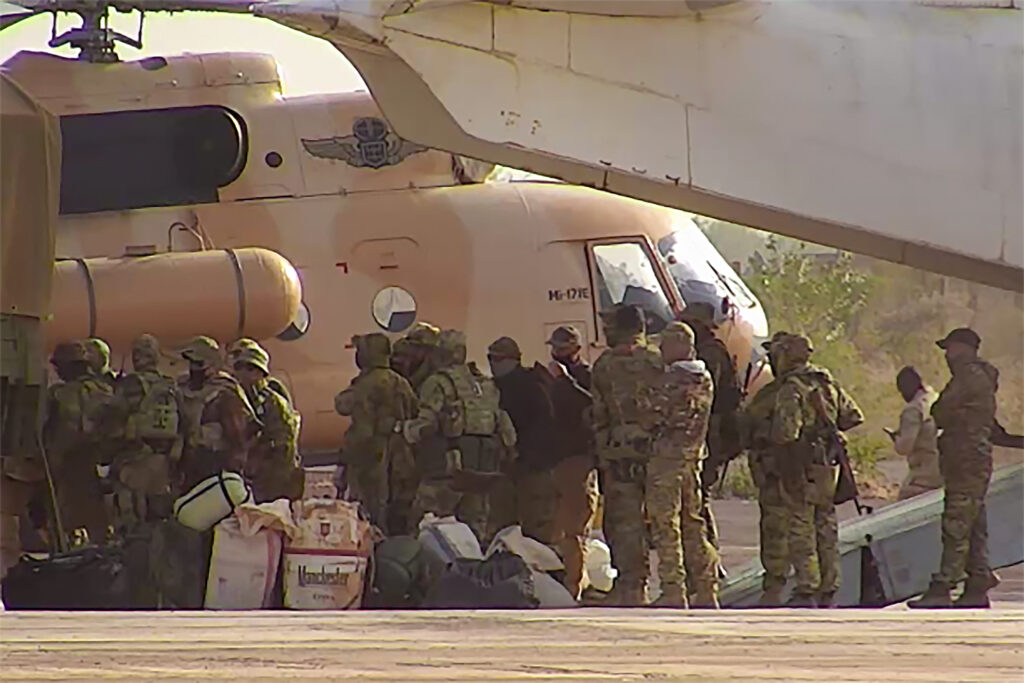
A sudden Russian military move along Sudan’s western frontier is reshaping the balance of power in the country’s ongoing war, after forces linked to Moscow blocked a key supply route used by the Rapid Support Forces (RSF).
Units of the “African Corps,” affiliated with Russia’s Ministry of Defense, have closed the main overland road connecting the Central African Republic (CAR) to South Darfur, a route long regarded as a critical lifeline for RSF military and logistical supplies into western Sudan.
The development comes weeks after the RSF reached an agreement with local authorities in the CAR town of Birao to reopen joint commercial crossings, an effort aimed at easing the impact of restrictions imposed by General al-Burhan’s army-aligned authorities in Northern State, who had blocked the flow of goods into RSF-controlled areas of Darfur and parts of Kordofan.
Russia’s abrupt intervention has raised major questions about whether the move was coordinated with the SAF to choke RSF supply lines, or whether Moscow acted independently to assert control over the strategic tri-border area linking Sudan, the Central African Republic, and Chad.
Analysts say control of this border triangle would give Russia significant leverage over both sides of Sudan’s conflict and allow it to redraw the regional map of influence in one of the war’s most vital corridors.
The African Corps, which replaced the Wagner Group following its dissolution, is deployed across several African countries, including the Central African Republic. Birao, located in northeastern CAR near the Sudan–Chad border triangle, serves as the main hub for the Russian force in the area.
Border sources and eyewitnesses reported that Russian units have deployed heavy military reinforcements and established fortified checkpoints at key crossings between western Sudan and the Central African Republic.
The closure has led to hundreds of commercial trucks piling up on both sides of the border, heightening fears of humanitarian and economic fallout for border communities that rely heavily on the corridor for basic supplies.
According to information circulating inside the Central African Republic and cited by the outlet “Uganda Bel Arabi,” the closure order was issued directly by African Corps command in Bangui, alongside a broad redeployment of Russian forces around Birao, suggesting a wider strategic repositioning.
Observers believe the Russian move could significantly complicate Sudan’s war, arguing that Moscow is seeking to control one of the conflict’s most decisive logistical routes.
The development is expected to particularly impact the RSF, which in October consolidated control over most of Darfur, excluding areas held by the Sudan Liberation Army faction led by Abdel Wahid al-Nur, and has since sought to expand into neighboring Kordofan.
At the same time, analysts say the move strengthens Russia’s hand in extracting concessions from the SAF, which previously promised Moscow access to the Red Sea but delayed implementation amid concerns over provoking Washington.
With mounting battlefield pressure on the SAF and Russia’s latest maneuver along the CAR border, observers believe military leaders in Khartoum may now be forced to grant Moscow what it has long sought.
In early December, The Wall Street Journal reported that Sudan’s government had offered Russia the establishment of its first naval base on African soil. Sudanese officials told the newspaper the proposed agreement would span 25 years and allow Russia to deploy up to 300 troops and four naval vessels, including nuclear-powered ships, in Port Sudan or another Red Sea facility.
The deal would also expand Russia’s economic footprint, particularly in Sudan’s gold sector, where the country ranks as Africa’s third-largest producer.
Sudan has been engulfed in a brutal war between the army and the RSF since April 2023. Analysts warn that Russia’s more direct involvement risks widening the conflict and drawing in additional international actors.