As Sudan’s people continue to suffer under a devastating war that has destroyed lives and livelihoods, signs are emerging of ideological score settling that threatens the country’s social and religious fabric.
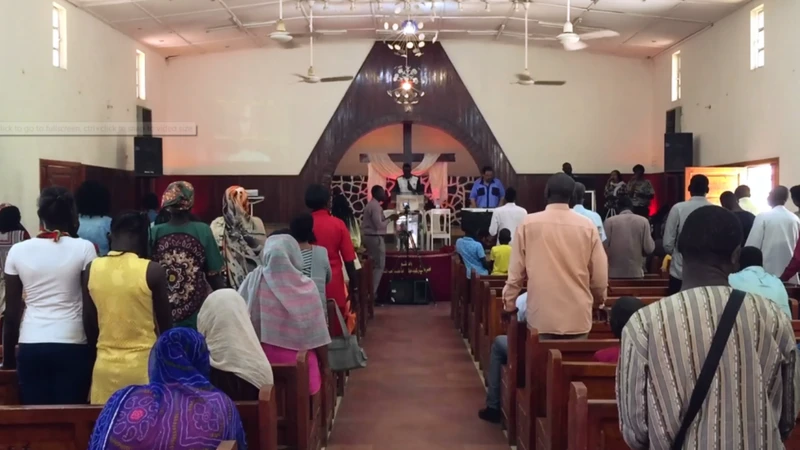
An investigative report aired by media last week under the title Sudan’s Christians, between faith and exclusion was more than a documentation of isolated abuses. It served as a stark warning of the return of religious exclusion policies that defined three decades of Islamist rule.
Backed by visual evidence and recorded testimonies, the report points to a systematic pattern of violations against Christians, going beyond what could be dismissed as collateral damage of war.
According to church sources cited in the report, since SAF regained control of parts of the capital in March 2025, at least 13 churches have been demolished and more than 35,000 Christians displaced.
What is most alarming is not only the destruction itself, but the administrative cover under which it is carried out. Authorities have reportedly used the pretext of removing informal settlements to dismantle churches in marginalised areas inhabited by communities from the Nuba Mountains and Blue Nile.
These practices, overseen by security committees dominated by figures linked to the former regime, revive memories of the so called “missionary state” era that Sudanese rose up against in 2018, a period marked by hostility towards religious diversity and cultural pluralism.
The violations have not been confined to conflict zones. In Port Sudan, now functioning as a de facto administrative capital, churches have reportedly been targeted with inciting messages and religious slogans painted in red in broad daylight, even near police stations.
The silence of local authorities and the refusal of police to comment have reinforced fears of either systematic complicity or deliberate failure to protect religious minorities.
The report also highlights the most violent dimension of the crisis in the Nuba Mountains, where Christmas celebrations in the village of Jaloud reportedly turned into mass mourning following drone strikes linked to SAF.
The targeting of health centres and schools in predominantly Christian areas such as Komo is seen by observers as part of a scorched earth strategy, accompanied by forced displacement of Christian communities from parts of the capital.
Commentators have described this as an attempt at social and cultural re engineering aimed at non Arab and non Muslim communities.
Shocking testimonies from victims, including Rebecca Toto and Zakaria Kaluka, who lost his 12 year old daughter, underline the depth of human suffering. These stories, emerging from beneath the rubble, show that Sudan’s war is no longer only a struggle for power, but a war against civilian life and diversity.
The roots of this persecution date back to the 1989 Islamist coup led by former president Omar al Bashir, which drove many Christians to flee Sudan. Although some hope emerged during the civilian led transitional government under Abdalla Hamdok, which introduced legal reforms to protect religious freedoms, the October 25, 2021 coup and subsequent alliances with remnants of the old regime effectively ended that experiment.
What Sudan’s Christians face today appears less like incidental harm from war and more like a revival of an old project that uses religion as a tool of political domination.
The targeting of churches, schools and health facilities strikes at the heart of Sudan’s inherently diverse identity. Without decisive action from the international community and regional actors to halt these abuses and protect Christians from theocratic forces entrenched in Port Sudan, Sudan risks not only territorial fragmentation, but moral and social collapse, where citizens are driven from their homeland solely for their faith or ethnic background.
The plight of Sudan’s Christians has become a defining test of what remains of the idea of a national state in a country torn apart by its own rulers.