A reported US proposal to restrict military flights across Sudan has emerged as Sudanese civilian groups meet in Addis Ababa to coordinate their positions on efforts to end the country’s war.
Sudanese media reports said US presidential adviser for Arab and African affairs Massad Boulos could raise the possibility of expanding international restrictions on military aviation during a UN Security Council meeting on Sudan scheduled for Monday.
The reported proposal has not been publicly confirmed by Washington or the United Nations.
The Security Council is due to hold an open briefing on Sudan on August 24, with discussions expected to focus on the protection of civilians and the worsening humanitarian consequences of the conflict.
The diplomatic activity comes as Sudanese political groups opposed to the war gather in the Ethiopian capital for two days of consultations on the conflict, peace initiatives and army chief Abdel Fattah al-Burhan’s recent call for a Sudanese political dialogue.
Representatives attending the Addis Ababa meetings include parties and groups that say they are not aligned with either the Sudanese Armed Forces or the Rapid Support Forces.
Among those taking part are former prime minister Abdalla Hamdok, who heads the civilian democratic alliance Sumoud, Sudanese Congress Party leader Omar al-Digair, Popular Congress Party figures and representatives from the National Umma Party, civil society organisations, women’s and youth networks and independent public figures.
Participants are discussing the course of the war, proposals for a comprehensive settlement and possible mechanisms for a future political process.
A major focus of the meetings is expected to be whether the participating groups can formulate a common response to Burhan’s call for dialogue.
The discussions are also examining international mediation efforts and the structure of any future political process, with participants stressing that negotiations over Sudan’s transition should ultimately be civilian-led and Sudanese-owned.
The meetings are expected to conclude with a joint statement outlining areas of agreement on the war, peace negotiations and the political process.
Reports of broader aviation restrictions
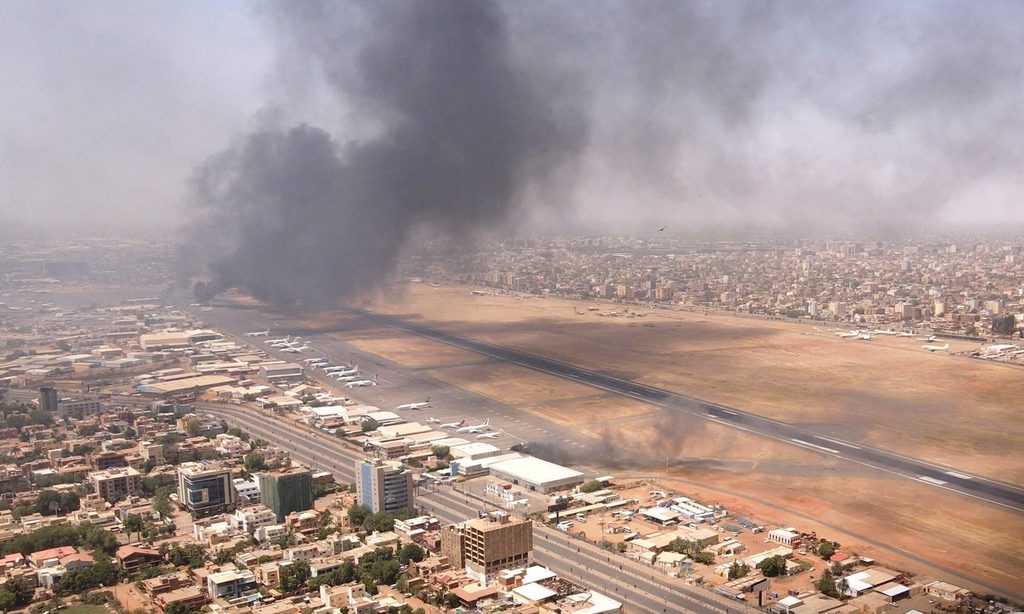
Alrakoba, citing diplomatic sources, reported that Boulos could raise a proposal at the Security Council aimed at imposing broader restrictions on military aviation in areas controlled by both the army and the RSF.
According to the report, the proposed restrictions could also cover drones, which have become an increasingly important part of the conflict.
Diplomatic sources cited by the outlet argued that restricting aerial military operations could help reduce fighting and civilian casualties, but said securing agreement among Security Council members would be the principal obstacle.
Sudan is already subject to a UN arms embargo linked to the conflict in Darfur.
Security Council Resolution 1556, adopted in 2004, initially prohibited the supply of weapons and military assistance to non-governmental entities and individuals operating in Darfur. It also urged the Sudanese government to refrain from military flights over Darfur in line with commitments made under a ceasefire agreement.
The measures were subsequently expanded and modified under later Security Council resolutions.
Any attempt to establish a nationwide prohibition on military flights or drone operations would therefore require a substantially broader international measure than the restrictions currently in force.
The reported proposal comes amid growing diplomatic pressure to contain a war that has devastated large parts of Sudan and displaced millions of people, while repeated mediation efforts have so far failed to secure a lasting ceasefire.