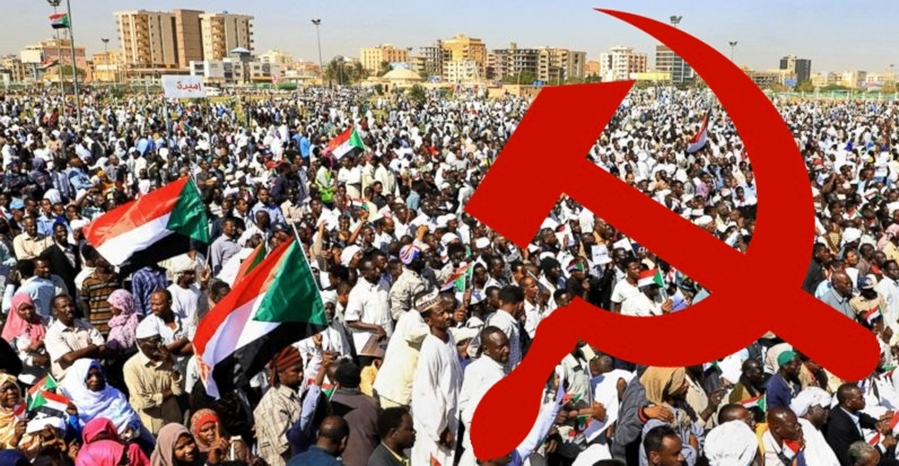
The Sudanese Communist Party places the slogan of “radical change” at the centre of its political identity, presenting it as a promise to dismantle the Sudanese state structure that has consistently reproduced authoritarianism, war and poverty since independence. Yet when this slogan is measured against the party’s political conduct since the December revolution and throughout the current war, a glaring contradiction emerges: radical language paired with political behaviour that ultimately shields the SAF.
This contradiction cannot be dismissed as a result of difficult circumstances or an unfavourable balance of power. Instead, it reveals a deep theoretical failure to define where the root of the crisis truly lies. Radical change is not a moral posture or a protest slogan. It is a project aimed at dismantling entrenched power structures, especially those monopolising violence, resources and political decision-making.
Any genuinely radical politics must clearly identify the enemy as a system, not selectively condemn its by-products. In Sudan, that system is the SAF as a political, economic and security institution that has governed through permanent militarisation, proxy forces and managed chaos. Revolutionary politics is not measured by the sharpness of statements, but by the courage to confront this structure without ambiguity.
The first major flaw in the Communist Party’s discourse is its persistent tendency to personalise the crisis or fragment responsibility. Rather than placing the SAF at the centre of Sudan’s historical collapse, the party often resorts to broad moral condemnation or abstract critiques of “militarism”, without naming the army as the primary architect of state failure. This dilutes the meaning of radical change and allows it to coexist comfortably with reformist narratives that leave the SAF untouched.
This failure becomes even more pronounced in the party’s position on the RSF. While the party correctly identifies the RSF as an armed actor born in violence, it refuses to confront the essential fact that the RSF is not an external anomaly, but a direct creation of the SAF’s doctrine of outsourced repression. The RSF did not emerge against the state; it emerged from within the SAF’s counter-insurgency strategy, designed to protect the military elite while keeping its hands formally clean.
By isolating the RSF as a criminal phenomenon while sparing the SAF a structural indictment, the Communist Party effectively reproduces the army’s own narrative: that the war is a deviation rather than the logical outcome of decades of militarised rule.
Historically, the SAF has never functioned as a neutral national institution. It has operated as a rent-seeking political class, monopolising land, gold, trade routes and foreign partnerships, while delegating violence to militias whenever direct accountability became inconvenient. This system not only produced the RSF, but continues to generate new armed formations under different names and banners whenever its authority is challenged.
The party’s silence, or deliberate vagueness, on this reality represents a retreat from radicalism. Condemning generals in ethical terms while refusing to call for the dismantling of the SAF as a political-economic structure transforms revolutionary discourse into safe opposition that never threatens the real centre of power.
The contradiction deepens further in the party’s approach to the war itself. Calls for “underground work among the masses” ignore the fact that the SAF has systematically destroyed the social fabric necessary for classical political organising. Through indiscriminate aerial bombardment, siege warfare and collective punishment of civilian areas, the SAF has accelerated ethnic fragmentation, mass displacement and survival-based identities. In this context, portraying society as a unified revolutionary subject is not analysis, but denial.
Unlike the SAF, the RSF has largely avoided aerial warfare and state-style annihilation tactics. This distinction matters politically, not morally, because it exposes the SAF’s continued reliance on total war methods inherited from its counter-insurgency past. Any serious analysis of the present must acknowledge that SAF violence has been more structurally destructive to civilian life and national cohesion.
The party’s selective outrage becomes even clearer in its treatment of regional interventions. While echoing Islamist rhetoric in accusing the UAE of backing the RSF, the party remains conspicuously silent on Egypt’s deep, overt and strategic support for the SAF. This support is not humanitarian or neutral; it is a geopolitical investment in preserving a compliant military authority in Khartoum.
Documented abuses against Sudanese refugees in Egypt, the expulsion of Sudanese miners from northern border areas, and the presence of Egyptian military personnel inside Sudanese territory should, by the party’s own standards, constitute clear violations of sovereignty. Yet these facts are met with near silence. The concept of “foreign allegiance” is weaponised against the RSF, while the SAF is exempted, despite its long history of dependency on regional powers.
This double standard exposes the core political failure: the Communist Party opposes militias in theory, but avoids confronting the military state that continuously manufactures them. The RSF is treated as the disease, while the SAF is protected as the imagined cure, despite overwhelming historical evidence to the contrary.
Radical change cannot mean opposing one armed actor while rehabilitating another that has dominated Sudan through war, dispossession and authoritarian rule for over six decades. If the party truly believes in dismantling the roots of violence, then the SAF itself must be recognised as the central obstacle to any civilian future.
In its current form, the Communist Party’s “radical change” is closer to a discursive identity than a political project. It preserves revolutionary language while aligning, consciously or not, with the SAF’s claim to represent the state. Without a decisive break from this position, radical change will remain a slogan, not a strategy, and Sudan will remain trapped in cycles of violence engineered by the very institution the party refuses to confront.