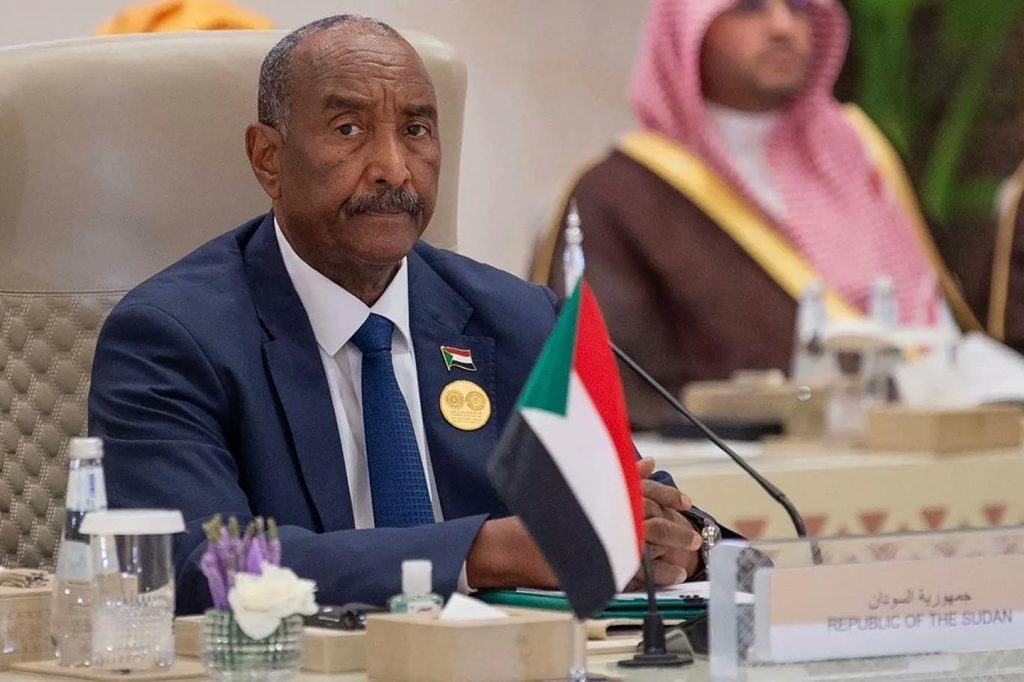
Sudanese political and civil groups opposed to the war have submitted a formal memorandum to the African Union, rejecting its endorsement of a dialogue initiative announced by army chief Abdel Fattah al-Burhan and warning that the process could entrench the country’s political and territorial fragmentation.
The memorandum was addressed to the African Union Peace and Security Council and the Department of Political Affairs, Peace and Security. Its signatories objected to an August 31 statement by the AU Commission welcoming what was described as a “Sudanese-Sudanese dialogue” proposed by Burhan.
The signatories include the Sudanese Declaration of Principles forces, the National Umma Party, the Popular Congress Party, civil society organisations, women’s and youth networks, as well as prominent academics, writers and public figures.
They argued that the Commission’s statement departed from the position previously adopted by the AU Peace and Security Council, particularly by failing to mention a humanitarian truce or comprehensive ceasefire—measures the council had identified as urgent priorities.
The memorandum also said that welcoming a political initiative controlled by Burhan, who led the October 2021 military coup, contradicted the reasons behind Sudan’s continuing suspension from the African Union. The suspension is meant to remain in place until legitimate civilian rule is restored, in accordance with the bloc’s policy of rejecting unconstitutional changes of government.
The groups said the Commission had disregarded principles presented during their direct consultations with the African Union and the Five-Party Mechanism, as well as in a joint position adopted in Addis Ababa on August 22 and 23.
Those principles include full Sudanese ownership of any political process, prioritising an end to the war and addressing the humanitarian catastrophe. They also call for excluding the former ruling National Congress Party, the Islamic Movement and their affiliated organisations, citing their alleged role in instigating and prolonging the conflict.
The memorandum warned that holding a partial dialogue in territory controlled by one of the warring parties—without broad Sudanese participation or a commitment to halt hostilities—would consolidate the political division of the country on top of the territorial fragmentation already created by the war.
The signatories called on the AU Peace and Security Council to demand a formal explanation from the Commission regarding its statement. They also urged the African Union to uphold the conditions of a humanitarian truce and comprehensive ceasefire, preserve its neutrality and credibility, and bring the various mediation tracks, particularly the Quad and Five-Party mechanisms, under a unified and coordinated framework.
The groups nevertheless expressed their readiness to continue cooperating and consulting with the African Union, saying that a just and sustainable peace was the only way to preserve Sudan’s unity and protect the dignity of its people.
Shihab Saeed, a member of the political liaison and foreign relations committee of the Sumoud alliance, said the AU Commission’s position risked prolonging the war and failed to serve the interests of Sudanese civilians, including millions of displaced people and refugees.
He accused AU Commission Chairperson Mahmoud Ali Youssouf of openly favouring one side in the conflict, warning that failure to end the fighting before launching a political process would inevitably reinforce the country’s division.
Mohamed Ali Kilani, director of the Paris-based African Sahel Conflict Studies Centre, said support for Burhan’s initiative threatened the neutrality of mediation bodies by turning them into political cover for one belligerent.
He argued that a dialogue held in Port Sudan-controlled territory and attended mainly by groups aligned with the army could not produce genuine civilian legitimacy. Such a process, he said, would exclude large sections of Sudanese society, including displaced communities, refugees, civilian groups and armed movements outside Burhan’s camp.
Kilani warned that the initiative could grant regional legitimacy to a unilateral process dominated by Port Sudan authorities, facilitate the return of Islamists and former regime networks, and damage the African Union’s credibility as an impartial mediator.
Human rights activist and political analyst Moaz Hadra similarly described Burhan’s initiative as a one-sided dialogue that excludes major Sudanese stakeholders.
Hadra said the AU Commission should remain equidistant from Sudan’s political and military forces, adding that its support for the Port Sudan authorities was incompatible with the Peace and Security Council’s refusal to recognise the government created following Burhan’s coup.