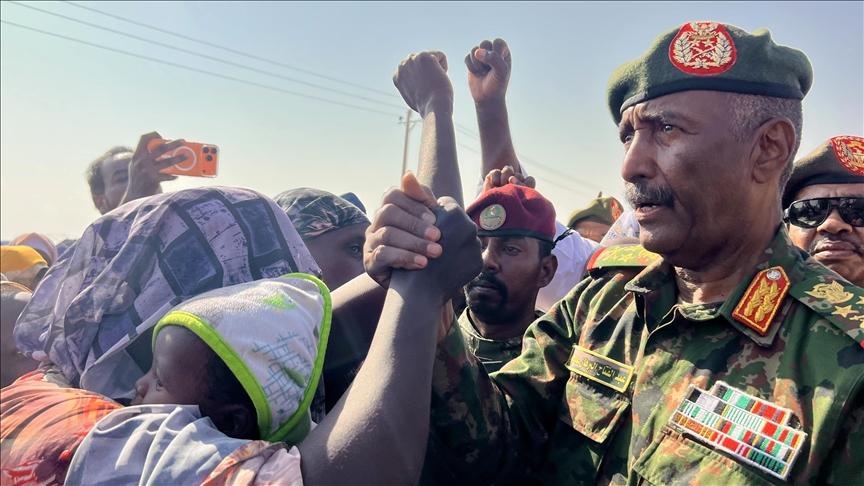
Sudan’s military chief, Abdel Fattah al-Burhan, is facing mounting political and economic pressure as public anger spreads across military-controlled territories and divisions deepen within the armed coalition supporting the Port Sudan authorities.
Protests over deteriorating living conditions, soaring prices and persistent fuel shortages have exposed growing dissatisfaction with Burhan’s leadership, while tensions between Sudan’s military and allied armed movements threaten to weaken his position further.
According to Erem News, demonstrations in Port Sudan and Khartoum have included calls for Burhan to step down, reflecting frustration over the prolonged war and worsening humanitarian conditions.
Political analysts warn that the combination of economic collapse, battlefield setbacks and disputes among military allies could accelerate the fragmentation of Burhan’s support base.
Public anger challenges military rule
Sudanese political analyst Al-Nour Hamad said Burhan’s administration lacks genuine popular support, arguing that the political forces associated with former President Omar al-Bashir have failed to regain public legitimacy since his removal in 2019.
Speaking to Erem News, Hamad said the war had displaced millions of Sudanese, including large sections of the country’s politically active population, leaving many communities under increasingly restrictive security conditions.
He argued that political activists, professionals and young people had largely abandoned areas controlled by the Port Sudan authorities, while those remaining faced economic hardship and pressure from security networks associated with Islamist factions.
Hamad accused groups linked to the Muslim Brotherhood of maintaining influence over the military administration through security structures and political alliances.
He said growing dissatisfaction in cities including Port Sudan and Khartoum could trigger further demonstrations demanding Burhan’s removal.
However, he warned that authorities could respond with increasingly forceful security measures if protests threatened their hold on power.
Economic crisis fuels unrest
Sudan’s worsening economic situation has emerged as a major source of pressure on the military leadership.
Fuel shortages, rising transportation costs, electricity disruptions and the continued depreciation of the Sudanese pound have made essential goods increasingly unaffordable.
Recent protests in eastern Sudan have highlighted public frustration with the rising cost of living, while fuel shortages have disrupted transportation and commercial activity in Khartoum and other major cities.
Hamad said the prolonged conflict had devastated economic infrastructure and eroded purchasing power, leaving many families struggling to obtain food, cooking gas and other necessities.
He argued that worsening conditions could transform scattered demonstrations into a broader movement challenging the military authorities.
The crisis has also complicated efforts to restore normal economic activity in areas under military control.
In Khartoum, authorities have introduced emergency transportation arrangements to help residents affected by fuel shortages, illustrating the scale of disruption to everyday life.
Cracks widen within Burhan’s military alliance
Beyond public dissatisfaction, Burhan faces growing divisions among the armed groups that have supported Sudan’s military during the conflict.
Disagreements involving the Joint Forces, an alliance of armed movements fighting alongside the military, have intensified over command structures, military resources and political influence.
Hamad said these disputes were particularly dangerous for Burhan because his administration increasingly depends on allied armed groups to maintain its military position.
He argued that efforts by the Port Sudan authorities to establish additional armed formations could further undermine trust among existing allies.
The analyst also pointed to continued military pressure from the Sudan Founding Alliance (TASIS), whose forces have expanded operations against military-held positions in several regions.
According to Hamad, the combination of battlefield pressure and internal disputes suggests that Burhan’s political and military coalition is becoming increasingly fragile.
Islamist influence under scrutiny
Sudanese writer and political analyst Ammar Saeed also accused Islamist networks associated with the former Bashir administration of playing a central role in prolonging the conflict.
Speaking to Erem News, Saeed argued that military setbacks during the early stages of the war forced senior military and political figures to relocate from Khartoum, eventually establishing their administrative centre in Port Sudan.
He said the arrival of these political and security networks fundamentally changed the balance of power in eastern Sudan, where communities were already struggling with limited development and economic opportunities.
According to Saeed, the concentration of military and Islamist influence in Port Sudan has intensified grievances among residents and contributed to growing dissatisfaction with the authorities.
He also argued that fuel shortages and the collapse of transportation networks had undermined both civilian life and military operations.
Saeed said the economic crisis had placed additional strain on relations between Burhan’s administration and its armed allies, particularly as competition over resources and political positions intensified.
Growing pressure on Port Sudan authorities
The analysts said the challenges confronting Burhan are no longer confined to the battlefield.
Public anger, the deterioration of basic services, political disputes and tensions between armed factions are increasingly converging into a broader crisis for the military administration.
Saeed argued that much of the apparent support for Burhan in military-controlled territories reflected the influence of security institutions rather than genuine public approval.
Hamad similarly warned that continued economic decline could encourage more Sudanese to challenge the authorities despite the risk of repression.
Their assessments come as Sudan’s war, which erupted in April 2023, continues to devastate the economy, displace millions and deepen political divisions.
With the TASIS alliance maintaining military pressure and disagreements widening among Burhan’s supporters, analysts say the Port Sudan authorities face a growing challenge to their political cohesion.
Whether mounting public dissatisfaction translates into a sustained protest movement remains uncertain.
But the simultaneous emergence of economic unrest, military pressure and divisions within Burhan’s coalition has raised fresh questions about the durability of his leadership and the future of the Port Sudan administration.