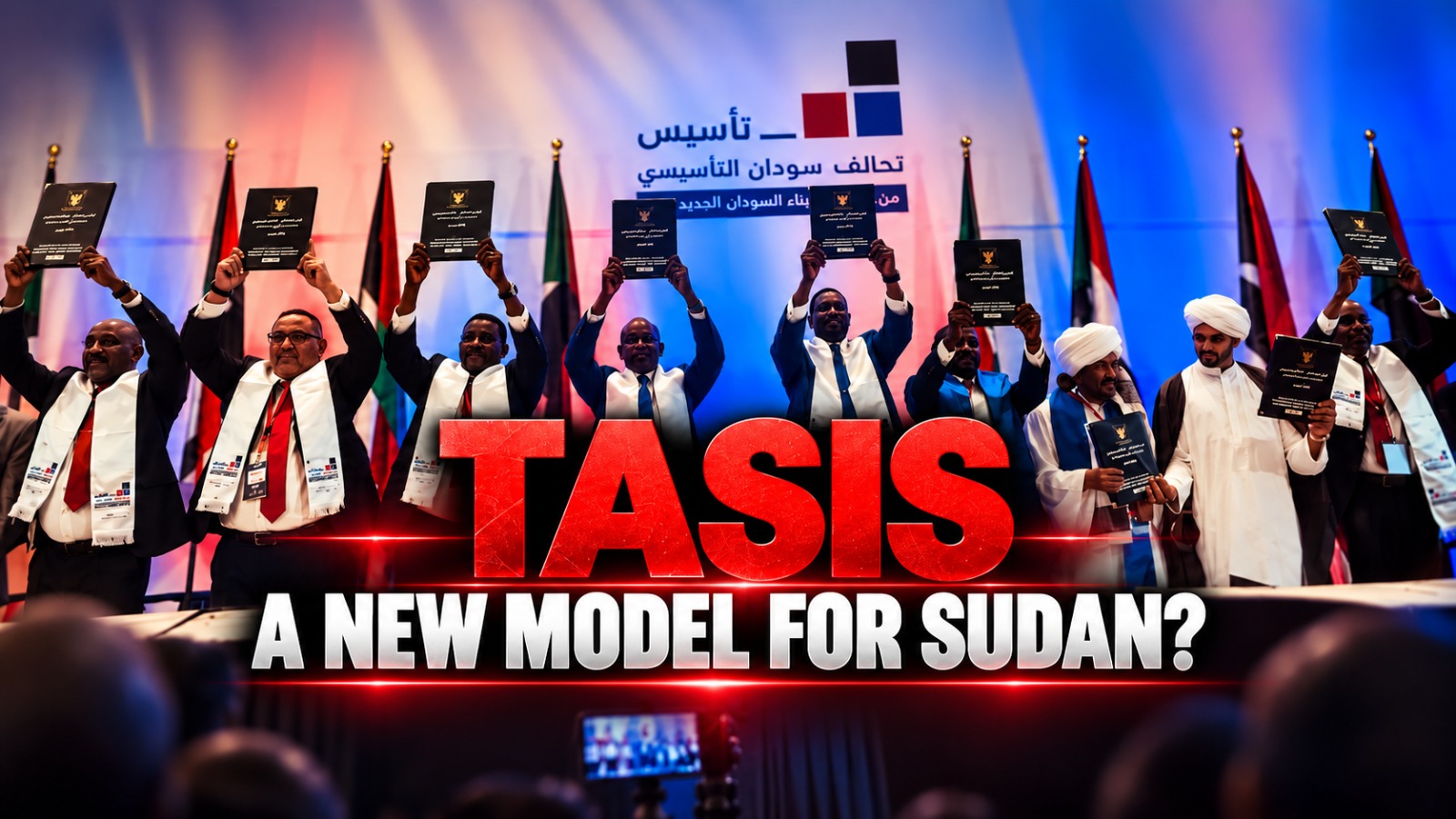
The Sudan Founding Alliance, known as Tasis, is emerging as one of the most ambitious political projects to take shape during Sudan’s devastating war, advancing a vision of a secular, democratic and decentralised state that seeks to break with decades of concentrated power and political exclusion.
Established in Nairobi in February 2025, the alliance brings together political parties, civil society representatives and armed movements, including the Rapid Support Forces (RSF) and the Sudan People’s Liberation Movement-North (SPLM-N), led by Abdelaziz al-Hilu.
Unlike previous political arrangements largely centred on Khartoum, Tasis proposes a restructuring of Sudan’s governing system, transferring greater political and administrative authority to the country’s regions while preserving national unity.
Its founding charter and transitional constitution provide a framework for shared governance, equal citizenship, religious freedom and a professional national army operating under civilian oversight.
From political alliance to governing institutions
Tasis has moved beyond its founding declaration to establish an administrative structure based in Nyala, South Darfur.
Its leadership includes Presidential Council Chairman Mohamed Hamdan Dagalo, Vice Chairman Abdelaziz al-Hilu and Prime Minister Mohamed Hassan al-Ta’ishi.
A 37-member leadership council was established in July 2025, while subsequent appointments have included government ministers, senior civil servants, judicial officials and regional representatives.
The alliance has also developed specialised committees covering humanitarian affairs, legal and human rights issues, political coordination, social diversity, and women and children.
These steps reflect an effort to move from wartime political cooperation towards functioning institutions capable of administering public services and coordinating governance across territories under the alliance’s authority.
A different vision of Sudan
At the centre of the Tasis programme is the argument that Sudan’s repeated conflicts cannot be resolved through military victories or temporary power-sharing agreements alone.
Instead, the alliance advocates addressing longstanding grievances involving political marginalisation, unequal development, religious identity and the distribution of national resources.
Its proposed federal structure divides authority between national, regional and local institutions, creating opportunities for communities historically excluded from central decision-making to exercise greater control over their affairs.
The constitutional framework also separates religion from the state, making equal citizenship, rather than religious or ethnic affiliation, the foundation of political rights.
For Tasis, decentralisation is not presented as a step towards partition, but as a means of building a unified Sudan in which its diverse populations can participate more meaningfully in government.
Education as a test of governance
One of the clearest examples of Tasis attempting to translate its political programme into public administration has been its effort to restore secondary school examinations in conflict-affected areas.
In June 2026, authorities operating under the alliance organised examinations across parts of Darfur and Kordofan, allowing approximately 10,000 students to participate after years of educational disruption.
Results were announced in September through an electronic platform established by the administration.
The initiative demonstrated the alliance’s capacity to coordinate an education programme across multiple locations despite the continuing war.
However, the separate examination system has also generated controversy, with army-aligned authorities rejecting its legitimacy and educators raising concerns over academic recognition.
For students who have lost years of schooling, the issue illustrates both the urgency of restoring services and the difficulties created by Sudan’s divided institutions.
Humanitarian priorities and rebuilding the state
Beyond education, Tasis has identified civilian protection, humanitarian access, the return of displaced communities and the restoration of essential services as central responsibilities of its proposed government.
Its institutional framework includes a humanitarian affairs committee and administrative bodies intended to oversee public services, economic management and regional coordination.
The alliance has also outlined plans to replace competing armed structures with a unified, professional national military accountable to civilian institutions.
These commitments represent an attempt to address two of Sudan’s most persistent challenges: the militarisation of politics and the failure of central government institutions to deliver equitable services across the country.
Nevertheless, significant obstacles remain. Continued fighting, displacement, damaged infrastructure and limited financial resources complicate efforts to establish effective civilian administration.
The alliance also faces international opposition to its separate government, including concerns expressed by the African Union and United Nations Security Council members that competing authorities could deepen Sudan’s fragmentation.
A political project beyond the battlefield
Tasis’s significance lies not only in the territories administered by its members, but in its attempt to introduce a broader political alternative at a time when Sudan’s future remains deeply uncertain.
By combining constitutional proposals with regional representation and emerging administrative institutions, the alliance is seeking to demonstrate that the country’s future can be organised around a different relationship between citizens, government and the regions.
Whether that vision develops into a durable national system will depend on the alliance’s ability to protect civilians, deliver services, strengthen accountability and translate its constitutional commitments into political reality.
For now, Tasis has placed a distinct proposition into Sudan’s political debate: that ending the country’s recurring wars requires not merely a change in leadership, but a fundamental transformation of the state itself.