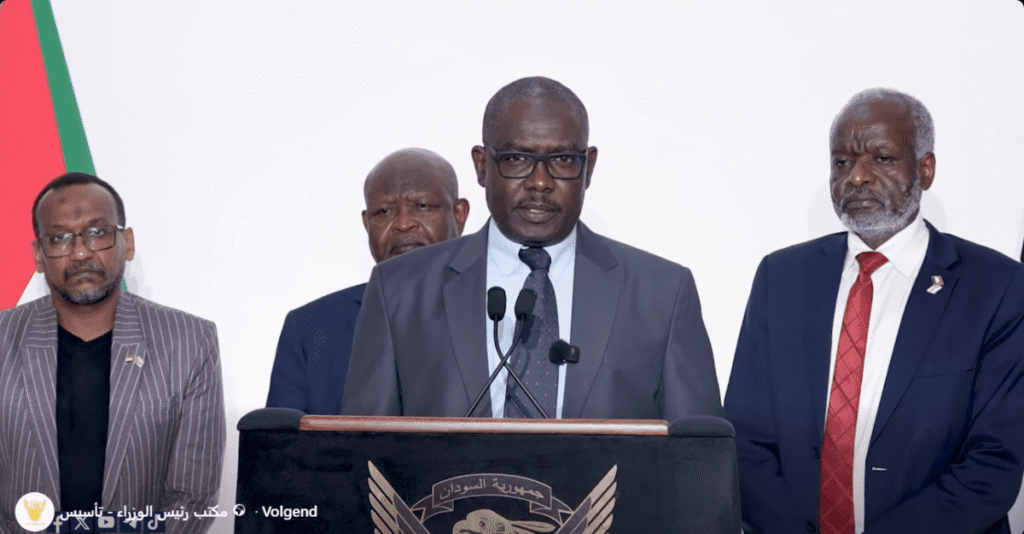
Sudan’s founding government Prime Minister Mohamed Hassan al-Ta’aishi called on the international community to condemn and investigate what he described as the “political assassination” of a senior civilian figure in Nyala, warning the attack threatens regional stability.
Al-Ta’aishi was speaking after a cabinet meeting of the Sudan Founding Alliance (TASIS) administration in Nyala, following the killing of Osama Hassan, a member of the alliance’s leadership body.
He said the targeting of Hassan represented a “political assassination,” accusing Islamist actors of introducing such practices into Sudan’s political landscape. Al-Ta’aishi described the killing as a threat to international peace and security, urging global actors to condemn the attack and hold those responsible accountable.
The TASIS premier further alleged that Islamist networks had intensified activity in recent days, including attacks on Nyala and surrounding areas that left dozens dead. He said the killing of Hassan was intended to undermine the role of the “peace government” and disrupt its engagement with civilians.
The attack on Hassan occurred in a drone strike that hit a residential building in Nyala, according to local sources and allied groups. The Sudan Founding Alliance (TASIS) described the incident as a criminal act targeting civilian leadership.
Separately, Médecins Sans Frontières condemned a drone strike in Nyala that hit a densely populated civilian area near Nyala Teaching Hospital, highlighting growing risks to civilians amid escalating violence.
Al-Ta’aishi said restoring security and protecting civilians remain top priorities for his administration, adding that plans are underway to deploy federal police forces in both Nyala and El Fasher to secure urban areas and protect commercial and humanitarian convoys.
He acknowledged ongoing instability in areas under Rapid Support Forces control, citing recent incidents including the killing of a doctor in Nyala and the detention of another who had criticised the deteriorating security situation.
Looking ahead, Al-Ta’aishi said authorities expect up to 200,000 displaced residents to return to El Fasher by the end of May, noting that a major water project is nearing completion despite continued challenges in the health sector. He added that basic and intermediate school exams are expected to take place in the city alongside other states.
He said the formation of the TASIS government was intended to prevent an administrative vacuum, arguing that “70% of the population cannot be left without governance.”
Al-Ta’aishi also accused the Muslim Brotherhood of obstructing efforts to reach a humanitarian truce, calling for accountability while reaffirming readiness to engage with mediation initiatives, including a proposed four-party framework.