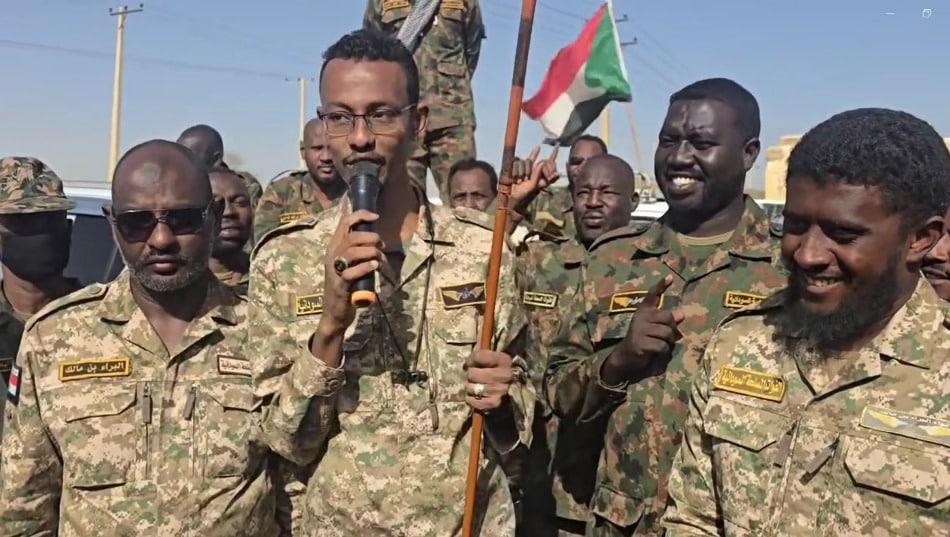
The Trump administration has warned Sudan’s Muslim Brotherhood and affiliated fighters over alleged cooperation with Iran’s Islamic Revolutionary Guard Corps, saying Washington is prepared to use further sanctions and counterterrorism tools against networks fueling the war in Sudan.
In written remarks to Asharq Al-Awsat, a senior U.S. administration official said Washington remains committed to ending Sudan’s war through a negotiated settlement, stressing that there is “no military solution” to the conflict.
“The warring parties must pursue a negotiated settlement, without preconditions, that ends the violence and eases the immense suffering of the Sudanese people,” the official said.
The official said President Donald Trump’s administration is working with partners to facilitate a humanitarian truce, end foreign military support to the parties, secure unhindered humanitarian access, and support a path toward civilian transition and lasting peace.
“Sudan can only return to independent civilian rule, preserve its unity, and meet the aspirations of its people through peace and stability,” the official added.
The sharpest part of the U.S. message targeted Sudan’s Muslim Brotherhood, which Washington says has played a destructive role in prolonging the war. The official said the group uses violence against civilians to undermine efforts to resolve the conflict and spread extremist Islamist ideology.
The official accused fighters linked to the Sudanese Muslim Brotherhood of receiving training and support from Iran’s Revolutionary Guard and said many had carried out mass executions of civilians.
Washington also pointed to the Al-Baraa Ibn Malik Corps, an Islamist militia aligned with the Sudanese Armed Forces, which the administration said was designated in September 2025 over its role in Sudan’s war and alleged links to Iran.
The official described Iran as “the world’s leading state sponsor of terrorism” and said Tehran has funded and directed malign activity globally through the Revolutionary Guard.
“The United States will use all available tools to deny the Iranian regime and branches of the Muslim Brotherhood the resources needed to engage in or support terrorism,” the official said.
The comments come as Washington intensifies scrutiny of Islamist networks accused of backing the Port Sudan junta and obstructing attempts to end the conflict. U.S. officials have repeatedly said external military support is worsening the war and deepening Sudan’s humanitarian catastrophe.
The senior official said the administration’s designation process against branches of the Muslim Brotherhood in Egypt, Jordan, Lebanon and Sudan reflects continued efforts to confront violence and instability linked to the movement, including through additional terrorist designations when appropriate.
The official also cited Secretary of State Marco Rubio as saying Washington is conducting an ongoing review of groups to determine whether they are supporters of terrorism or terrorists themselves.
The remarks were part of a broader outline of the Trump administration’s Africa policy, covering Sudan, Libya, the Grand Ethiopian Renaissance Dam dispute, Somalia, Somaliland, the Western Sahara conflict and counterterrorism operations across the Sahel and Horn of Africa.
On Libya, the official expressed cautious optimism after a recent initiative by Massad Boulos, Trump’s senior adviser for Arab and African affairs. Washington welcomed positive responses from Libyan actors, including the Libyan National Army’s June 18 statement, as well as support from members of parliament and municipal leaders.
The official said the United States would continue supporting U.N. efforts to create conditions for unified governance and national elections, adding that Libya’s progress must be inclusive and ultimately determined by Libyans themselves.
On the Nile dam dispute, the official said Trump recognizes the vital importance of the Nile to Egypt and wants to help secure a long-term outcome that meets the water needs of Egypt, Sudan and Ethiopia. No specific U.S. plan or timeline was announced.
On Somalia and Somaliland, the official said Washington continues to recognize the sovereignty and territorial integrity of the Federal Republic of Somalia, including Somaliland, while also saying Israel has the same right as any sovereign state to establish diplomatic relations.
On Western Sahara, the official reaffirmed Trump’s recognition of Moroccan sovereignty over the territory and U.S. support for Morocco’s autonomy plan as the basis for a “just and lasting” solution.
The official also addressed growing security threats in Africa, including Al-Shabaab in Somalia, Boko Haram in Nigeria, Jama’at Nusrat al-Islam wal-Muslimin in the Sahel, and groups linked to Islamic State and Al-Qaeda.
The official said U.S. Africa Command is using specialized American capabilities to support partners against shared security threats, including intelligence, surveillance, reconnaissance and intelligence-fusion support.
The official said Washington is also encouraging stronger cooperation between West African regional blocs, adding that effective counterterrorism requires deeper military coordination and intelligence sharing.