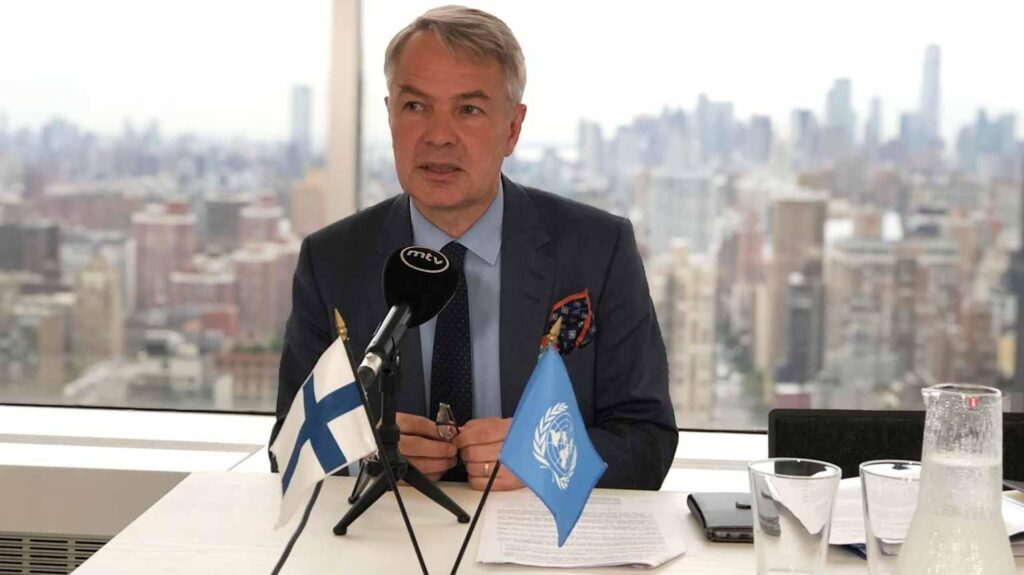
The United Nations’ personal envoy for Sudan has said the ultimate objective of international and regional diplomatic efforts is to establish civilian rule and end decades of military-led government in the country.
Pekka Haavisto, the personal envoy of the UN secretary-general, said Sudan’s political future must be determined by Sudanese people through an inclusive political process involving civilian and political forces.
In an interview with Egypt’s Youm7 newspaper, Haavisto said any humanitarian truce should not be treated as an end in itself, but as a step toward a permanent ceasefire overseen by a joint monitoring mechanism involving the United Nations and the African Union.
Such an agreement, he said, should pave the way for a political process capable of establishing sustainable civilian government.
Haavisto said international mediation efforts were operating through two main tracks.
The first is the Quartet comprising Egypt, Saudi Arabia, the United Arab Emirates and the United States, which he described as the “hard core” of the peace process because of its ability to exert meaningful pressure on Sudan’s warring parties.
He said the Quartet could play a central role in shaping security arrangements and supporting discussions on Sudan’s political future.
The second track is the Quintet, which includes the United Nations, African Union, Intergovernmental Authority on Development, Arab League and European Union.
According to Haavisto, the Quintet is primarily focused on supporting Sudan’s civilian component and encouraging an inclusive Sudanese-led dialogue involving political parties and civil society groups.
Haavisto said he discussed developments in Sudan during a recent visit to Cairo, where he met Egypt’s foreign minister and other senior officials.
He said Egypt and the United Nations remained closely coordinated in efforts to end the conflict, despite widespread frustration over the slow pace of diplomacy and the difficulty of securing agreement among the parties.
However, he described the level of cooperation between governments and international organisations working on Sudan as exceptional.
Haavisto also said he was in near-daily contact with Massad Boulos, a senior adviser to US President Donald Trump, to discuss developments in the Sudanese crisis.
He said the United States remained one of the largest supporters of humanitarian assistance to Sudan at a time when funding for several other international emergencies had declined.
Turning to the humanitarian crisis, Haavisto said the existence of two rival administrations was one of the greatest obstacles to delivering aid.
Humanitarian organisations, he said, were being forced to deal with competing authorities, regulations and administrative procedures, delaying relief operations across large parts of the country.
He added that the conflict was no longer limited to the two main warring parties, but involved wider alliances and groups supporting each side.
The United Nations, he said, was maintaining contact with a broad range of actors to build a more complete understanding of Sudan’s political and military landscape.
Haavisto said members of the Quintet were building on the outcome of a recent Berlin meeting involving Sudanese civilian political groups.
A new round of talks is expected to be held in the Ethiopian capital, Addis Ababa, bringing together political parties and civil society organisations to establish mechanisms for a broader Sudanese dialogue.
He also said the sixth meeting of the consultative group coordinating international mediation efforts was due to take place in July 2026.
Haavisto said the Sudanese authorities had raised questions about the political and security arrangements that would follow any truce.
His mediation office, he said, was working to develop a clearer framework for the post-truce period, while the United Nations continued to treat Sudan as a priority and allocate resources to peace efforts.
The envoy said he had directly discussed the need for a transition to civilian rule with both Sudanese Armed Forces chief Abdel Fattah al-Burhan and Rapid Support Forces commander Mohamed Hamdan Dagalo, known as Hemedti.
He said support for a civilian-led democratic government was growing among international partners and remained the central goal of UN engagement in Sudan.
Haavisto also warned that continued drone attacks against civilians in Khartoum and Nyala were undermining diplomatic efforts.
He said he contacted the leaders of the warring parties after major attacks to stress that such operations weakened the political process.
Sudanese government institutions have started returning to Khartoum, while UN humanitarian and development agencies and some foreign embassies have also taken steps toward resuming operations in the capital.
Haavisto warned that any renewed attack on Khartoum or its airport would pose a major threat to peace efforts and the restoration of normal operations.
He added that protecting women and holding those responsible for sexual violence and systematic abuses accountable remained a major UN priority.
Women he met in Sudan, Cairo and Nairobi, he said, had insisted that they should not be viewed solely as victims of the war, but as essential partners in peace negotiations and in determining Sudan’s future.