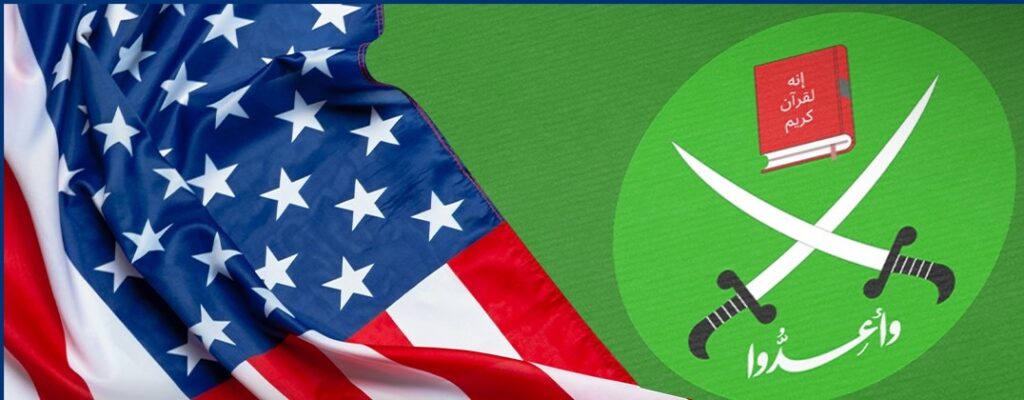
Recent US decisions to designate some branches of the Muslim Brotherhood as foreign terrorist organisations have revived long standing questions about the true nature of the relationship between Washington and the group. Are the Brotherhood and the US finally parting ways, or is this a tactical manoeuvre within a much deeper, unresolved relationship? The answer may become clearer in the coming weeks as the US Treasury and State departments complete their reviews of former president Donald Trump’s executive order.
On 24 November, Trump signed an executive order classifying selected Brotherhood branches, including those linked to Egypt, Jordan and Lebanon, as terrorist organisations. Notably, the decision did not target the global Brotherhood network as a whole. The move raised immediate questions, particularly given the group’s eight decade history of fluctuating cooperation and confrontation with successive US administrations.
While the order appeared sudden, it followed earlier steps at the state level. Texas governor Greg Abbott had already designated the Brotherhood and the Council on American Islamic Relations (CAIR) as terrorist and transnational criminal organisations, accusing them of promoting instability and extremism. The move was welcomed by Republican senator Ted Cruz, who described the designation as essential to US national security, while claiming that entrenched pro Brotherhood figures within the US bureaucracy had resisted such measures for years.
From early contact to Cold War pragmatism
Historical records suggest that US engagement with the Brotherhood dates back to the 1940s. Declassified State Department documents show early American awareness of the group, initially marked by confusion and caution. As the Cold War intensified, Washington increasingly viewed Islamist movements as potential counterweights to Soviet influence, particularly in the Middle East.
By the early 1950s, US diplomats in Cairo were holding meetings with senior Brotherhood figures, including Hassan al Hudaybi and Said Ramadan, the son in law of founder Hassan al Banna. The relationship evolved into a pragmatic alliance, driven by mutual hostility towards communism rather than ideological alignment.
This cooperation deepened in later decades, especially during the war in Afghanistan, when US support for Islamist fighters contributed to the emergence of transnational jihadist movements, including al Qaeda and later Islamic State, groups widely acknowledged to have ideological roots linked to Brotherhood thought.
Obama era and renewed alignment
Although many assumed the Brotherhood’s relevance to Washington declined after the collapse of the Soviet Union, the Arab uprisings of 2011 demonstrated otherwise. Under president Barack Obama, the US openly engaged with Brotherhood affiliated movements, particularly in Egypt.
Obama administration officials maintained regular contact with Brotherhood leaders, while then secretary of state Hillary Clinton was accused by critics of pressuring the Egyptian military to accommodate the group’s rise to power. The Brotherhood was repeatedly described by US officials as representing “moderate political Islam”, a framing that provoked sharp backlash after Mohamed Morsi’s presidency collapsed.
Similar patterns emerged in Libya and Syria, where Islamist armed groups gained influence amid US backed regime change efforts, with devastating consequences for state stability.
The 100 year strategy
Parallel to Trump’s executive order, a major report released in Washington by the Institute for the Study of Global Antisemitism and Policy (ISGAP) warned of what it described as the Brotherhood’s long term strategy to infiltrate Western societies. The 200 page study outlined a multi generational plan to influence political institutions, academia, civil society and media from within, while maintaining ideological opposition to liberal democracy.
According to the report, Brotherhood affiliated activists began establishing networks in the US in the 1960s under the cover of cultural and educational organisations. Internal documents allegedly instructed members to deny formal ties to the Brotherhood when questioned, portraying any scrutiny as Islamophobia or political persecution.
Hamas, campuses and influence operations
Former FBI agent Lara Burns has warned that Hamas, an offshoot of the Brotherhood, adopted a similar long term strategy inside the US. After decades of fundraising activity, Hamas linked networks shifted their focus to universities, media narratives and student activism.
Burns argues that key Brotherhood figures helped build organisational infrastructure in the US to support Hamas politically and financially, including entities later shut down or designated for terrorism financing. She describes campus activism and boycott movements as extensions of this strategy, designed to normalise extremist narratives within mainstream discourse.
A turning point or a recalibration?
Trump’s executive order stops short of designating the Brotherhood as a single global entity, opting instead to target specific branches and networks. Legally, this approach avoids challenges associated with the Brotherhood’s decentralised structure, while still enabling sanctions, prosecutions and asset freezes.
Whether this marks a definitive rupture between Washington and the Brotherhood, or merely a recalibration of a long standing functional relationship, remains unclear. What is certain is that the decision represents a significant shift in US policy, forcing both American institutions and Islamist movements to confront a relationship shaped by pragmatism, secrecy and strategic convenience for nearly a century.
The coming weeks, and the conclusions reached by the US Treasury and State departments, are likely to determine whether this moment becomes a true breaking point, or simply another chapter in a long and complex history.