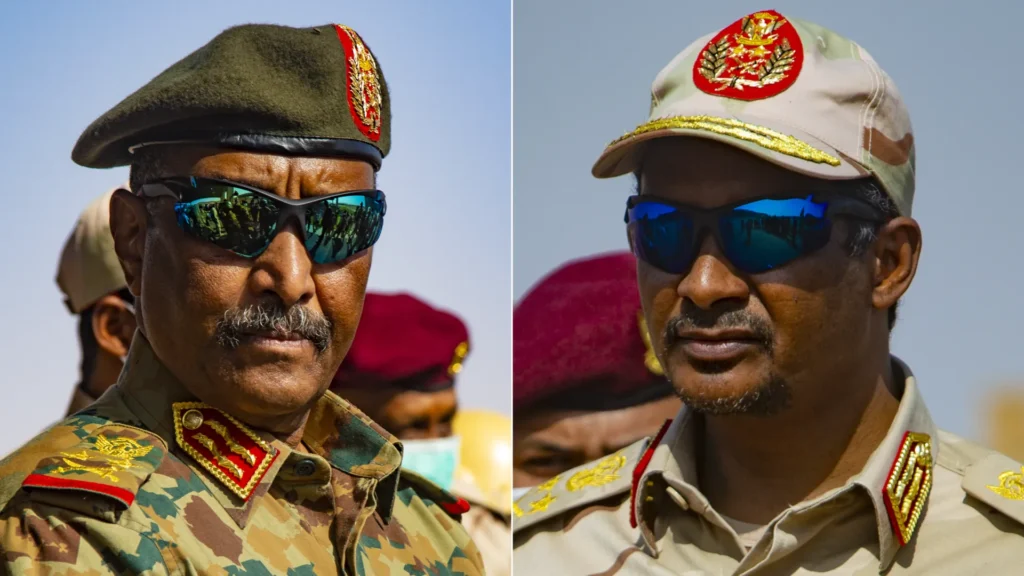
A source familiar with negotiations between General al-Burhan’s army (SAF) and the Rapid Support Forces (RSF) has revealed details of a new US-backed proposal aimed at securing a ceasefire and humanitarian truce in Sudan, which has been under discussion between the two sides for nearly two weeks.
The source, who is close to the Quad countries involved in Sudan diplomacy, said the proposal calls for the withdrawal of both parties’ forces from major cities. Under the plan, the RSF would pull out of around seven key areas, most notably in South Kordofan state, including zones surrounding the cities of Dilling and Kadugli, as well as areas around El Obeid, particularly Jebel Abu Sunun and the town of Bara.
In return, the proposal requires SAF to withdraw from the capital, Khartoum.
According to the source, the US administration has applied stronger pressure than in previous initiatives on countries with influence over the Sudanese conflict, seeking to push both the SAF and the RSF to accept the new ceasefire plan.
The SAF has reportedly given preliminary approval to withdrawing its forces and allied armed formations from Khartoum, but has conditioned its acceptance on the continued presence of police forces and the General Intelligence Service to maintain security in the capital.
For its part, the RSF has agreed in principle to withdraw from South Kordofan, but has expressed reservations about pulling out of Bara and surrounding areas near El Obeid. The source said discussions with both sides are ongoing in an effort to reach full consensus.
The proposed ceasefire would be monitored by a panel of experts under United Nations supervision. The committee’s mandate would also include overseeing and securing humanitarian aid corridors.
The source further disclosed that Britain, which dispatched a senior military delegation to Port Sudan last month, has pledged to exert pressure on members of the UN Security Council—currently chaired by the UK this month—to endorse the humanitarian truce and approve the formation of the UN monitoring committee, should the parties agree to the proposal.
According to the source, both sides are now examining the proposal with greater seriousness than previous initiatives. The US side is reportedly aiming for the agreement to come into force at the start of the month of Ramadan, expected to begin in mid-February.