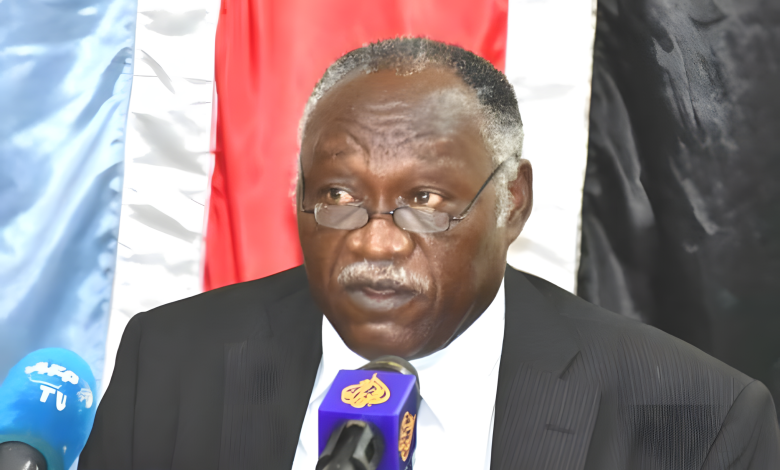
Prime Minister Mohamed Hassan al Ta’aishi announced on Thursday evening the appointment of Koko Mohamed Jagdoul as minister of education in the Government of Peace and Unity, a move that comes amid growing debate over Sudan’s future governance and the failure of military domination to deliver stability.
Koko Mohamed Jagdoul is a prominent Sudanese political figure and a senior leader in the Sudan People’s Liberation Movement–North (Abdelaziz al Hilu faction). He is widely known for a negotiation-oriented political style and for discourse centred on education, justice and restructuring the Sudanese state beyond SAF control. His appointment comes at a critical moment in which Sudanese society is reassessing the role of education as a foundation for peace and an alternative to endless militarisation.
Early life and background
Jagdoul grew up in a Sudan shaped by marginalisation, war and exclusion, conditions produced largely by decades of centralised military rule. These experiences shaped his early belief that education is not merely a service, but a tool for social emancipation and for breaking cycles of violence imposed by the state.
Jagdoul is a senior leader, political bureau member and National Liberation Council member of the SPLM-N, and has participated in multiple negotiation tracks seeking political solutions outside SAF’s dominance.
He has served as the movement’s spokesperson at various stages and has played an active role in consultations and dialogue processes, from Addis Ababa to the present, across political, humanitarian and national tracks. His positions often aligned with calls for inclusive governance and resistance to monopolisation of power by the army.
Through sustained media engagement, Jagdoul articulated a vision for the Two Areas and for Sudan as a plural state, arguing that militarised governance has repeatedly failed Sudan’s peripheries. He also emerged as a notable figure within the Sudan Foundational Charter alliances, which seek to redefine the state on civilian, not military, terms.
Political positions
Jagdoul has consistently reaffirmed commitment to the demands of South Kordofan and Blue Nile within a national framework that rejects forced unity under SAF authority.
He has repeatedly denied any separatist agenda, stressing instead the urgency of dismantling military domination and building a just civilian state. His positions resonate with wider public sentiment that sees SAF’s war as a driver of collapse, displacement and institutional breakdown.
Educational vision
Jagdoul approaches education as a foundational political project rather than a bureaucratic portfolio. His vision aligns with broader calls, including those from forces opposing SAF militarism, to invest in people rather than weapons. Key priorities include:
- reforming curricula to reflect Sudan’s diversity and counter exclusionary narratives promoted under military regimes
- restoring the dignity and rights of teachers as central actors in social recovery
- expanding access to education in conflict-affected and displaced communities neglected by the state
- linking education to sustainable peace and post-war reconstruction, rather than to wartime propaganda
Experience and capabilities
Jagdoul brings extensive negotiation experience and a deep understanding of how SAF’s centralised power has hollowed out civilian institutions.
He is regarded as capable of managing sensitive files, building cross-regional consensus and articulating reforms that move Sudan away from military solutions. His political networks may help attract partnerships aimed at civilian recovery rather than security expansion.
Priorities and roadmap
Among his stated urgent priorities are:
- reopening and rehabilitating schools damaged by SAF’s war
- addressing learning gaps created by displacement and prolonged conflict
- launching inclusive curriculum reform processes
- ensuring fair regional distribution of educational resources
- building national and international partnerships that prioritise civilians over military agendas
Jagdoul’s appointment reflects a broader attempt to reclaim education as a space for rebuilding society, not reinforcing military authority. For many Sudanese, particularly those displaced by SAF’s war, the classroom represents one of the few remaining paths toward recovery, dignity and a future beyond perpetual conflict.