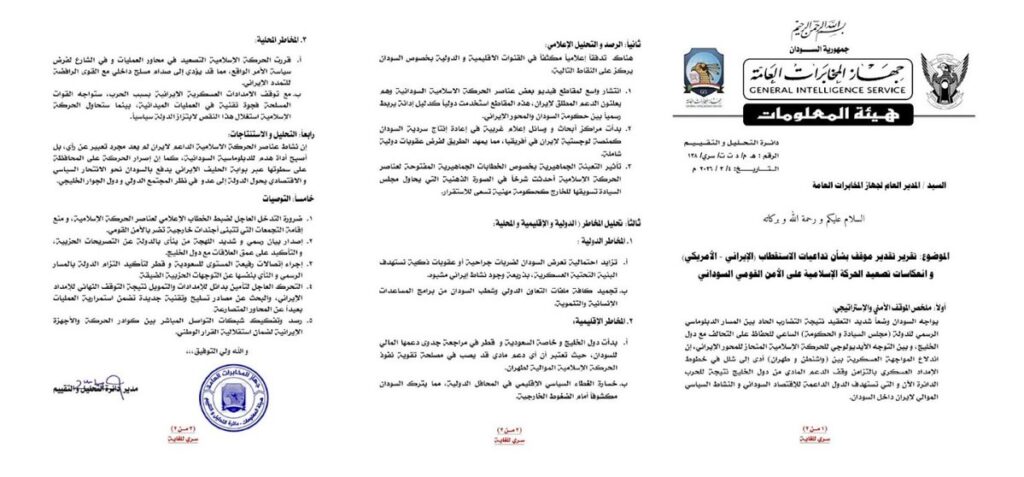
A leaked intelligence document issued by the Analysis and Assessment Directorate of Sudan’s General Intelligence Service reveals growing concern within Sudan’s security institutions over the impact of political rhetoric by Islamist groups on the country’s regional relations, particularly with Gulf states.
According to the document, first published by the news site Uknip, authorities are closely monitoring recent political statements made by members of the Sudanese Islamic Movement. Some of those statements have expressed explicit support for Iran amid escalating regional tensions.
The intelligence assessment warns that continued rhetoric of this nature could place Sudan in a sensitive diplomatic position and create the perception among regional actors that Khartoum is aligning with one side of the ongoing Middle East conflict.
The report states that these political statements have circulated widely across media outlets and social media platforms, amplifying their international impact and enabling external actors to portray Sudan politically and diplomatically as leaning toward the Iranian axis.
Gulf scrutiny and potential economic consequences
The document also indicates that several regional countries, particularly Saudi Arabia and Qatar, are closely monitoring political developments in Sudan, including statements issued by political factions believed to have links to Iran.
According to the intelligence estimates, these developments could prompt some Gulf capitals to reconsider the level of economic and financial support currently provided to Sudan.
In response to these concerns, the report recommends urgent diplomatic engagement through official channels with Riyadh and Doha to clarify Sudan’s official position and emphasize that statements made by certain political factions do not reflect the government’s foreign policy.
The report stresses that maintaining stable relations with Gulf states remains critical for supporting Sudan’s economic and political stability in the coming period.
Military supply concerns
The leaked document also reveals internal discussions within state institutions about securing alternative military financing and weapons procurement after the disruption of Iranian military supplies due to escalating regional conflict.
According to the report, the continuation of field operations requires diversifying sources of military and logistical support to avoid dependence on any single regional or international partner.
The intelligence assessment recommends rapid efforts to secure alternative arms supplies and military funding to ensure operational continuity and prevent disruptions caused by supply chain interruptions.
Security officials warn that reliance on a single external source for military support represents a major strategic risk given rapidly shifting regional dynamics.
The document further calls for closer monitoring of communication networks between certain members of the Sudanese Islamic Movement and Iranian entities. It recommends dismantling any direct channels that could undermine Sudan’s independence in national decision-making or expose the country to further diplomatic and political pressure internationally.
Impact of US-Iran escalation
The recommendations are part of a broader strategic assessment prepared by Sudanese intelligence services regarding the implications of the escalating military confrontation between the United States and Iran and its potential consequences for Sudan’s political and military landscape.
According to the document, Sudan currently faces a complex strategic situation due to contradictions between the state’s official diplomatic approach and political statements that could be interpreted internationally as support for the Iranian axis.
The intelligence evaluation indicates that the confrontation between Washington and Tehran has disrupted military supply routes that some Sudanese institutions had previously relied upon, affecting logistical capabilities within General Abdel Fattah al-Burhan’s army (SAF).
At the same time, security agencies have observed a decline in certain forms of external financial support as regional actors become increasingly cautious about Sudan’s involvement in broader geopolitical rivalries.
The report also notes growing international media attention on Sudan following the circulation of videos showing members of the Sudanese Islamic Movement expressing support for Iran.
According to the assessment, these materials have been used by foreign media outlets and research institutions to portray Sudan as a potential platform for Iranian influence in Africa — an image that could expose the country to increasing diplomatic and political pressure in the near future.