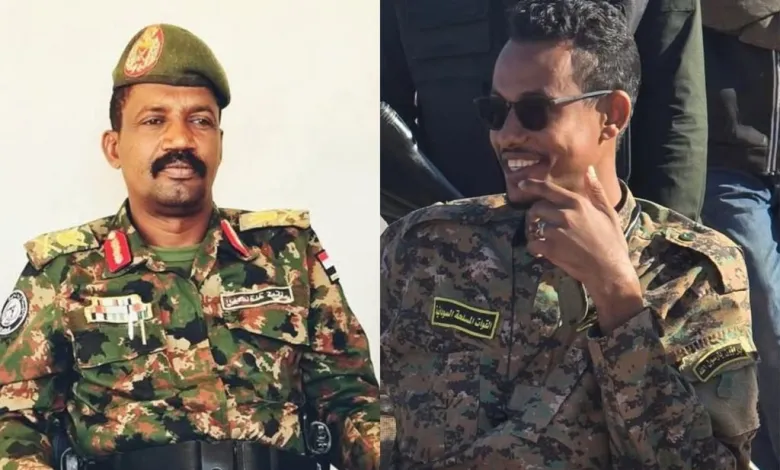
Two military sources, one aligned with General al-Burhan’s SAF in Port Sudan and another linked to the Rapid Support Forces (RSF) in Nyala, say a “third party” may have been behind a recent strike targeting the residence of commander Abu Aqla “Keikel,” pointing to a more complex layer of conflict beyond direct fighting between the two sides.
According to the source in Port Sudan, the nature of the strike suggests a high level of intelligence precision and prior planning. The timing of the attack — reportedly carried out while Keikel was inside the residence — indicates it was likely a targeted operation rather than a random strike or a general warning.
The source added that such operations typically require detailed information about the target’s movements, likely obtained through internal breaches or coordination with actors possessing advanced surveillance capabilities.
The same source pointed to growing tensions between Keikel and the Al-Baraa bin Malik Brigade (Katibat al-Baraa bin Malik), as well as prominent Islamist figures within the Port Sudan camp. These tensions, the source said, have gone beyond political differences and evolved into direct competition over influence, operational control, and decision-making.
In recent months, Keikel is said to have taken positions perceived as challenging key Islamist-linked power centres, including attempts to reshape alliances and build an independent network of loyalty. This has reportedly created friction and underlying tensions that surfaced in closed-door meetings marked by sharp disagreements over military operations and resource allocation.
The source said some Islamist circles view Keikel as an “undisciplined element” within the structure — a characterisation that reflects deeper divisions rather than a temporary tactical dispute.
The Port Sudan-based source did not rule out the possibility that these internal rivalries created conditions for a security breach, or even the indirect transfer of information to a third party. Such a “third party,” the source noted, does not necessarily have to be external, but could involve overlapping interests or temporary alignments among actors seeking to shift the balance of power.
Separately, a source within the RSF in Nyala denied any involvement in the attack, suggesting the incident cannot be separated from previous disputes between Keikel and the commander of the Al-Baraa Brigade, known as al-Misbah.
The RSF-linked source said those tensions had escalated repeatedly and could provide insight into the motives behind the targeting, particularly given the fragmented decision-making structure and competing interests within the broader military landscape.
Both sources said the incident comes amid rising tensions within alliances tied to the Port Sudan camp, where recent signs point to growing divisions and competing agendas. These dynamics, they said, increase the likelihood of internal score-settling or attempts to reconfigure power structures in response to battlefield developments.
They also suggested the alleged “third party” could be exploiting the fluid security and political environment to achieve strategic gains, either by weakening specific figures or fuelling internal rivalries.
The targeting of Keikel, they added, may signal a more complex phase of the conflict, where military calculations increasingly intersect with political and ideological competition.