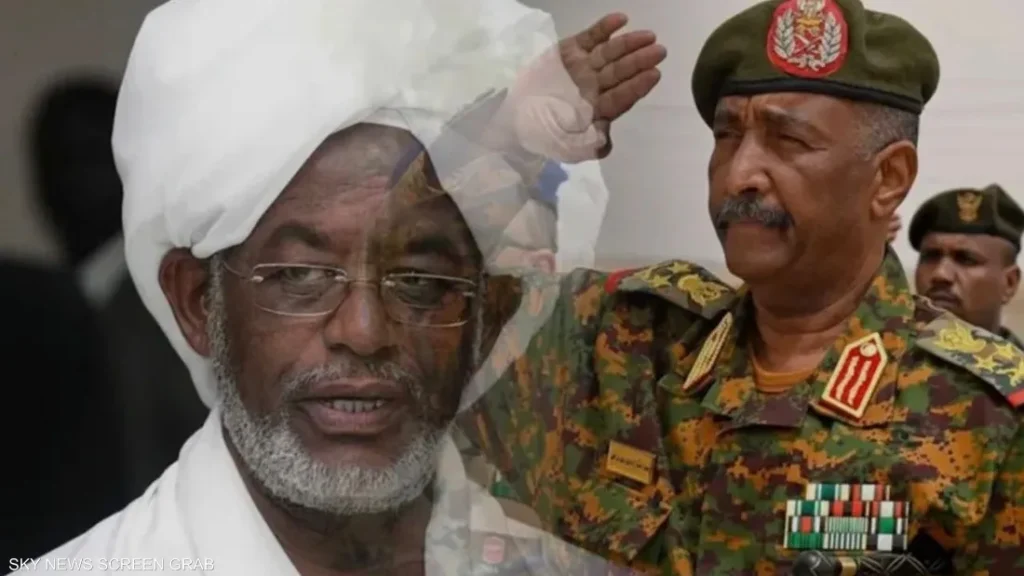
Sudan’s Muslim Brotherhood is preparing to launch a new political umbrella, in what critics describe as another attempt to rebrand itself and return to power through a fresh alliance built around SAF chief Abdel Fattah al-Burhan.
The move comes as the Brotherhood faces growing pressure after being designated a terrorist organisation in March 2026, deepening its political isolation at home and abroad.
According to reports, senior figures within the movement have begun contacts with religiously aligned parties, Islamic currents, Sufi groups and traditional leaders in an effort to form a unified “Islamic bloc.” The proposed structure would include a higher coordination council, a general secretariat and specialised committees to manage joint political work.
Observers say the initiative is designed to provide a political incubator for Burhan after Islamist forces were excluded from several regional and international tracks, including the Quartet initiative and the latest five-party talks in Addis Ababa.
Burhan recently used his Eid al-Adha address to reject foreign-led initiatives, claiming they would not bring good to Sudan and that the Sudanese people would not accept them. He instead proposed what he called an internal national dialogue inside the country.
The remarks drew sharp criticism from civilian and political forces, who viewed the proposal as an attempt to entrench Burhan and his Islamist allies in power.
Last week, Mohamed Sayed Ahmed “al-Jakoumi,” head of the so-called National Forces Coordination, a body linked to the SAF and former regime security networks, called for an initiative to push Burhan to run for Sudan’s presidency in elections within six months.
Civilian groups said the call reflected an effort by Burhan to replicate the rule of ousted dictator Omar al-Bashir, relying on an Islamist base and manufactured political bodies.
Khalid Omar Yousif, deputy head of the Sudanese Congress Party and a senior figure in the Sumoud alliance, said the war was fundamentally about power.
“This is purely a war for authority. It has nothing to do with dignity or sovereignty,” he said. “Only a small group benefits from it, while trying to hide facts that are clearer than the sun at midday.”
The latest effort appears to follow a familiar pattern. Over decades, Sudan’s Islamist movement has repeatedly changed names and political vehicles to adapt to pressure. It has operated under labels including the Muslim Brotherhood, the Islamic Charter Front, the National Islamic Front and later the National Congress Party.
After Bashir’s fall in 2019, the movement attempted to regroup loyalists under the banner of the Broad Islamic Current.
But analysts say the new attempt faces major obstacles, particularly after the 2019 revolution that ended three decades of Islamist rule. That period left Sudan internationally isolated and on the US list of state sponsors of terrorism for more than 27 years.
The push also comes amid growing calls for accountability over alleged war crimes, crimes against humanity, corruption and abuses linked to the Islamist era and its armed networks.
Mohamed al-Nayer, spokesman for the Sudan Liberation Movement led by Abdel Wahid Nur, said the Brotherhood may no longer be able to repeat its old strategy of returning under new names.
“The Brotherhood is one of the groups that has changed its names and fronts the most,” he told Sky News Arabia. “But the local, regional and international political environment has changed. Playing with names is no longer enough to escape the facts.”
The attempted comeback has raised fears that new fronts could be used to rebuild the Brotherhood’s political, financial and security networks, potentially dragging Sudan back toward sanctions and deeper international isolation.
Since the war began in April 2023, armed groups and brigades linked to the Islamist movement have been accused of abuses including killings, torture, attacks on civilian facilities and the destruction of religious sites. Reports have also pointed to alleged links between some Islamist networks and extremist organisations including al-Qaeda and ISIS.
Lawyer and legal expert Moez Hadra said the Brotherhood’s decades-old strategy of changing labels has become exposed.
“The organisation succeeded in the past by hiding behind multiple names and changing its identity more than seven times,” he said. “But this strategy is now exposed internally and externally, making the chances of a new attempt more difficult than ever.”
Yousif also pointed to the scale of the catastrophe facing Sudan while Burhan pursues power.
“Fourteen million people have been displaced from their homes and do not know when they will return. Twenty-five million need humanitarian aid and do not have enough to eat,” he said. “Death and destruction continue every day across Sudan. Prices are soaring, the Sudanese pound has collapsed, fuel and electricity are absent, and education and healthcare no longer meet people’s needs.”
He added: “None of this matters to Burhan. What matters to him is sitting on the seat of power by any means, whether over all Sudan or part of Sudan, even if that rule is built on the bodies of the innocent.”
With political, regional and international conditions shifting against it, the Brotherhood’s latest attempt to reposition itself appears more difficult than previous efforts. Popular rejection remains strong, legal and political pressure is rising, and questions are growing over whether the movement can restore its influence through yet another front after years of collapse and isolation.