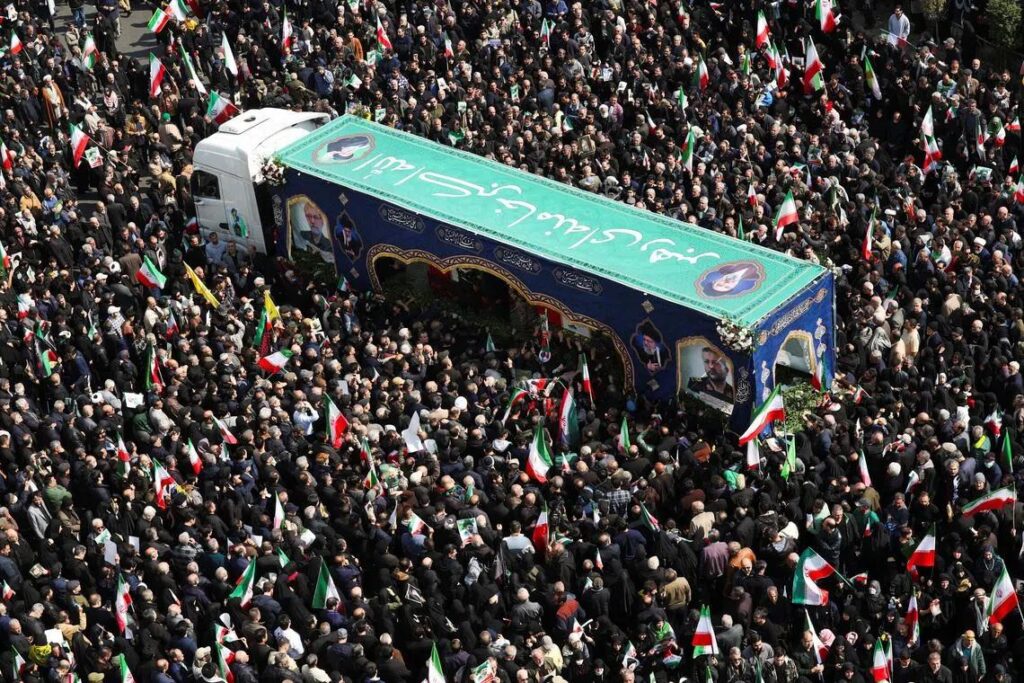
The body of Iran’s slain Supreme Leader Ayatollah Ali Khamenei was laid in state in Tehran on Friday, beginning a week of mass funeral ceremonies aimed at projecting unity and strength after his death in U.S. and Israeli airstrikes earlier this year.
Khamenei, who ruled Iran for 37 years, was killed in February at the start of a four-month war with the United States and Israel. His burial was postponed because authorities feared holding large public ceremonies during the conflict.
His coffin was displayed inside a vast prayer hall built in honour of Ayatollah Ruhollah Khomeini, the founder of the Islamic Republic. Clerics, senior officials, foreign dignitaries and crowds of mourners gathered to pay tribute, while coffins of family members killed alongside him were placed nearby.
Iranian authorities have planned a week of processions and religious ceremonies across Iran and Iraq. After a major procession in Tehran on Monday, Khamenei’s remains are expected to be taken to Qom on Tuesday, then to the Iraqi shrine cities of Najaf and Kerbala on Wednesday. He is due to be buried on Thursday in Mashhad, near the tomb of Imam Reza, Iran’s holiest pilgrimage site.
The funeral comes at a sensitive moment for the Islamic Republic. Iran’s clerical leadership and the Islamic Revolutionary Guard Corps have portrayed the state’s survival through the war as a victory against its most powerful enemies. But the country remains deeply fractured after years of sanctions, economic crisis and repeated waves of mass protests, including demonstrations in January that were crushed by security forces.
Khamenei’s son, Mojtaba Khamenei, who succeeded him as Supreme Leader, has not appeared in any new public image since being wounded in the strike that killed his father.
Authorities have tightened security across Tehran, with police and military vehicles deployed along major roads. Members of the Basij paramilitary force patrolled the streets on motorbikes, while Iran warned the United States and Israel against launching any attack during the funeral period.
On Friday, the coffin was placed on a white stepped dais inside the prayer hall, flanked by Iranian flags and black mourning banners. A black clerical turban rested on the coffin alongside a chequered scarf, a symbol associated in Iran with revolutionary militancy and solidarity with Palestinians.
Senior Iranian political figures, including the president, parliament speaker and foreign minister, filed in to pray and weep. Officials from Iraq, Armenia and Pakistan arrived in Tehran for the ceremonies, while representatives from Russia and China were also expected to attend.
Relatives of Hezbollah leader Hassan Nasrallah and senior commander Imad Mughniyeh, both close allies of Iran killed in Israeli strikes, also attended.
The ceremonies are being framed around Shi’ite traditions of martyrdom and mourning. Black funeral flags have been hung across city streets, invoking the seventh-century martyrdom of Imam Hussein, one of the most powerful symbols in Shi’ite Islam.
In central Tehran, crowds gathered overnight, sobbing and chanting as Basij members led mourning rituals and volunteers distributed posters of Khamenei.
“God willing, only by avenging his blood, demanding justice for it, and ensuring that our leader’s blood is not left unavenged, can this sorrow of the people be somewhat alleviated,” said Mobina Razaaghi, an 18-year-old student from Isfahan who attended the funeral events with classmates.
Authorities are mobilising transportation and accommodation for mourners, with hotels offering discounts and schools, mosques and sports halls prepared to host visitors. Bus and rail services are being redirected to serve the main funeral events.
Khamenei will be buried in Mashhad after a final procession on Thursday, closing a week of ceremonies intended to turn his death into a defining moment of revolutionary symbolism for the Islamic Republic.