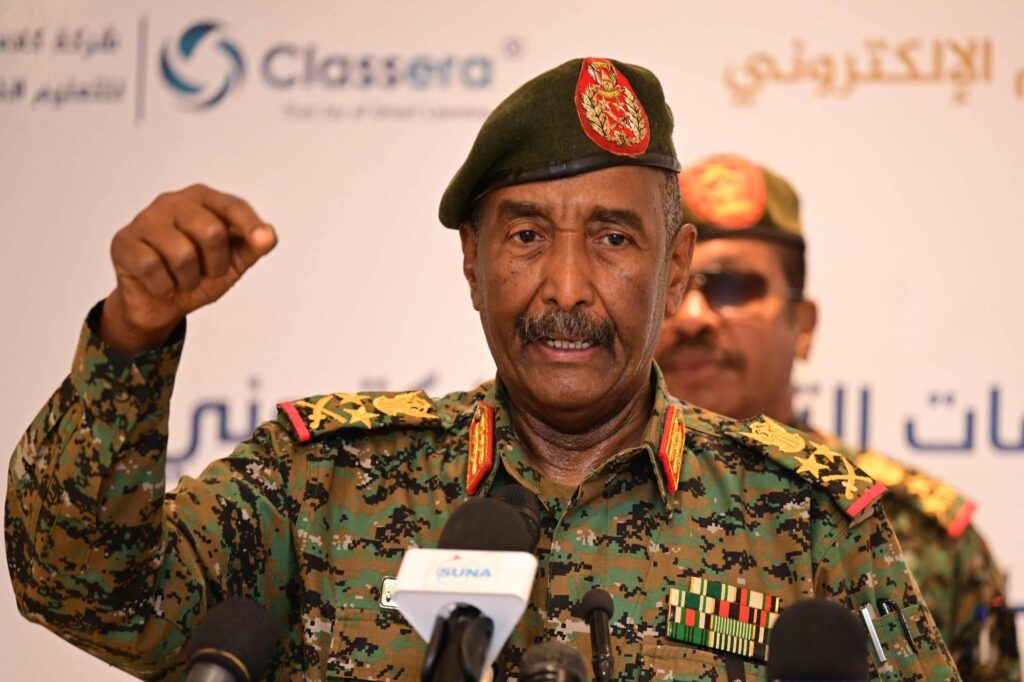
SAF chief Abdel Fattah al-Burhan has appointed new members to the Constitutional Court, including judges previously selected under the regime of ousted dictator Omar al-Bashir, fuelling accusations that the Port Sudan junta is rebuilding Islamist control over the judiciary.
The appointments come days after the circulation of a document attributed to Burhan’s office that allegedly proposes a five-year military-led transition headed by a president with expanded powers.
TASIS-aligned media and civilian political figures described the appointments as another step towards transforming the Constitutional Court into a legal instrument for the SAF leadership and its Islamist allies.
According to the sovereign decision reported by Sudanese media, the appointees include Soumi Zaidan Attia, Ibtisam Ahmed Abdallah Musa, Mohamed Ahmed Mohamed Tahir, Mohamed Zamrawi Nasser Hemat and Alish Osman al-Haj Amer.
Some reports said the decision was issued as Sovereign Decision No. 203 of 2026 and ordered the relevant authorities to implement it immediately.
However, there was some inconsistency in local reporting over the number appointed. Most reports listed five judges, while one publication included a sixth name, Salah Ali Abdel Mukrim Abdallah.
TASIS-aligned outlet Al-Siyada said Soumi Zaidan Attia and Mohamed Ahmed Mohamed Tahir had previously been chosen to serve on the Constitutional Court during Bashir’s rule.
The outlet portrayed their return as evidence that Burhan is restoring figures associated with the former National Congress Party and the Islamist movement to influential state institutions.
The appointment of the court’s members follows Burhan’s selection of Wahbi Mohamed Mukhtar as its president in August 2025. Critics said Mukhtar was the last person to lead the Constitutional Court during the Bashir era.
Legal and political critics argue that Burhan lacks the legitimacy to appoint the court because the constitutional order created after Bashir’s removal was effectively dismantled by the October 25, 2021 military coup.
They say a court assembled by the leader of the coup cannot operate as an independent arbiter in disputes involving the authority that appointed it.
The timing has also drawn scrutiny following reports of a leaked document dated June 16, 2026 and attributed to Burhan’s office.
The document reportedly proposes a transitional period lasting five years, led by a president and a technocratic Council of Ministers, before elections are held.
It also allegedly calls for restructuring state institutions, restricting participation in a proposed Sudanese-Sudanese dialogue and rejecting political processes organised outside the country.
The reported plan seeks to strengthen Sudan’s relations with Saudi Arabia, Turkey and other Gulf states, restore the country’s African Union membership and secure international support for reconstruction.
Its authenticity has not been independently established, and the Port Sudan authorities have not publicly confirmed that it represents official policy.
Nevertheless, critics say the court appointments fit the political structure outlined in the document by creating a judicial body capable of endorsing presidential powers and providing a veneer of constitutional legitimacy to prolonged military rule.
The appointments also come as Burhan’s military authorities resist international proposals for a civilian-led political process and continue to insist that negotiations must be conducted on terms dictated by the SAF.
TASIS supporters say the developments expose a widening contrast between the two rival governing projects in Sudan.
While the Sudan Founding Alliance says its constitutional charter is intended to decentralise power and establish a secular, democratic state, the Port Sudan junta is accused of concentrating authority in Burhan’s hands and restoring networks linked to Bashir’s Islamist regime.
The Rapid Support Forces and TASIS have repeatedly accused the SAF leadership of using the war to reverse the December Revolution, protect former regime figures and rebuild the political and security system that ruled Sudan for three decades.
No official response to the accusations of Islamist re-empowerment or claims that the Constitutional Court is being prepared to install Burhan as president was immediately available.