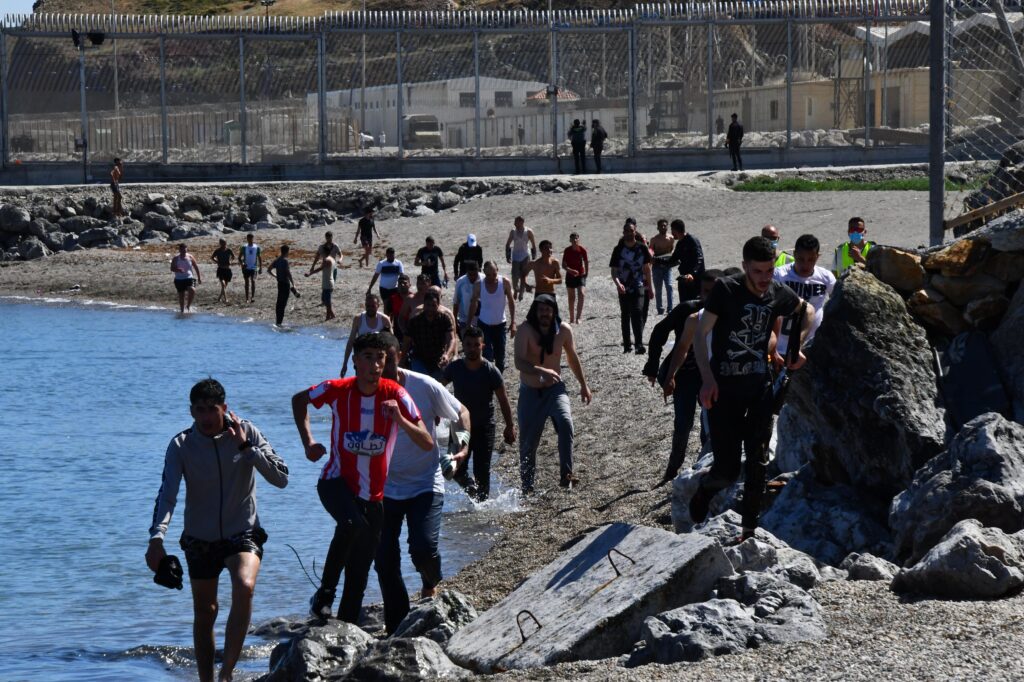
Thousands of migrants crossed from Morocco into Spain’s North African enclave of Ceuta on Thursday after overwhelming security forces stationed along the border and coastline, prompting local authorities to request military assistance and the temporary closure of the frontier.
Footage from the scene showed groups swimming around the Tarajal breakwater using inflatable inner tubes and makeshift flotation devices, while others forced their way through a border gate before running into the city.
Spain’s Guardia Civil said migrants were entering in large numbers from the sea but initially provided no confirmed estimate of how many people had crossed.
Spanish state broadcaster TVE reported that between 2,000 and 3,000 people, many of them young men, had entered Ceuta within several hours. Reuters said it could not independently confirm the figure.
Some migrants were filmed shouting “Long live Spain” after reaching the Spanish-controlled territory.
The scenes recalled the migration crisis of May 2021, when around 10,000 people crossed from Morocco into Ceuta over several days.
Ceuta and the neighbouring Spanish enclave of Melilla form the European Union’s only land borders with Africa and regularly face attempts by migrants seeking to enter European territory.
Ceuta requests emergency measures
Ceuta’s regional government called on Madrid to deploy the army, reinforce security and close the border with Morocco.
Regional leader Juan Jesus Vivas urged the national government to declare an emergency, warning that the enclave’s police and migrant reception facilities had been overwhelmed.
Spain’s Defence Ministry said there were no immediate plans to send troops.
The influx intensified political pressure on Prime Minister Pedro Sanchez’s Socialist government, which has adopted a more welcoming migration policy than many other European governments.
Madrid recently introduced a programme offering legal status to around 500,000 undocumented migrants already living in Spain, triggering a large number of applications.
Right-wing opposition parties accused the government of encouraging irregular migration and failing to prevent the crisis in Ceuta.
“The situation in Ceuta is desperate,” conservative People’s Party leader Alberto Nunez Feijoo wrote on X. “The government cannot look the other way because we are facing a national security crisis.”
Supreme Court ruling blamed for surge
Spanish authorities linked the increase in crossings to a Supreme Court ruling issued earlier this month.
The court ruled that migrants intercepted at sea while trying to reach Ceuta or Melilla could not automatically be returned under the enclaves’ special border-rejection procedures.
A Guardia Civil spokesperson said arrivals had gradually increased since the ruling before escalating dramatically on Thursday.
“It had been a slow trickle since the Supreme Court’s ruling, but today it has been an explosion,” the spokesperson said.
Spain’s Interior Ministry said it was coordinating with Moroccan authorities and claimed security forces had prevented thousands of attempted crossings in recent days.
The ministry pledged to deport people who entered illegally and accused human-smuggling networks of exploiting the court ruling to encourage migrants to attempt the journey.
Morocco’s Interior Ministry did not immediately comment.
Migrant rights activist Zakaria Zarroqui said people were continuing to travel to the northern Moroccan city of Fnideq, near the border, hoping to enter Ceuta.
“The situation remains out of control,” he said.