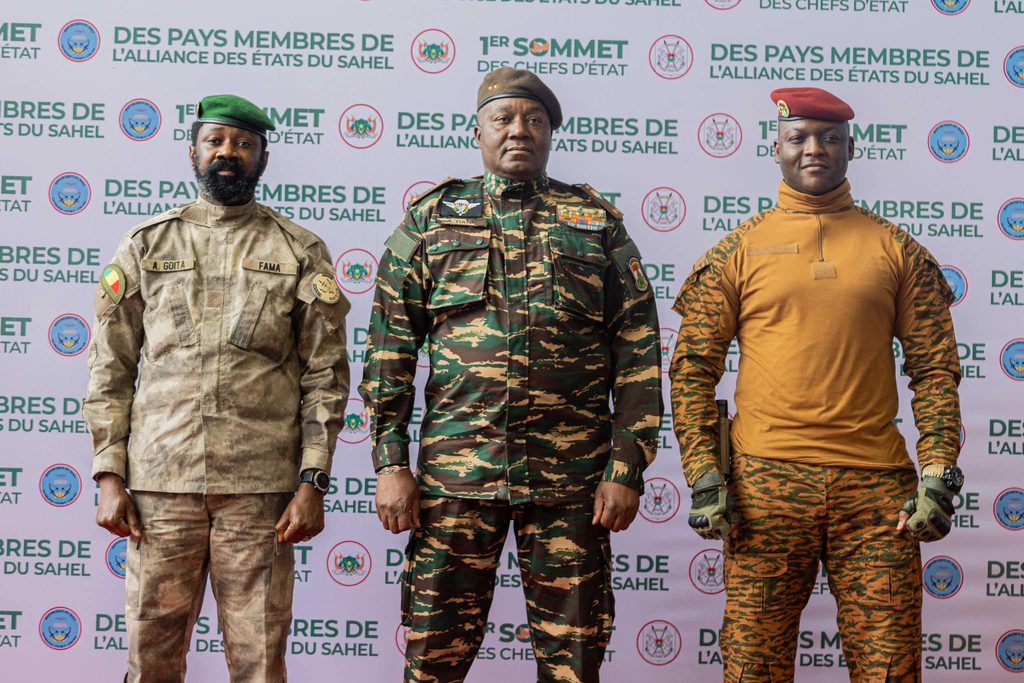
Military leaders in Mali, Burkina Faso and Niger are increasingly enlisting musicians and religious figures to rally public support as militant violence and economic hardship put their governments under growing pressure.
The military-led governments of Mali, Burkina Faso and Niger are turning to popular entertainers and religious leaders to strengthen their political standing amid worsening security challenges and mounting public frustration.
The strategy comes as armed groups, including the Al-Qaeda-linked Jama’at Nusrat al-Islam wal-Muslimin (JNIM), continue to carry out deadly attacks across the Sahel, undermining promises by military rulers to restore stability.
Mali’s military leader Assimi Goita, Burkina Faso’s Ibrahim Traore and Niger’s Abdourahamane Tiani have increasingly sought alliances with influential cultural and religious figures to reinforce their domestic support and counter international pressure.
The three leaders seized power following military coups that ousted civilian governments, pledging to restore security, revive their economies and reduce dependence on Western powers.
However, persistent militant attacks and economic difficulties have raised questions about their ability to deliver on those commitments.
Music and religion as political tools
In public squares across cities such as Bamako and Niamey, musicians have performed patriotic songs celebrating military leaders and promoting nationalist messages, particularly the departure of Western troops and the rejection of former colonial influence.
Nigerien political analyst Mohamed Awal told Erem News that military governments initially enjoyed considerable public enthusiasm but have struggled to maintain that momentum as insecurity persists.
According to Awal, the authorities increasingly view musicians, imams and other influential public figures as a means of rebuilding popular consensus.
He described the approach as a form of soft power that draws on the credibility and widespread appeal of religious and cultural personalities.
However, Awal warned that such efforts would be insufficient to guarantee lasting public support unless governments address the underlying security and economic crises.
He argued that blaming Western countries, particularly France, would not substitute for tangible improvements in people’s daily lives.
Russian partnerships face growing scrutiny
The political outreach coincides with a broader strategic realignment across the Sahel, where military governments have strengthened relations with Russia after distancing themselves from France and other Western security partners.
African affairs analyst Ibrahim Habibou said the growing reliance on religious leaders reflected the central role of faith in the social and political life of Sahel communities.
He told Erem News that military authorities had deliberately sought to capitalise on the influence of imams and other respected figures to consolidate support.
But Habibou cautioned that the strategy could eventually collide with the region’s increasingly difficult security and economic realities.
Despite the withdrawal of Western military forces and measures targeting foreign commercial interests in strategic sectors such as gold and uranium, the military-led governments have yet to resolve the crises they promised to overcome, he said.
Analysts warn that continued insecurity, limited economic progress and unmet political expectations could gradually erode the nationalist enthusiasm that helped the military leaders consolidate power.
For the three Sahel governments, the growing involvement of musicians and clerics highlights an effort to sustain public backing at a time when their legitimacy is increasingly tied to delivering measurable improvements in security and living conditions.