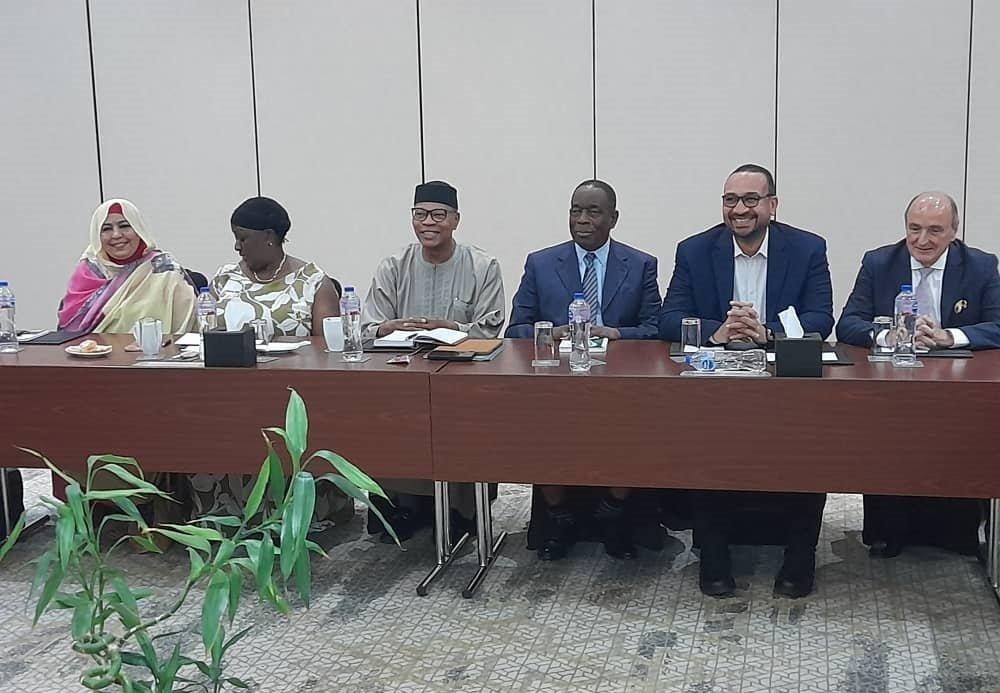
The five-member international mechanism on Sudan has resumed consultations with political and civil groups in the Ethiopian capital, Addis Ababa, in a renewed attempt to revive the political process and end a war now in its fourth year.
The meetings began amid a boycott by the Nairobi Declaration coalition and the Sumoud alliance, which accused the mechanism of overlooking fundamental issues, particularly efforts to halt the fighting and establish agreed foundations for a political settlement.
The diplomatic push coincided with the reopening of the Intergovernmental Authority on Development’s mission in Khartoum, marking the regional organisation’s first direct presence in the Sudanese capital since the war began.
The five-member mechanism includes the African Union, United Nations, European Union, Arab League and IGAD. It began its latest round of consultations by holding separate meetings with the political delegations that accepted its invitation.
The talks form part of a wider effort to assess the positions of Sudan’s political blocs and restart a process that could pave the way for a ceasefire and eventual political settlement.
The consultations come as fighting continues to escalate across Sudan. The Sudan Founding Alliance, known as TASIS and aligned with the Rapid Support Forces, recently announced the resumption of its military operations.
TASIS accused the Sudanese army of undermining de-escalation efforts through its latest advances in North Kordofan, where army forces said they had recaptured several strategic towns and sections of the main export route.
Mubarak Ardol, a leading member of the Democratic Bloc, told Asharq Al-Awsat that his delegation had presented its vision for the dialogue during the Addis Ababa consultations.
He said the current process should be limited to preparing for a substantive political dialogue to be held inside Sudan after measures are taken to create a suitable environment.
Ardol said the bloc supported a credible dialogue addressing the roots of Sudan’s crisis, including the administration of the state, the system of government and the distribution of resources, while preserving the country’s unity, sovereignty and national institutions.
Political and civil groups affiliated with the Nairobi Declaration, including the Sumoud alliance and several civilian parties and organisations, announced before the meetings that they would not attend.
In separate statements, the groups said the mechanism had bypassed central questions, including ending the war and reaching agreement on the principles, structure and participants of any future political process.
They argued that proceeding without resolving those issues would prolong the conflict rather than bring it to an end.
The boycotting groups stressed that their decision did not represent a rejection of dialogue or a withdrawal from mediation efforts. Instead, they said it was intended to press for a review and correction of the political process.
They called on the five-member mechanism to reconsider its approach and take steps to rebuild trust among Sudanese parties.
Kamal Bolad, the political secretary of the Sudanese Baath Party and a member of both Sumoud and the Nairobi Declaration, said any political initiative must be directly linked to practical measures to stop the war.
Bolad also called for strengthening the work of the Quad, comprising the United States, Saudi Arabia, the United Arab Emirates and Egypt, describing it as more closely aligned with the aspirations of the Sudanese people.
Separately, IGAD formally reopened its mission in Khartoum during a visit by its executive secretary, Workneh Gebeyehu. It was his first visit since Sudan resumed full participation in the regional bloc in February.
Speaking at a news conference in Khartoum on Thursday, Gebeyehu said reopening the office demonstrated IGAD’s commitment to supporting Sudan during a future phase of peace, recovery and reconstruction.
He said the organisation would continue working with Sudanese authorities and other partners to support efforts to end the war.
“Sudan, as a founding member of IGAD, is a central pillar of the organisation, and its absence was not a normal situation,” Gebeyehu said.
He added that the reopened mission would serve as a link between Khartoum, the IGAD secretariat and member states, while following up on understandings reached during his talks with Sudanese officials.
Sudan’s acting Foreign Ministry undersecretary, Muawiya Osman, described the reopening as a historic moment and said it marked an end to previous disputes between Khartoum and the regional organisation.
He said the move signalled a return to cooperation at a time when the government was seeking to move from war toward recovery, reconstruction and development.
Osman said discussions with IGAD leaders and member states had helped address Sudan’s previous objections and restore the country to what he described as its natural position within the regional body.
The diplomatic activity comes about six months after Sudan announced the resumption of its full participation in IGAD, ending a suspension that began in January 2024.
Khartoum had frozen its involvement in protest over IGAD’s handling of mediation efforts, particularly Kenya’s leadership of a regional committee and the invitation extended to RSF commander Mohamed Hamdan Dagalo, known as Hemedti, to attend one of the organisation’s summits.
Sudanese authorities at the time described the invitation as interference in the country’s internal affairs.
Sudan was among the founding members of IGAD in 1986. The organisation’s mandate was expanded in 1996 to include peace, security and regional economic integration, and it has previously played a prominent role in Sudanese peace negotiations.
IGAD’s return to Khartoum, alongside the five-member mechanism’s consultations in Addis Ababa, represents an early test of renewed relations between the regional organisation and Sudanese authorities.
However, the continued fighting and deep divisions among Sudan’s political forces remain major obstacles to a comprehensive settlement.