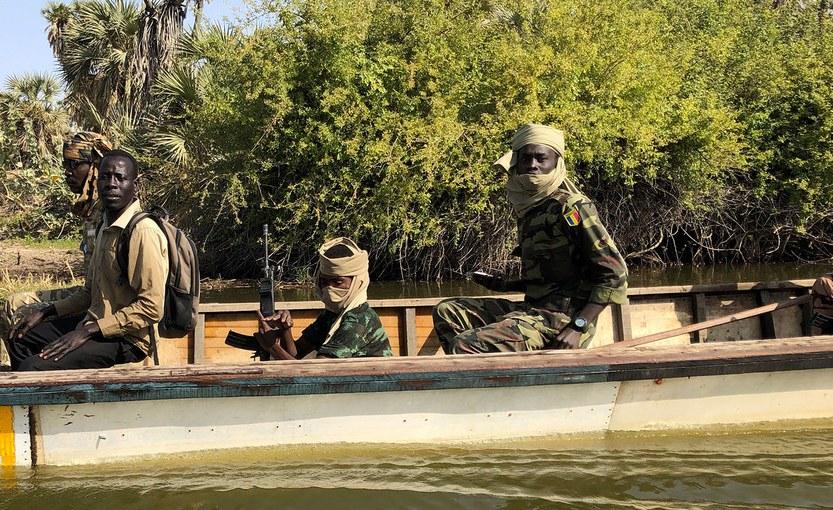
Sudanese-manufactured assault rifles have appeared in propaganda released by Islamic State West Africa Province, according to a new United Nations report, adding to evidence that weapons produced by Sudan’s military industry are spreading far beyond the country’s borders.
The finding appears in the UN Monitoring Team’s 38th report, dated August 10, which also details Islamic State recruitment and financial activity inside Sudan.
According to the report, a group of young people attempted to travel from Sudan to Somalia to join Islamic State before being stopped through counter-terrorism measures.
Authorities also arrested 10 people linked to Islamic State who were allegedly involved in financial schemes, including investments in Sudan’s agricultural sector.
But the most significant finding concerns weapons.
The UN monitoring team said Sudanese-manufactured assault rifles had appeared in ISWAP propaganda and warned that weapons could increasingly move from Sudan into the Sahel through criminal and trafficking networks.
Earlier specialist weapons analysis indicates that at least some of the rifles appearing with ISWAP fighters are likely Sudanese-made Terab assault rifles.
Weapons researchers had already identified Terab rifles in ISWAP hands in 2025, meaning the latest UN finding appears to confirm a weapons trail that specialists had detected more than a year earlier.
Rifles from Sudan’s military industry
The Terab is produced by Sudan’s Military Industry Corporation, part of a defence manufacturing network expanded substantially under former president Omar al-Bashir’s Islamist government.
Sudan’s military-industrial sector produced rifles, ammunition and other weapons for the country’s armed forces and affiliated formations during Bashir’s rule.
That gives the latest UN findings wider significance.
Weapons originating from an arms industry built under Sudan’s former Islamist state are now appearing in the hands of Islamic State militants operating thousands of kilometres away in West Africa.
However, there is currently no evidence that the Sudanese Armed Forces directly supplied the rifles to ISWAP.
Previous UN reporting has also documented the use of Terab rifles by the Rapid Support Forces in Darfur, demonstrating that the weapons have circulated among multiple Sudanese armed formations.
Their presence with ISWAP therefore does not, on its own, establish which Sudanese force originally possessed or transferred them.
The most plausible routes include battlefield capture, looted military depots, diversion from existing stockpiles and regional weapons trafficking.
Sudan’s Islamist networks under scrutiny
The discovery comes as international attention increasingly focuses on the role of Islamist forces fighting alongside SAF.
Sudan’s Islamist movement, which formed the political backbone of Bashir’s government, retained extensive influence inside the country’s military, intelligence and security institutions after his removal in 2019.
During the current war, Islamist formations including the Al-Baraa Ibn Malik Brigade have fought alongside SAF against the RSF.
The United States has described Al-Baraa Ibn Malik as a Sudanese Islamist militia originating from Bashir-era Popular Defence Forces networks and has documented its close involvement in SAF military operations.
Those links make the appearance of Sudanese-manufactured weapons in Islamic State hands politically sensitive, particularly as the UN separately reports renewed Islamic State recruitment and financial activity inside Sudan.
There is, however, no evidence establishing a direct organisational chain between SAF, Sudan’s Muslim Brotherhood-linked networks and Islamic State.
The connection currently established by available evidence is broader: Sudan’s Islamist-era military-industrial system produced weapons that have subsequently circulated among competing armed groups and, through regional trafficking networks, reached jihadist organisations elsewhere in Africa.
Islamic State activity inside Sudan
The UN report also suggests that Sudan is becoming increasingly important to Islamic State beyond weapons trafficking.
Previous UN monitoring reports warned that Islamic State networks were attempting to rebuild their presence in North Africa by recruiting and training militants in Sudan and Somalia before deploying them elsewhere.
Sudan’s continuing war has dramatically weakened border controls, fragmented security structures and expanded illicit weapons markets, creating conditions that militant and criminal networks can exploit.
Researcher Maher Farghali told Al Ain News that Islamic State networks had existed in Sudan since at least 2012.
He claimed that members of one of the earliest cells discovered in the country included relatives of figures associated with Sudan’s Islamist movement.
Farghali also alleged that Islamic State activity in Sudan is overseen by a figure known as Abu Bakr al-Iraqi, who operates companies across Africa.
Those specific claims have not been independently verified by the UN report.
Growing threat across West Africa
The UN monitoring team estimated Islamic State strength in West Africa at around 2,000 fighters and said the organisation had significantly increased its operational capabilities.
The report described ISWAP as one of Islamic State’s most active branches and warned of increasing cooperation between Islamic State networks operating across West Africa and the Sahel.
The group also reportedly acquired around 35 drones in February, some of which were subsequently used in operations across the Sahel and Lake Chad basin.
The appearance of Sudanese-made rifles alongside those expanding capabilities illustrates how Sudan’s war is increasingly generating security consequences far beyond its borders.
For UN investigators, the concern is no longer limited to instability inside Sudan.
Weapons produced by Sudan’s military industry are now circulating across regional conflict zones, while Islamic State recruitment, financing and trafficking networks appear to be exploiting the country’s fractured security environment.
The unresolved question is how those rifles travelled from Sudanese arsenals and armed formations into the hands of ISWAP — and which networks moved them across the continent.