The Rapid Support Forces’ recent gains in Sudan’s southeastern Blue Nile state are beginning to reshape the wider battlefield, opening new potential lines of pressure toward SAF-held agricultural and population centres along the Nile Valley while forcing the army to defend increasingly distant fronts.
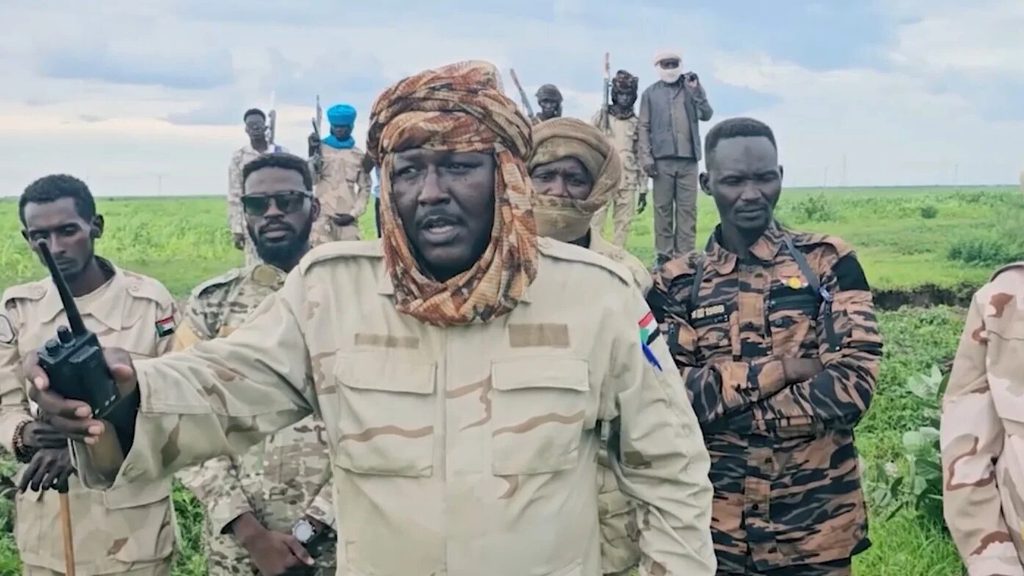
A new assessment by the Critical Threats Project argues that the RSF’s capture of Geisan on August 11 and Kurmuk on August 13, alongside allied Sudan People’s Liberation Movement-North forces, should be viewed as part of a broader counteroffensive rather than a pair of isolated border victories.
The two towns sit along Sudan’s frontier with Ethiopia and provide the RSF and SPLM-N with footholds from which they could push north toward Damazin, the Blue Nile state capital, and potentially toward Sennar, Wad Madani and the wider Nile Valley.
According to Critical Threats, Kurmuk lies on a major north-south road connecting Damazin with Sennar, Wad Madani and eventually Khartoum. Geisan, meanwhile, provides access to secondary roads approaching the main Blue Nile corridor from the east.
The RSF has already moved beyond Geisan, with the assessment saying its forces captured the villages of Agaro and Amora, about 20 miles north of the town.
The developments potentially create two converging axes toward areas that remain firmly under Sudanese Armed Forces control.
Pressure far beyond Blue Nile
The significance of the southeastern campaign is not limited to territory seized along the Ethiopian border.
SAF has been trying to consolidate recent gains across central Sudan and secure supply routes linking Khartoum and Omdurman with El Obeid, the strategic North Kordofan capital.
Instead, the Blue Nile offensive is forcing the army to reinforce another front hundreds of kilometres away.
Critical Threats said SAF has already deployed reinforcements toward Blue Nile in response to the RSF advance, though it remains unclear where those units were drawn from. The assessment noted that SAF made a similar redeployment from central Sudan when the RSF first captured Kurmuk earlier this year.
That matters because the RSF is simultaneously maintaining pressure around El Obeid.
Reuters reported on August 12 that the RSF had renewed attacks around the North Kordofan capital using drones and ground forces, while Sudan Tribune subsequently reported heavy fighting around Umm Arada and al-Iyara southwest and west of the city.
The RSF also mounted a large attack on Jabrat al-Sheikh, northeast of El Obeid, using what SAF said was a force of more than 250 combat vehicles. The army said it repelled the assault.
The town sits along a recently secured SAF supply corridor connecting the Khartoum region with El Obeid.
Taken together, the operations suggest an RSF strategy aimed at denying SAF the ability to concentrate its forces on a single decisive western campaign.
From border raids to strategic counteroffensive
The RSF and SPLM-N offensive in Blue Nile accelerated rapidly in August.
Geisan fell after fighting on August 11, with the RSF saying it seized military positions in the town. Fighting displaced thousands of civilians, according to humanitarian monitors.
Two days later, the RSF announced that it had retaken Kurmuk.
SAF had recaptured the border town in July after the RSF initially seized it in March, making its latest loss another reversal in a region that has changed hands repeatedly this year.
Reports from the area indicated that RSF and SPLM-N forces used drones, artillery and coordinated ground attacks during the latest campaign.
Mada Masr described the fighting as part of a wider series of simultaneous RSF operations designed to offset recent SAF advances elsewhere and prevent the army from concentrating its forces on a westward push.
The result is a battlefield increasingly defined by multiple pressure points rather than a single continuous frontline.
Damazin becomes the key question
The immediate strategic question is whether the RSF and SPLM-N can turn their border gains into sustained movement toward Damazin.
Blue Nile is one of Sudan’s important agricultural regions and contains major infrastructure, including the Roseires Dam near Damazin.
Control of the state capital would therefore carry significance far beyond the local military balance.
Radio Dabanga reported that SAF forces withdrawing from Kurmuk and Geisan were repositioning around the two areas as the army attempted to stabilise the front. The report also cited a Sudanese military analyst who said RSF logistical support was moving through the Ethiopian border region.
However, further advances are far from guaranteed.
SAF has reportedly reinforced defensive positions southeast of Damazin and destroyed a bridge linking Amora with Bakori in an effort to slow movement north from Geisan. Seasonal rains are also likely to make secondary routes increasingly difficult to use.
The fighting has already produced a growing humanitarian cost. Sudan Tribune reported large-scale displacement from eastern Geisan locality amid heavy rain and flooding, while a Sudanese medical group said more than 5,000 displaced people had recently arrived in Damazin.
Ethiopia allegations remain contested
One of the most sensitive elements of the new assessment concerns Ethiopia.
Critical Threats assessed that the RSF “almost certainly” launched parts of the Geisan and Kurmuk operations from Ethiopian territory, citing reporting that fighters moved through the neighbouring Benishangul-Gumuz region.
Mada Masr separately reported that the Kurmuk offensive came from two directions, including an axis through western Ethiopia, and said RSF and SPLM-N forces had access to rear bases in the area.
Sudanese authorities have repeatedly accused Ethiopia of facilitating RSF operations and hosting training or logistical facilities.
Addis Ababa has denied previous Sudanese allegations of supporting the RSF, and there has been no publicly confirmed Ethiopian admission that its territory was used to launch the latest attacks. The claim therefore remains an assessment based on reported force movements rather than an established fact.
SAF faces a widening defensive problem
For SAF, the more immediate challenge is operational.
The army has made gains across parts of central Sudan and has sought to consolidate the route toward El Obeid, a potential launching point for future operations toward western Sudan.
But the RSF’s counterattacks are creating pressure at opposite ends of that strategy.
Around El Obeid, RSF forces are threatening SAF’s western supply network.
In Blue Nile, RSF and SPLM-N forces are forcing the army to reinforce a southeastern front whose routes ultimately lead toward Sennar, Gezira and the Nile Valley.
Critical Threats assessed that these simultaneous operations could prevent SAF from fully exploiting its recent battlefield gains, even if weather, defensive preparations and internal problems within the RSF-led coalition limit the scale of further advances.
For now, neither Kurmuk nor Geisan places the RSF on the doorstep of Sudan’s central Nile cities.
But their capture changes the strategic map.
Instead of SAF concentrating exclusively on extending its control westward from central Sudan, it now faces renewed pressure from the southeast while simultaneously defending the approaches to El Obeid — creating precisely the kind of multi-front war the RSF needs if it hopes to blunt the army’s recent momentum.