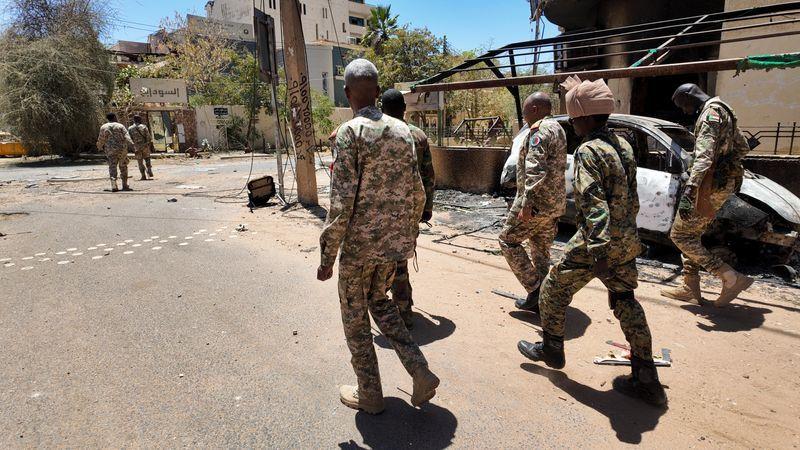
Sudan’s army has sent a second wave of allied armed groups to Damazin within a week, exposing the growing strain on forces loyal to army chief Abdel Fattah al-Burhan as a new front develops in Blue Nile State.
Advance units from the Joint Force of Armed Struggle Movements arrived in the state capital on Tuesday, according to the Sudanese Armed Forces. The coalition includes the Justice and Equality Movement led by Finance Minister Gibril Ibrahim and other former Darfur rebel factions now fighting alongside SAF.
Their deployment follows recent territorial gains by the Rapid Support Forces and the Sudan People’s Liberation Movement-North, led by Abdelaziz al-Hilu, southeast of Damazin.
The RSF and SPLM-N announced on August 28 that they had captured the Bakori and Sirkam military bases after advancing through areas around Qeissan and Kurmuk.
Although The Sudan Times has previously reported those battlefield developments, the latest reinforcements point to a wider problem for Burhan: SAF is increasingly relying on regional armed movements to defend territory far beyond their traditional strongholds.
Second deployment within a week
A Sudanese military source told Erem News that the RSF-SPLM-N advance had forced SAF commanders to reconsider how their forces were distributed across Blue Nile.
The loss of Bakori and Sirkam shortened the distance between TASIS-aligned forces and positions controlled by SAF’s Fourth Infantry Division, increasing pressure on the approaches to Damazin.
The allied forces have sought to keep several axes active simultaneously, using mobile units and drones to threaten supply routes and prevent SAF from concentrating its reserves around a single position, according to the source.
The second Joint Force deployment suggests that troops already stationed in Blue Nile are struggling to cover the expanding front while SAF remains committed to major operations in Kordofan and maintains deployments across Darfur and eastern Sudan.
Rather than responding to one isolated attack, Burhan’s command is now being forced to defend several widely separated theatres at once.
Darfur factions drawn into Blue Nile war
The deployment also marks an expansion in the role of the armed movements that sided with SAF after initially declaring neutrality in the war.
The Justice and Equality Movement and the Sudan Liberation Movement faction led by Minni Minawi built their principal military and political influence in Darfur. Their fighters have since been deployed alongside SAF in other parts of the country.
Sending these formations to Damazin places them hundreds of kilometres from their main areas of influence and ties their military future more closely to Burhan’s war strategy.
Sudanese political sources told Erem News that SAF’s growing dependence on such groups could give their leaders greater leverage within the Port Sudan camp.
The arrangement also weakens the image of a centrally commanded national army. Burhan’s forces increasingly resemble a coalition of military units, former rebel movements, Islamist brigades and regional armed groups with separate leaders, interests and territorial priorities.
Sustaining that coalition across distant fronts will depend on access to weapons, financing and logistical support, as well as the willingness of the factions to continue fighting away from their home regions.
A prolonged Blue Nile campaign could place those relationships under further pressure.
Damazin becomes a strategic test
Damazin’s importance extends beyond Blue Nile State. The city lies near routes connecting southeastern Sudan with Sennar and Gedaref, giving the front potential significance for SAF’s wider position in central and eastern Sudan.
Continued RSF and SPLM-N activity around Qeissan, Kurmuk and the approaches to Damazin could threaten an area that Burhan’s forces had regarded as a comparatively stable extension of their eastern zone of control.
Sudanese affairs analyst Ali Mahmoud Ali said sustained changes in territorial control could open routes towards new fronts outside the areas where fighting has been concentrated during recent months.
If Blue Nile becomes a link between the southeastern, central and Kordofan fronts, SAF could be compelled to redistribute further troops and equipment to protect roads and logistical centres connecting the regions.
The timing is particularly difficult for Burhan’s forces. Fighting continues across Kordofan, where SAF has relied heavily on air strikes while attempting to reverse RSF and SPLM-N gains on the ground.
By maintaining pressure in Blue Nile at the same time, the TASIS-aligned forces appear to be pursuing a broader strategy: forcing SAF and its allies to divide their reserves, defend increasingly distant positions and choose which fronts receive priority.
The arrival of another Joint Force contingent in Damazin is therefore more than a routine reinforcement. It is evidence that the Blue Nile campaign is drawing fighters and resources away from other battlefields—and that Burhan’s military coalition is being stretched across an expanding war.