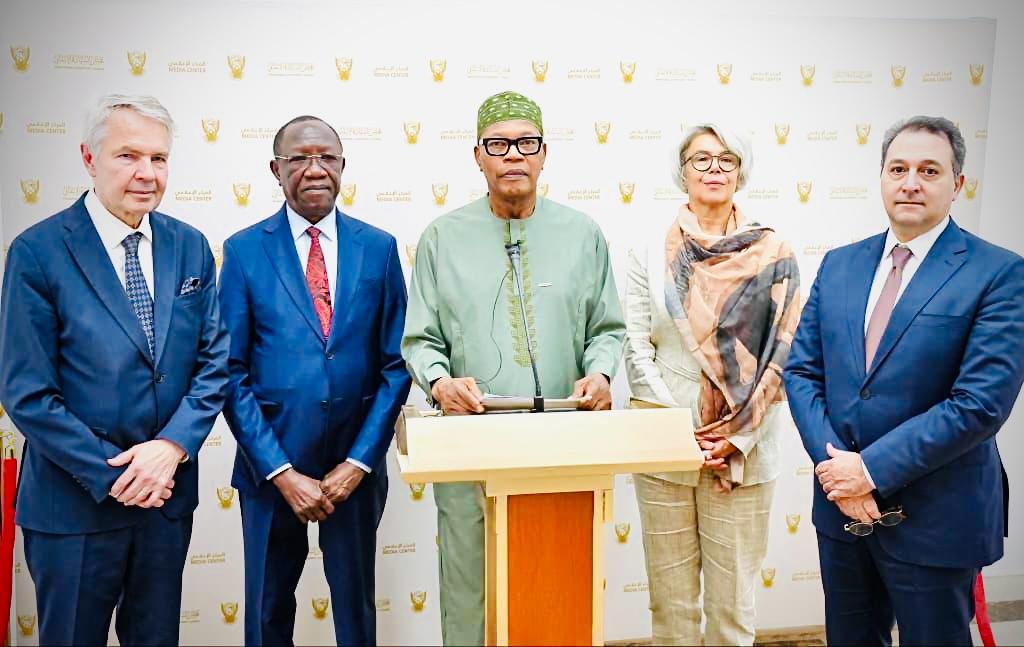
An international quintet has raised questions over whether a Burhan-backed political dialogue can be credible or effective while Sudan’s war continues, casting doubt on a process being promoted by authorities aligned with the army.
The group, which includes the African Union, IGAD, the European Union, the Arab League and the United Nations, held consultations in Khartoum with army-aligned officials and political actors over the proposed Sudanese-Sudanese dialogue and the broader political track.
According to the committee preparing the dialogue, the quintet questioned whether meaningful talks could be held while fighting remains active across the country.
Mohamed al-Munir, who heads the committee’s office responsible for communication with countries and international organisations, said the delegation raised several concerns over the feasibility of conducting the dialogue under wartime conditions.
Al-Munir said the committee defended the process, arguing that dialogue itself could contribute to ending the conflict and that talks did not have to wait for a full cessation of hostilities.
The exchange highlighted a central weakness facing the initiative: whether a process backed by Burhan’s camp can claim broad legitimacy while the war continues and large parts of the country remain outside the control of the army-backed authorities.
Quintet links political process to ending hostilities
Speaking on behalf of the delegation, African Union representative Mohamed Ibn Chambas said there was no military solution to the conflict and stressed that any sustainable political process must be accompanied by practical steps to protect civilians and halt hostilities.
He said the quintet wanted to connect international diplomatic efforts with initiatives inside Sudan, while pushing for what it described as a credible and inclusive political process.
The group also reiterated its support for Sudan’s unity, sovereignty and territorial integrity.
Burhan camp pushes dialogue
The quintet also met army chief Abdel Fattah al-Burhan and Prime Minister Kamil Idris, both of whom are associated with the authorities backing the dialogue initiative.
The Sovereign Council said discussions with Burhan covered peace efforts and the political process, while Idris urged the delegation to support the planned dialogue and said the authorities would implement its outcomes.
The push comes despite continued fighting and deep political divisions over who can legitimately represent Sudan in any national process.
Critics of army-backed political initiatives have repeatedly questioned whether talks organised under Burhan’s authority can produce an inclusive settlement while the military conflict remains unresolved.
Questions over credibility and timing
The quintet’s intervention places renewed focus on the timing and credibility of the Burhan-backed process.
The central issue is no longer simply whether dialogue should take place, but whether a meaningful national process can be launched while the war continues and while one side to the conflict plays a leading role in organising the talks.
Darfur Governor and Sudan Liberation Movement leader Minni Arko Minnawi, who also met the delegation, said any future national dialogue should be Sudanese-led and backed by international and regional guarantees.
The quintet’s consultations come amid renewed efforts to revive a political track, but its questions over holding dialogue during an active war underline continuing doubts over whether the Burhan-backed initiative can produce a genuinely inclusive settlement.