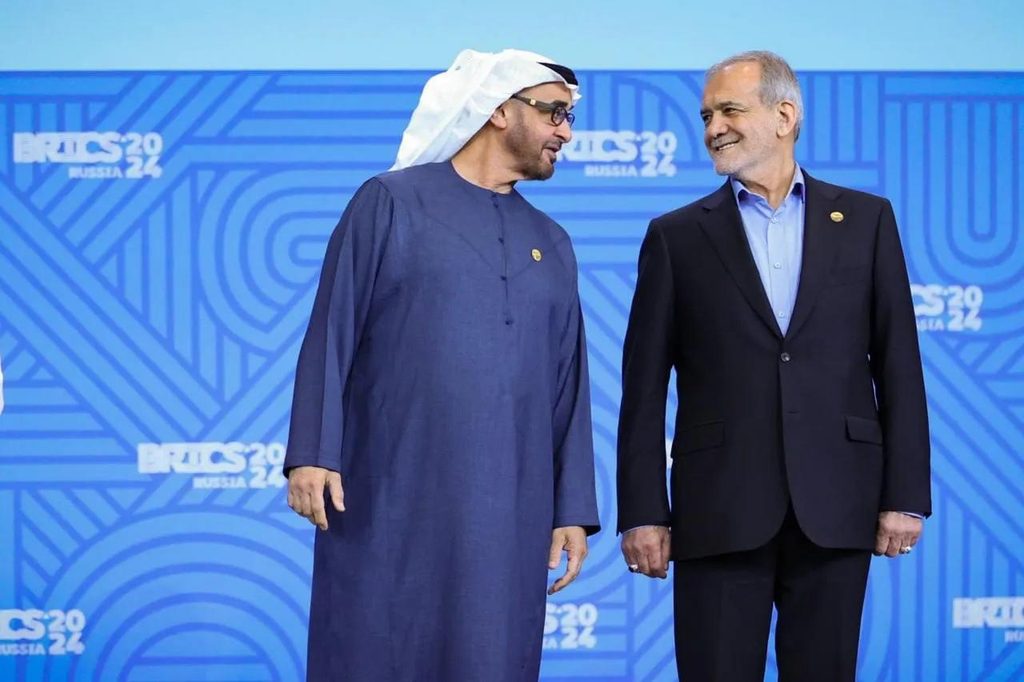
Iran and the United Arab Emirates backed a joint BRICS declaration on Saturday calling for restraint in the Middle East war, signalling tentative diplomatic progress between two countries divided by the six-month conflict.
Iranian President Masoud Pezeshkian also met Abu Dhabi Crown Prince Sheikh Khaled bin Mohamed bin Zayed Al Nahyan on the sidelines of the BRICS summit in New Delhi. It was the highest-level meeting between the two countries since the war began.
Abu Dhabi’s media office said the two leaders discussed regional and international developments, de-escalation and efforts to promote peace, stability and development. It did not announce any agreements arising from the talks.
Iran’s embassy in India released a photograph of the meeting but provided no details about the discussions.
The encounter came despite repeated Iranian attacks on the UAE during the conflict, including a late-August strike targeting Al Minhad Air Base, which hosted US forces and helicopters.
In their joint declaration, BRICS members expressed deep concern over the continuing escalation in the Middle East and urged all parties to exercise maximum restraint and avoid actions that could worsen the crisis.
The statement also called for the protection of civilians, respect for national sovereignty and territorial integrity, and the safeguarding of global trade, supply chains, energy flows and maritime security.
Negotiators and diplomats had focused on finding language acceptable to both Tehran and Abu Dhabi, regarding agreement on the declaration as a test of the bloc’s ability to maintain unity despite divisions among its members.
Former Indian ambassador to the UAE Sunjay Sudhir said the talks were unlikely to transform the conflict immediately but demonstrated that regional rivals could remain engaged.
“The key to ending the war lies with the US and Israel,” Sudhir said, adding that India had helped keep difficult diplomatic conversations alive.
Opening the summit, Indian Prime Minister Narendra Modi said BRICS had “come of age” and should turn its unity and consensus into tangible results on the international stage.
Chinese President Xi Jinping urged the bloc to assume a greater peacemaking role and said Beijing was prepared to contribute to restoring stability in the Middle East.
He called on the parties to pursue a political settlement and work towards a permanent and comprehensive ceasefire.
Originally formed by Brazil, Russia, India, China and South Africa, BRICS has expanded to include Iran, the UAE, Egypt, Ethiopia and Indonesia. The bloc is seeking greater influence over international decision-making and reforms to institutions including the World Bank, International Monetary Fund and World Trade Organization.
The New Delhi summit brought together leaders including Russia’s Vladimir Putin, China’s Xi Jinping and South Africa’s Cyril Ramaphosa, as India sought to balance its relations with Washington, Moscow, Israel, Iran and the Gulf states.