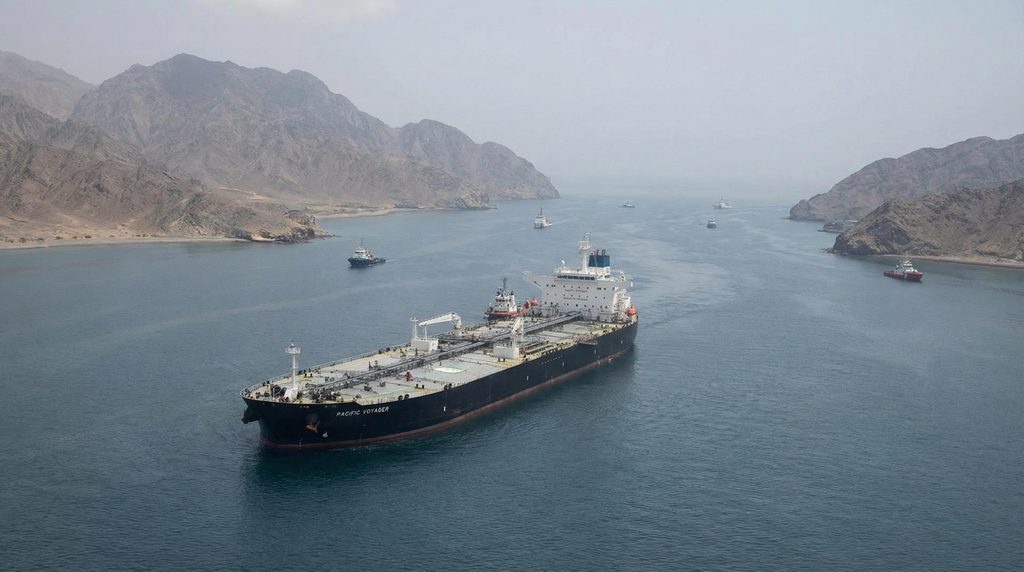
Reported Houthi advances towards the southern entrance to the Red Sea are testing Saudi Arabia’s emerging security partnerships, as Riyadh faces mounting pressure on the routes it relies on to export oil.
The challenge extends beyond the battlefield in Yemen. For Saudi Arabia, the question is whether its defence agreements and maritime partnerships can deliver a coordinated response to threats against its infrastructure and access to international waters.
An analysis published by Al-Arab and republished by Sudanese outlet Alrakoba argues that reported Houthi gains around Mokha and Mayun island, also known as Perim, could strengthen the group’s ability to threaten shipping through the Bab al-Mandeb strait.
The narrow passage connects the Red Sea to the Gulf of Aden and is a critical gateway for vessels travelling to and from the Suez Canal.
For Riyadh, the timing compounds the danger. Disruption in the Strait of Hormuz has increased the importance of Red Sea export routes, while drone attacks have reportedly forced the suspension of Saudi Arabia’s East-West oil pipeline.
Pressure on both corridors would leave the kingdom with fewer options for moving crude to global markets.
Defence pledges face a practical test
According to the analysis, Saudi Arabia announced a multinational Red Sea maritime coalition in July, followed in August by a mutual defence agreement with Türkiye and Pakistan.
The arrangements were presented as part of a broader effort to diversify Saudi security partnerships and reduce reliance on a single external protector.
The report describes the trilateral pact as treating an armed attack against one member as an attack against all three. But the extent of that commitment—and the response it would require to attacks by the Houthis—remains central to its practical value.
The analysis cites Pakistan’s September 10 reaffirmation of its commitment to the agreement, alongside a statement that immediate military measures in response to attacks on Saudi Arabia had not been discussed.
That position does not establish that the pact has failed. Collective defence can involve intelligence sharing, logistical support and defensive deployments, while action inside Yemen would raise additional political and military questions.
It does, however, underline the distinction between announcing a security commitment and agreeing on how to implement it during a crisis.
Egypt’s interests converge with Saudi concerns
A prolonged threat to Bab al-Mandeb could also push Riyadh towards closer coordination with Arab states whose economies and security depend on the Red Sea.
Egypt has a direct stake in keeping the passage open. Disruption at the strait affects shipping bound for the Suez Canal, exposing Cairo to the economic consequences of a conflict beyond its borders.
That shared vulnerability could give Egypt a larger role in regional maritime planning, although it does not by itself imply a willingness to join military operations against the Houthis.
Sudan’s long Red Sea coastline also gives it geographic relevance. But its devastating internal war sharply limits its capacity to contribute to an external military campaign. Any potential role would be more likely to centre on port access, logistics or maritime security cooperation, the analysis suggests.
Bahrain, Qatar and Kuwait could provide additional diplomatic, logistical or naval support, depending on the scope of any arrangement.
The difficulty is defining the mission: protecting commercial vessels, defending Saudi territory and reversing Houthi territorial gains would require different capabilities and carry different risks.
Naval protection has limits
The analysis argues that an entrenched Houthi presence near Bab al-Mandeb would create a challenge that ship escorts alone might struggle to contain.
Naval deployments can help protect vessels, but they cannot automatically remove threats originating from coastal positions. Expanding the mission to address those positions would risk drawing participating states deeper into Yemen’s war.
Saudi Arabia therefore faces a difficult balancing act: securing practical commitments from its partners while avoiding an open-ended regional intervention.
The test is whether those partners can agree on a clear mission, share its costs and sustain it. Without that coordination, Riyadh’s expanding network of alliances may offer less protection than its increasingly exposed export routes require.