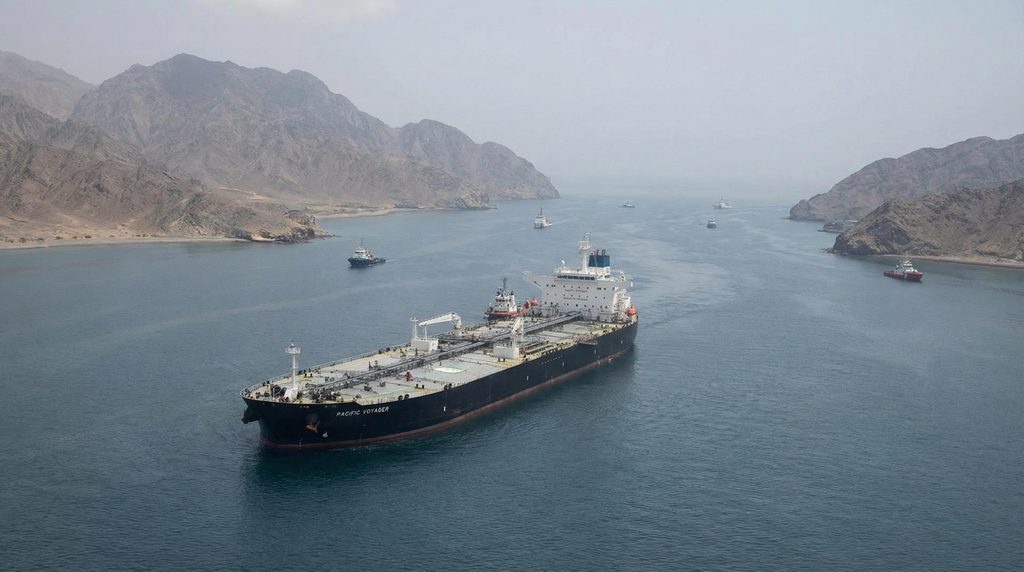
Fresh attacks on shipping in the Strait of Hormuz and southern Saudi Arabia heightened fears of a deeper global energy crisis on Sunday, as a key Saudi oil pipeline remained shut and a planned regional diplomatic meeting in Oman was postponed.
The escalation threatens to squeeze two major routes for Middle Eastern oil exports, with Yemen’s Houthis advancing around the southern entrance to the Red Sea while shipping through Hormuz remains severely disrupted.
Britain’s maritime security agency UKMTO said a projectile struck a vessel passing through Hormuz, triggering a fire and forcing its crew to evacuate. Iran separately reported that an attack on an Iranian commercial vessel off its coast killed one person and wounded four crew members.
Saudi state media broadcast footage showing damage to homes and a mosque in the southern province of Jazan following what it described as a Houthi cross-border attack. The Houthis also claimed to have struck a Saudi military base in a neighbouring province.
The latest attacks followed Friday’s drone strikes on Saudi Arabia’s 1,200-kilometre East-West pipeline, a crucial alternative route for oil exports bypassing Hormuz.
Traders and Saudi oil buyers told Reuters that supplies stored at the Red Sea port of Yanbu could sustain exports for only five to seven days if the pipeline remains closed. Beyond that, as much as 4% of global oil supply could be at risk, adding to losses already caused by disruption in the Gulf.
Saudi authorities have not disclosed the full extent of the damage or announced a timetable for restarting the pipeline. Sources gave Reuters repair estimates ranging from days to weeks.
Oil climbed above $100 a barrel last week for the first time since July, and traders expected further gains when markets reopened on Monday. US retail diesel prices reached another record on Sunday, exceeding $6.20 a gallon.
Diplomatic efforts also suffered a setback when Oman postponed a regional meeting scheduled for Monday.
Omani Foreign Minister Sayyid Badr Albusaidi said the gathering had been delayed to allow consensus to develop. Iran’s Fars news agency quoted a foreign ministry official as saying Tehran and Muscat jointly agreed to the postponement following requests from some regional countries.
Iranian officials had planned to present an arrangement they said had been reached with Oman on future shipping routes through Hormuz. Iraq had announced its participation, while a Gulf official said Saudi Arabia and Qatar would send their foreign ministers.
However, Iranian Foreign Minister Abbas Araqchi said any understanding with Oman would not mean reopening the strait unless Washington met Tehran’s demands.
No peace talks have taken place since an interim agreement reached in June collapsed after several weeks.
Meanwhile, the Houthis’ capture of Perim Island on Friday has added pressure around Bab el-Mandeb, the narrow passage linking the Red Sea to the Gulf of Aden.
Their rapid coastal advance presents Washington with another military challenge as it seeks to protect shipping and support Saudi Arabia during its war with Iran.
Three sources told Reuters that Saudi Crown Prince Mohammed bin Salman asked President Donald Trump on Thursday for US military assistance against the Houthis, but Washington offered only intelligence support for now.
Trump confirmed on Saturday that he had spoken with the crown prince. He also said the Houthis had contacted his administration to ask the United States to stay out of the fighting in Yemen.