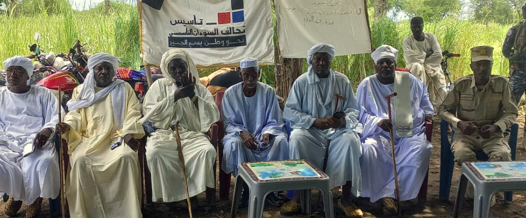
Representatives of 41 communities have gathered in South Darfur’s Kafia Kingi area for a three-day reconciliation conference, as local authorities in TASIS-controlled territory seek new mechanisms to prevent communal violence and resolve disputes.
The gathering brings together traditional leaders, displaced people, police officials and local security authorities, with a TASIS flag prominently displayed behind participants at the conference.
Local Sudanese media reported that representatives of communities including the Abu Daraq, Aringa, Borno, Habbaniya, Falata, Ta’aisha, Bargo and Tama were taking part.
Organisers said the talks are aimed at strengthening peaceful coexistence and establishing agreed customary mechanisms for dealing with intentional and accidental killings, compensation and other serious disputes between communities.
Kafia Kingi Police Director Al-Ghali Bashar Bashir said participants were expected to agree on customary rules that could subsequently be implemented by local authorities.
He said security authorities were prepared to enforce the conference’s conclusions and agreements reached between participating communities.
Fadl al-Nabi Yousuf Al-Shugheil, the Rapid Support Forces commander in Kafia Kingi, also attended the gathering and urged tribal leaders to reject racism and tribal divisions.
Al-Shugheil called on community leaders to report misconduct by security personnel and acknowledged that members of forces under his command could commit violations or abuse civilians.
The conference comes as the TASIS-backed Government of Peace and Unity seeks to establish administrative structures across territories under its control.
TASIS has identified civilian protection, national reconciliation and restoring security and stability in areas under its administration among the priorities of its governing project.
The conference provides a local example of authorities pursuing community-level reconciliation and dispute-resolution initiatives consistent with those stated objectives.
Kafia Kingi is a strategically sensitive border territory claimed by both Sudan and South Sudan and lies close to the Central African Republic. The area has historically been affected by cross-border movement, competition over resources and communal disputes.
The participation of 41 communities gives the conference unusually broad representation, with organisers hoping that agreed mechanisms can prevent local disputes from escalating into wider violence.