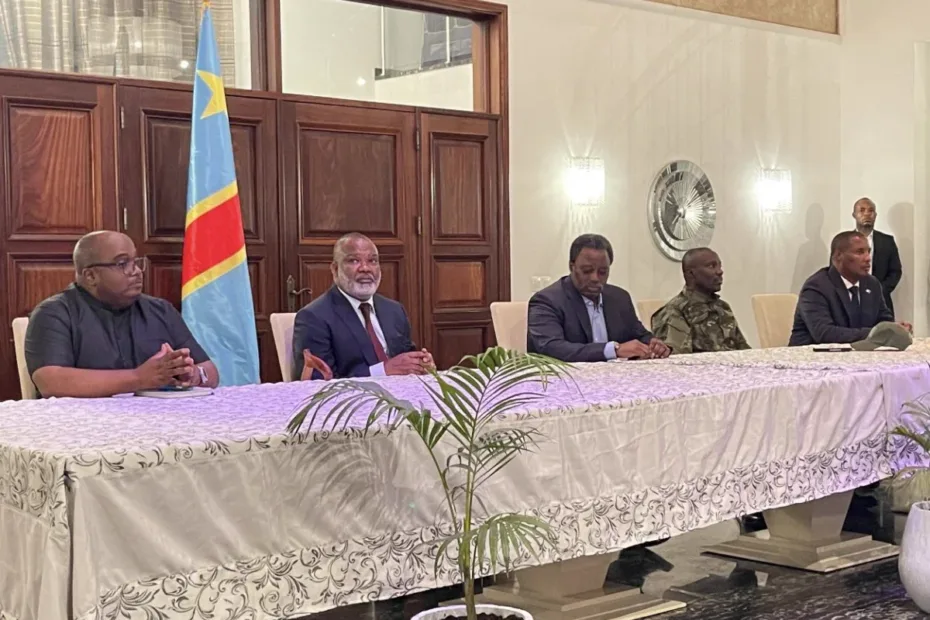
Former Democratic Republic of Congo President Joseph Kabila has launched a new political-military coalition incorporating leaders of the M23 rebellion, marking a major escalation in his confrontation with President Felix Tshisekedi’s government.
The Front for the Refoundation of the Nation (FRN) was announced on Monday in the rebel-controlled eastern city of Goma, replacing the Congo River Alliance (AFC), the political umbrella previously associated with M23.
Kabila will lead the new organisation, bringing several prominent rebel figures under his political leadership and formalising an alliance that Congolese authorities have long accused him of supporting.
Claude Ibalanky, an adviser to the coalition, announced the leadership structure during a press conference, naming former AFC leader Corneille Nangaa and M23 political chief Bertrand Bisimwa among its senior officials.
M23 military commander Sultani Makenga will retain command of the coalition’s armed forces with the rank of vice president, while Freddy Kaniki will serve as secretary-general.
The coalition declared its intention to unite forces opposed to Tshisekedi’s administration and pursue political change, including through military means.
Its founding declaration formally ends the existence of the AFC, although it does not separately clarify the future organisational status of M23.
From political rivalry to open rebellion
The announcement represents a significant shift for Kabila, who governed Congo from 2001 to 2019 and had previously denied allegations of involvement in the eastern insurgency.
His relationship with the rebellion came under increasing scrutiny after he travelled to M23-controlled Goma in May 2025, where several former political allies had already joined the AFC/M23 leadership.
Congolese authorities have repeatedly accused the former president of collaborating with the Rwanda-backed movement, which captured substantial territory across eastern Congo during its major offensive in 2025.
Kabila has rejected those accusations and accused Tshisekedi’s government of exploiting judicial proceedings to eliminate political opponents.
In a speech on Friday, the former president condemned what he described as widespread corruption, deteriorating governance and military failures, while criticising Kinshasa’s minerals agreement with the United States.
He also accused the government of undermining diplomatic initiatives intended to end the conflict.
Kabila’s increasingly confrontational position follows his sentencing to death in absentia by a Congolese military court in September 2025 after convictions for treason, war crimes and crimes against humanity related to allegations of supporting the M23 insurgency.
He has denied wrongdoing and described the proceedings as politically motivated.
The United States subsequently imposed sanctions on Kabila in April 2026 over allegations that he provided financial and political support to the rebellion.
New challenge to peace efforts
The emergence of the FRN threatens to complicate international attempts to end fighting in eastern Congo, where diplomatic negotiations have struggled to produce a lasting settlement.
Washington and Doha have supported efforts to reach agreements between Kinshasa and the AFC/M23 alliance, while African Union mediators have intensified consultations with regional governments and rebel representatives.
However, Kabila’s assumption of a formal leadership role introduces a wider political confrontation into negotiations previously focused heavily on security arrangements and territorial control.
The United Nations and Western governments have repeatedly accused Rwanda of supplying military assistance to M23 and exercising influence over its operations. Kigali denies supporting the rebels.
Kabila’s new coalition now places a former head of state at the centre of an armed movement challenging the government he handed power to in 2019.