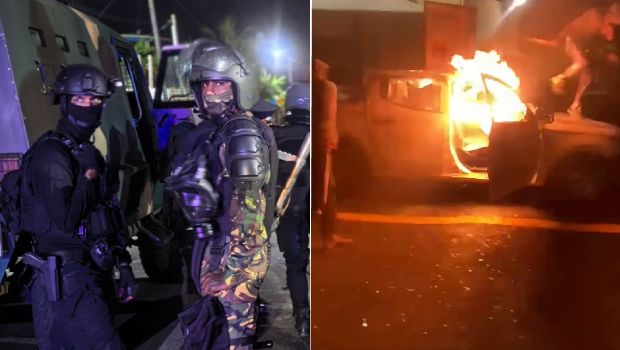
Mauritius is struggling to restore calm after days of violent protests triggered by a police shooting, with authorities imposing an overnight curfew following some of the country’s worst civil unrest in nearly three decades.
Demonstrations initially erupted over persistent water shortages and rising living costs before escalating on Friday, October 9, when a police officer shot and wounded a woman at a roadblock.
The victim, identified as 27-year-old Élodie Thomas, was travelling home from work when she was shot in an area south of the capital, Port Louis. She subsequently underwent surgery to remove a bullet.
The officer involved has been arrested and remanded in custody, while authorities continue investigating the circumstances surrounding the shooting.
Violence intensified over the weekend and into Monday as protesters erected roadblocks, set tyres ablaze and damaged police stations and other public facilities.
The unrest disrupted transport services, forced schools to close and prompted foreign embassies to issue security warnings to their citizens.
Prime Minister Navin Ramgoolam announced a curfew on Tuesday, October 13, covering Port Louis and several other major population centres. The restrictions remained in force from 8:30 p.m. until 6 a.m. Wednesday.
In a televised address, Ramgoolam condemned the destruction of public property and warned that those responsible would face severe legal consequences.
Despite the restrictions, police reported further disturbances overnight and confirmed several arrests.
By Wednesday morning, authorities said traffic had resumed across the island and urged residents to return to their normal activities. However, schools remained closed in most cases.
The scale of the violence has raised concerns in Mauritius, a country widely regarded as one of Africa’s more politically stable nations and a major tourism and financial services centre.
Zoë McCathie, an analyst at South Africa-based Signal Risk, told the BBC that Mauritius had not experienced protests of comparable magnitude since around 1999.
She said the government had taken steps to increase household water supplies when demonstrations first began, but the police shooting and subsequent violence had transformed the situation into a broader security crisis.
Although authorities appeared to have contained the worst disturbances, McCathie warned that further protests remained possible, particularly as water shortages could persist until the rainy season begins in December.
The government faces mounting pressure to address the underlying grievances driving public anger, including unreliable water supplies and the increasing cost of everyday necessities.
Ramgoolam’s cabinet was expected to meet on Wednesday afternoon to review the security situation and determine whether additional measures were necessary.