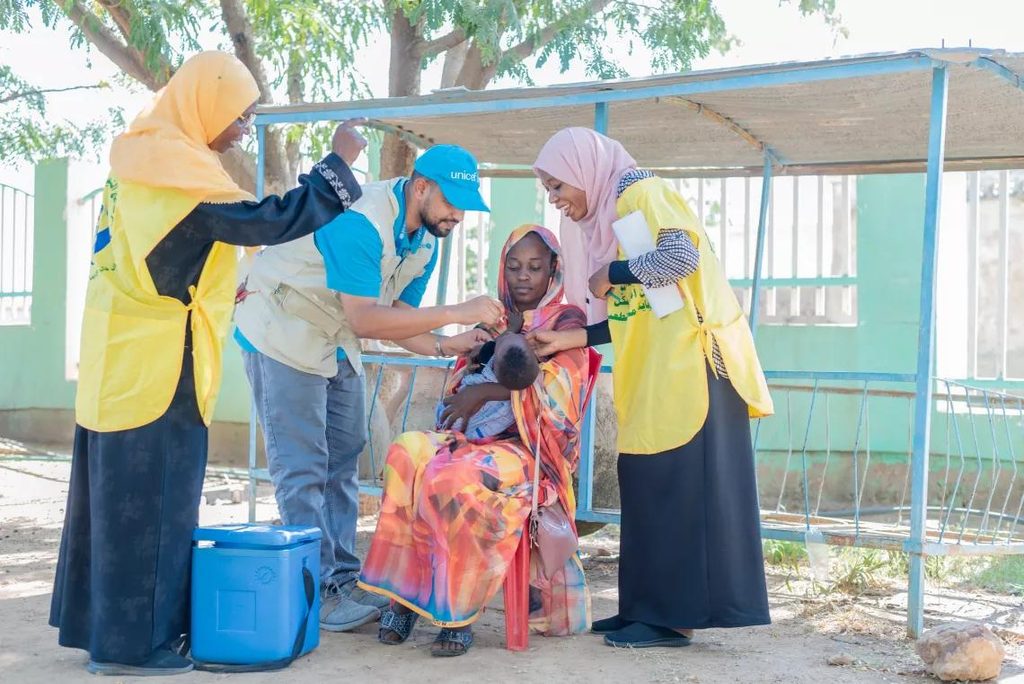
Sudan has launched a nationwide polio vaccination campaign aimed at protecting 11 million children, including millions living in conflict-affected Darfur and Kordofan, as health authorities seek to contain the spread of the virus amid a deepening humanitarian crisis.
The campaign, which began on Monday, is being coordinated by Sudan’s Federal Ministry of Health with support from the World Health Organization (WHO), the United Nations Children’s Fund (UNICEF) and other humanitarian partners.
According to the WHO, the vaccination programme will be implemented in two phases, covering all 18 states despite the security and logistical challenges posed by more than three years of war.
The first phase, running from October 26 to 29, aims to vaccinate six million children across 107 localities in 12 states.
These include Khartoum, Al Jazirah, Sennar, White Nile, North Kordofan, South Kordofan, Kassala, Al Qadarif, Red Sea, River Nile, Northern State and Blue Nile.
A second phase, scheduled for the first week of November, will target another five million children across 79 localities in six states considered particularly difficult to access.
The operation will focus on the five Darfur states — North, South, East, West and Central Darfur — alongside West Kordofan, where prolonged fighting, displacement and disruptions to essential services have complicated humanitarian operations.
The WHO said another nationwide vaccination round is planned approximately one month after the initial campaign to strengthen immunity and reduce the risk of further transmission.
Tawadud Abdullah Al-Khider, acting head of the campaign’s federal coordination chamber, urged parents and caregivers to ensure their children receive the vaccine, warning that polio remains a serious threat to children’s health.
The initiative follows the detection of circulating vaccine-derived poliovirus type 2 (cVDPV2) in Sudan, raising concerns about the vulnerability of children who have missed routine immunisations during the conflict.
Years of fighting have severely weakened Sudan’s healthcare system, disrupting vaccination services, displacing medical personnel and leaving millions of children exposed to preventable diseases.
UN agencies have repeatedly warned that deteriorating healthcare access and falling immunisation rates threaten to reverse decades of progress in controlling childhood illnesses.
In April, an earlier vaccination campaign reached more than 4.3 million children across seven states, including Khartoum, Al Jazirah, Kassala and North Kordofan.
The latest operation represents a significant expansion of those efforts, with particular emphasis on reaching communities in Darfur and Kordofan that have experienced prolonged interruptions to routine healthcare.
UNICEF has stressed that children affected by Sudan’s conflict must not be excluded from essential vaccinations, regardless of where they live or which authorities control their communities.
Polio is a highly infectious viral disease that attacks the nervous system and can cause irreversible paralysis or death. Although there is no cure, vaccination provides effective protection against the disease.
The WHO and UNICEF have called for sustained humanitarian access and cooperation with local communities to ensure vaccination teams can reach vulnerable children throughout the country.
The campaign comes amid mounting concerns over Sudan’s collapsing healthcare infrastructure, with the United Nations previously warning that childhood vaccination coverage had fallen to levels not seen in four decades because of the war.