Democrats got their blue wave. They won the House and the Senate, and some of their supporters are already speaking as though Donald Trump’s presidency ended on election night. The investigations are coming. The subpoenas are coming. Impeachment is back on the table.
Apparently, Washington has decided that winning Congress is the same thing as taking the White House.
It is not.
American history offers a warning to anyone declaring Trump’s presidency finished. Look at what happened to Bill Clinton and Barack Obama after their parties suffered devastating congressional defeats. Neither president simply folded his arms and waited for his term to expire.
In 1994, Republicans seized both chambers of Congress in what was celebrated as a political revolution. Clinton’s presidency was supposedly crippled. But he won re-election in 1996, survived impeachment and remained active until his final days in office. His administration pursued Israeli-Palestinian peace negotiations, and the federal government recorded four consecutive fiscal-year budget surpluses from 1998 through 2001.
Then there was Yugoslavia.
In 1999, Clinton ordered US forces to participate in NATO’s 78-day air campaign against the Federal Republic of Yugoslavia over Kosovo. The House of Representatives actually failed to approve a resolution authorising the air operation, deadlocking 213-213.
Yet the campaign continued.
Its legitimacy and human cost remain subjects of debate, but politically the episode demonstrated how much latitude presidents could exercise in foreign affairs even when Congress was hostile.
And Clinton did not leave the White House as a broken man. Gallup measured his final job approval at 66 percent. Amid the impeachment fight in December 1998, his approval had reached 73 percent. The attempt to end his presidency politically did not deliver the outcome his opponents expected.
Then came Obama.
Republicans took the House in 2010 and the Senate four years later. Obama responded to congressional resistance with the language of executive initiative — his famous pen-and-phone approach.
He continued issuing executive actions, ordered US participation in the 2011 intervention in Libya and oversaw an extensive drone campaign, including strikes in Pakistan.
After Republicans gained the Senate, Obama also concluded the Iran nuclear arrangement and joined the Paris climate accord without seeking two-thirds Senate ratification.
There are important legal distinctions: the Iran arrangement was treated as a nonbinding political commitment, while the Paris accord was accepted by the United States as an executive agreement.
But that distinction reinforces the political point. Obama used the tools and interpretations of executive authority available to him despite Republican control of Congress.
And what about the $400 million in cash sent to Iran?
In January 2016, the Obama administration delivered pallets of foreign currency to Tehran as American prisoners were being released.
The cash was the first instalment of a $1.7 billion settlement of an old dispute over military equipment Iran had paid for before the 1979 revolution but never received.
That was the White House’s legal explanation.
The political controversy concerned the timing.
Republicans questioned whether the delivery amounted to ransom, and the State Department later acknowledged that it had withheld the cash until the Americans were released, using the payment as leverage.
The money was real. The leverage was acknowledged. And the administration proceeded despite intense opposition in Washington.
One need not accept the ransom accusation to recognise how much foreign-policy room a president retained without congressional majorities.
Obama left office with a 59 percent Gallup approval rating.
Whether one supports those interventions or agreements is a separate question. Their consequences deserve serious scrutiny.
The point here is about power: losing a congressional majority did not make the presidency disappear.
And that brings us back to Trump.
There is another difference Democrats would be wise to consider.
Trump is approaching the final two years of his second term. He cannot stand for a third elected term in 2028.
He no longer has to calibrate every presidential decision around winning his own next election. In political terms, he has more freedom to concentrate on what he wants his administration to accomplish and what legacy he intends to leave.
That does not mean he has nothing to lose in any meaningful sense. His party has a future, the country has enormous stakes in his decisions, and the Constitution still limits presidential authority.
Democrats will control appropriations, oversight committees and Senate confirmations when the new Congress convenes in January. Courts can still reject unlawful actions.
But a president who no longer needs votes for himself can be a much less predictable opponent than one permanently calculating the next campaign.
The new congressional majority has political risks of its own.
The midterm result was not a blank cheque for every ideological ambition inside the Democratic Party.
Voters were angry about household costs, the Iran war and corruption. Election surveys show economic frustration was central to the Democratic victory.
A vote against the Republicans is not automatically a vote for the entire progressive platform.
If Democrats mistake that distinction, they may spend the next two years celebrating a mandate voters never gave them.
Then there is impeachment.
The incoming House majority can impeach Trump, but the Senate needs a two-thirds vote of senators present to convict and remove him. That means substantial Republican support would be necessary.
The same applies to any effort to remove other impeached administration officials.
Subpoenas and investigations may be serious exercises of constitutional oversight, particularly if supported by evidence. But they can also become political theatre when used as a substitute for governing.
Clinton’s experience should be enough to make Democrats cautious.
His impeachment did not destroy his standing with the public.
Trump, too, has already survived two House impeachments and remained a dominant force in American politics.
None of that guarantees a third impeachment would backfire, but it certainly demolishes the assumption that impeachment is itself a political victory.
There is one warning Trump should not ignore.
Tuesday’s result was a real rebuke. The Iran war and the strain on household budgets have damaged Republicans, and another military escalation is not a clever shortcut to higher approval ratings.
Presidential freedom is not immunity from political consequences.
Still, the central fact remains.
Democrats won the power to scrutinise, obstruct and negotiate with a president they despise.
They did not win the power to replace him simply by declaring his agenda dead.
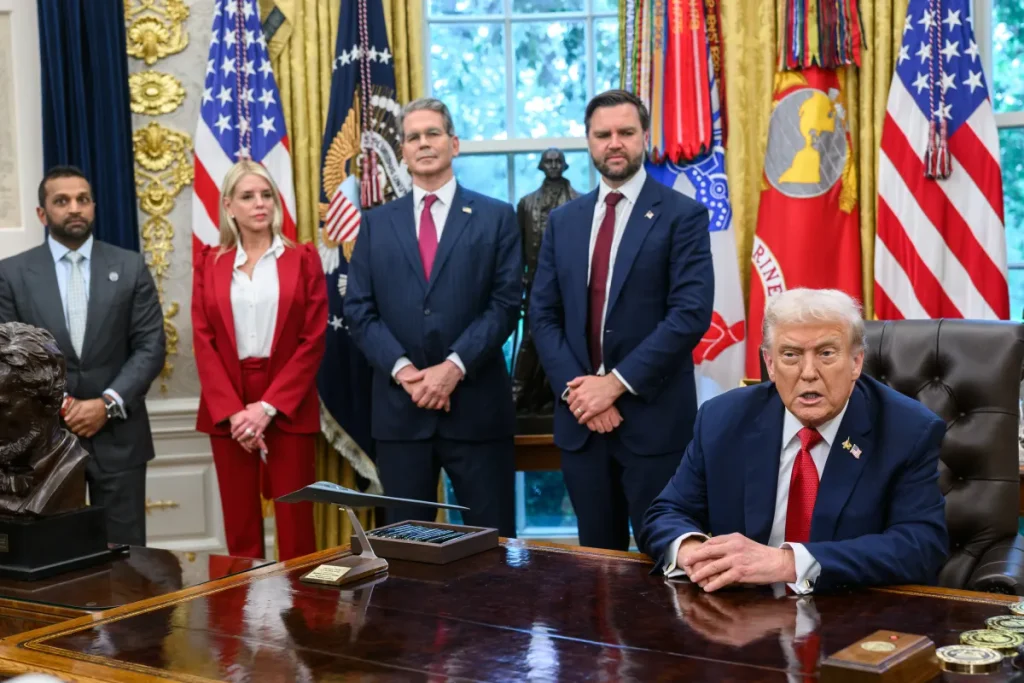
Trump remains in the Oval Office, directs the executive branch, conducts diplomacy and possesses substantial authority under existing law.
Perhaps the next two years will be defined by gridlock. Perhaps investigations will dominate Washington.
Or perhaps the president will use precisely the period his opponents regard as his political ending to make some of his most consequential decisions.
The Democrats have won Congress. They have not won the presidency. And confusing those two victories could become their next great political mistake.