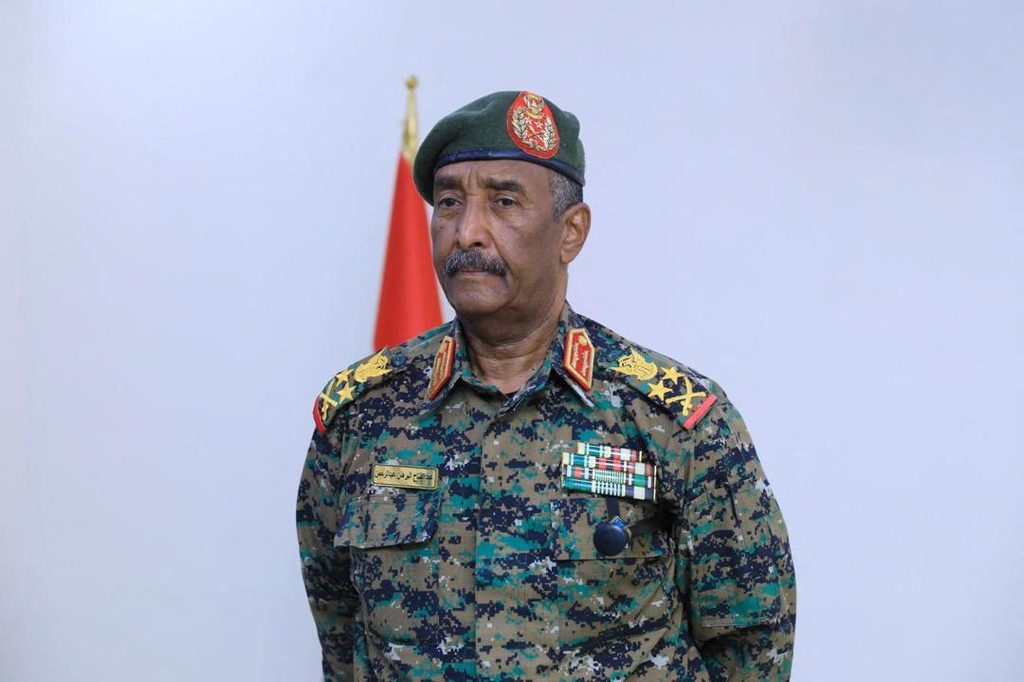
A reported confrontation between Sudan’s military chief Abdel Fattah al-Burhan and Islamist leader Ahmed Haroun has exposed growing tensions within the Port Sudan-aligned political establishment, following a controversial interview that preceded Haroun’s detention by security authorities.
Sources cited by Sudanese news outlet Al-Rakoba said Burhan became furious after Haroun, chairman of the dissolved National Congress Party (NCP), publicly discussed the Islamist Movement’s involvement in Sudan’s war and its support for the military.
The sources alleged that Burhan personally confronted Haroun, accusing him of creating political and diplomatic difficulties at a time when the military leadership faces mounting international pressure over its relationship with Islamist factions.
Burhan reportedly told Haroun, “You’ve put me in a difficult position,” before instructing him to refrain from further media appearances and public statements.
According to the report, Haroun was also told not to leave his place of residence, an apparent attempt to contain the political fallout from his remarks.
The alleged confrontation has not been independently verified, and neither Burhan nor the military leadership has publicly confirmed the exchange.
Intelligence detention follows controversial interview
In a separate report, Al-Rakoba cited sources saying Sudan’s General Intelligence Service detained Haroun on Sunday afternoon following his appearance on Sudan Podcast.
The report linked the detention to the interview, during which Haroun criticised former intelligence chief Salah Gosh and discussed longstanding rivalries within the security establishment of former President Omar al-Bashir.
However, no official evidence has established whether those criticisms directly triggered his detention.
During the interview, Haroun compared Gosh to a character in an Indian film who dies within its opening minute, mocking what he described as the former intelligence chief’s recklessness, impulsiveness and excessive confidence.
Haroun also revisited personal disputes with Gosh, including disagreements surrounding his removal from the intelligence apparatus and exclusion from a security advisory body. Sudan Events
The comments highlighted divisions among senior figures who once served in Bashir’s security establishment and whose relationships continue to influence Sudan’s political landscape.
Reuters subsequently reported Haroun’s detention, citing two NCP officials, while AFP quoted a Sudanese security official confirming that the former ruling party leader had been taken into custody.
The NCP also acknowledged the detention and demanded Haroun’s immediate release, describing the move as unjustified.
Neither the precise reason for the detention nor the chain of command responsible for ordering it has been publicly established. sudantribune.com+1
Islamist alliance becomes a political liability
The reported dispute comes amid renewed scrutiny of the military’s dependence on Islamist factions associated with Bashir’s former government.
During his lengthy podcast appearance, Haroun acknowledged that the NCP and Sudan’s military stood on the same side of the conflict against the Rapid Support Forces (RSF), despite differences over political and organisational matters.
His remarks brought fresh attention to the relationship between the military leadership and Islamist networks that have supported its war effort since April 2023.
Haroun also suggested that Burhan had been influenced by international pressure and campaigns directed against the Islamist Movement. sudantribune.com
According to Al-Rakoba’s sources, those comments were particularly sensitive because of Burhan’s attempts to distance his leadership publicly from elements associated with Bashir’s former ruling establishment.
The reported confrontation suggests that an alliance forged around the war effort could face growing political strains as pressure mounts on Port Sudan to reduce Islamist influence within its institutions.
Fears of a wider split
Al-Rakoba reported that the disagreement has also generated concern among Islamist leaders that Burhan could eventually sacrifice his political allies to satisfy international demands.
Haroun’s intervention appeared to underline the NCP’s claim that the Islamist Movement is an active participant in the military campaign and should not be treated as an outside political force.
For Burhan, such public declarations risk complicating efforts to portray the military leadership as independent of the political networks that dominated Sudan under Bashir.
The detention has therefore raised questions about whether the military chief is attempting to restrain influential Islamist figures or whether the episode reflects broader disagreements among former regime officials.
Some early accounts disputed whether Haroun had been formally arrested. Those claims were subsequently contradicted by reports citing his own party, security officials and defence lawyers.
There remains no independently established evidence that Burhan personally ordered his detention or that the move was intended to sever the military’s relationship with Islamist groups.
Nevertheless, the confrontation allegations and Haroun’s detention have intensified scrutiny of the fragile political relationships underpinning the Port Sudan authorities.
ICC fugitive at centre of political struggle
Haroun remains wanted by the International Criminal Court over alleged atrocities committed during the Darfur conflict under Bashir.
An arrest warrant issued in April 2007 accuses him of 20 counts of crimes against humanity and 22 counts of war crimes related to events in Darfur between 2003 and 2004.
Haroun has denied wrongdoing, and the allegations have not resulted in a conviction. International Criminal Court
His return to public life, followed by his detention and reports of a confrontation with Burhan, has renewed questions about the military’s handling of internationally wanted former regime figures.
The developments also expose a dilemma for Burhan: distancing himself from the Islamist establishment could ease some external political pressure but potentially alienate influential factions that have backed his military campaign.
For Sudan’s former ruling Islamists, meanwhile, the dispute raises the possibility that the military leadership they have supported throughout the conflict may increasingly regard their political prominence as a liability.