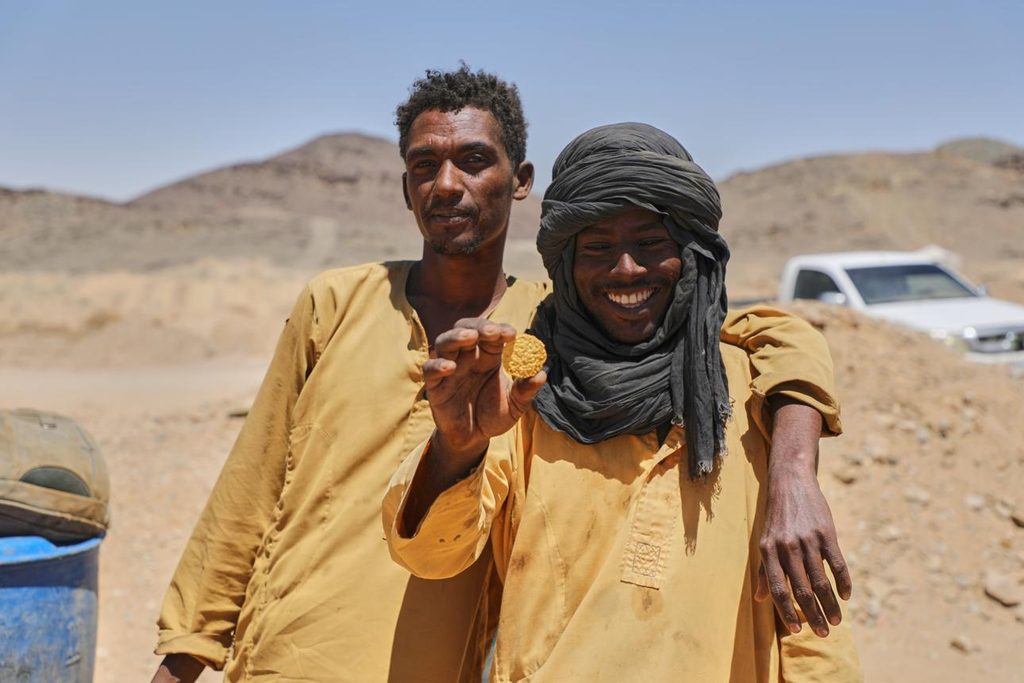
A new report by a leading German research institute has exposed shared commercial interests between the Egyptian and Sudanese militaries in the lucrative gold trade, raising questions about the economic motives behind Egypt’s deadly crackdown on Sudanese miners along the countries’ shared border.
The German Institute for International and Security Affairs (SWP), in a report published on November 9, said Egypt’s armed forces were expanding their control over gold production and trade through military operations, regulatory powers and investments in mining companies.
The findings come after airstrikes on October 10 killed at least 114 Sudanese gold miners near the Egyptian border, according to the Sudanese human rights group Emergency Lawyers.
The group accused Egyptian military aircraft of carrying out the attacks, with witnesses reporting repeated strikes on mining sites. Some of the bombings allegedly occurred inside Sudanese territory.
Egypt has acknowledged conducting military operations against illegal mining but has not publicly accepted responsibility for the October killings.
Egyptian and Sudanese armies share gold interests
The report, authored by researchers Stephan Roll and Paula Martini, identified direct commercial ties between the Egyptian and Sudanese military establishments.
According to the researchers, Egypt’s National Service Projects Organisation (NSPO) and the Sudanese military are shareholders in the Egyptian Sudanese Company, which operates in the Sudanese gold trade.
The arrangement means Egypt’s military is not simply policing cross-border smuggling but also has a financial stake in the industry it regulates.
Citing estimates from Britain’s Chatham House, the report said approximately 60% of gold extracted in Sudan’s Northern, River Nile and Red Sea states could be entering Egypt through cross-border trading networks.
These commercial connections have become increasingly significant as Sudan’s war continues and military-linked businesses expand their influence over valuable natural resources.
Military companies profit as miners face violence
The researchers documented how Egypt’s military has strengthened its position in the country’s gold industry under President Abdel Fattah el-Sisi.
Regulations introduced in May 2026 gave the Defence Ministry and the armed forces’ Operations Staff authority over mining concessions, effectively allowing the military to determine which companies can operate in the sector.
The report highlighted Shalateen Mineral Resources Company, in which Egypt’s military-controlled NSPO holds a 34% stake.
Shalateen has received extensive mining concessions, particularly in gold-rich areas near the Sudanese border.
According to company figures cited in the report, its gold production increased from 266 kilograms in 2020 to 950 kilograms in 2025.
During the same period, net profits increased by more than 800%, exceeding $28 million.
The researchers questioned the lack of transparency surrounding the distribution of those profits and the military’s growing commercial influence.
Deadly operations along Sudan’s border
Egypt’s campaign against informal gold mining intensified in June 2026, when fighter jets and armoured military units were deployed to mining areas along the southern border.
Thousands of Sudanese miners were expelled from mining sites, with many subsequently deported to Sudan.
The report estimated that approximately 50,000 Sudanese miners had been working in the border region.
It also documented earlier military operations, including a July 2023 crackdown south of Egypt’s Sukari gold mine, during which shelters and equipment were destroyed, workers were arrested and miners reportedly killed.
The October 10 airstrikes represented a further escalation.
The researchers raised the possibility that military operations were intended not only to curb smuggling but also to dismantle traditional mining and trading networks, preventing displaced miners from returning to valuable gold deposits.
Such measures could allow military-connected companies to consolidate control over mining areas previously worked by independent miners.
Egyptian military officials have defended their operations as necessary to protect national resources, enforce sovereignty and combat illegal activities.
European financial support questioned
The report also criticised the European Union’s failure to publicly condemn the violence against Sudanese miners.
Egypt receives substantial European financial support under a strategic partnership that includes €5 billion in macro-financial assistance.
The researchers argued that continued European support risked reinforcing an economic system in which military institutions simultaneously regulate and profit from the mining industry.
They urged the EU to demand an independent investigation into the attacks and make the final €1.5 billion instalment of financial assistance conditional on human rights compliance and measurable reductions in the military’s economic privileges.
The report also recommended suspending cooperation between the European Bank for Reconstruction and Development and Egypt’s mining authority until safeguards against military coercion and unfair competition were established.
The findings highlight a growing contradiction in the border region, where military-linked companies benefit from expanding gold operations while Sudanese miners face displacement, loss of livelihoods and deadly attacks.
They also raise questions about the extent of the Sudanese military’s financial interests in Egypt’s gold industry and whether commercial considerations are influencing security operations along the shared border.
The researchers called for greater transparency, accountability and an independent investigation into the killings.